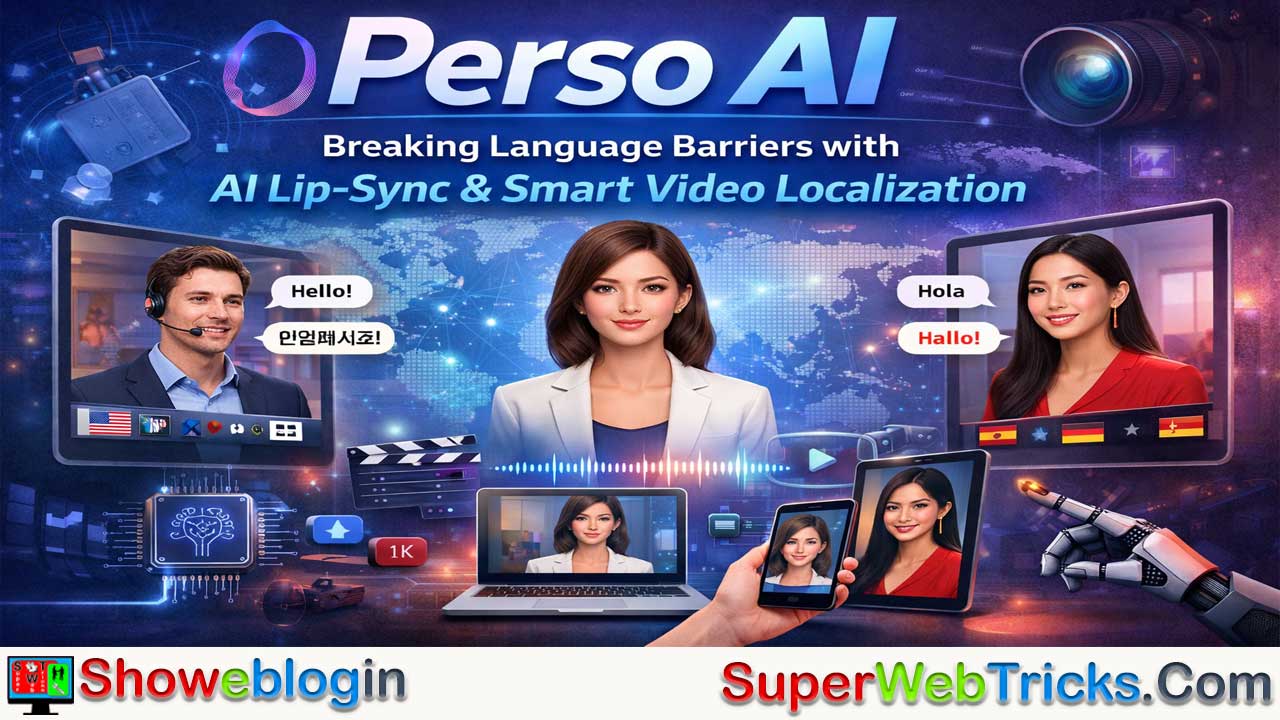


ESTsoft developed Perso AI to change how videos are translated and shared. The platform uses neural lip-sync and voice cloning to keep the speaker’s face and voice natural in other languages. It supports over 32 languages for dubbing and up to 110 languages in its interactive SDK.
The system transcribes speech, translates it with cultural awareness, then matches the new audio to mouth movements. It can also detect multiple speakers and keep their voices separate. Studio Perso lets users create AI avatar videos from text or PowerPoint without cameras or actors. The Interactive SDK adds real-time AI humans powered by large language models.
Perso AI works with companies like Samsung Electronics and ElevenLabs to improve voice and global use. The platform offers different pricing plans, but some users dislike recent subscription changes. Compared to HeyGen and Synthesia, Perso AI focuses more on dubbing and localization of real videos. Overall, it helps creators and businesses reach global audiences faster and at lower cost.
| Category | Details |
|---|---|
| Developer | ESTsoft |
| Core Technology | Neural lip-sync, voice cloning, AI video dubbing |
| Voice Match Accuracy | Up to 98.5% similarity |
| Language Support | 32+ dubbing languages, 110+ via Interactive SDK |
| Main Products | Video Translator, Studio Perso, Interactive SDK |
| Avatar Library | 52+ stock AI avatars |
| Video Length Limit | 5 sec – 30 min (up to 60 min Enterprise) |
| Max Upload Size | 2GB |
| Supported Formats | MP4, MOV, WebM, MP3, WAV |
| Export Quality | 1080p (Standard), 4K (PRO/Enterprise) |
| Multi-Speaker Detection | Yes (automatic voice separation) |
| Real-Time AI Human | Yes (LLM-powered interactive avatars) |
| Key Integrations | Samsung Electronics, ElevenLabs |
| Best For | Video localization, global content creators, enterprise training, tourism services |
Perso AI by ESTsoft: AI Video Dubbing, Lip-Sync & Global Localization Platform
The convergence of neural synthesis, computational linguistics, and real-time computer vision has birthed a new era of digital communication, where the constraints of geography and language are systematically dismantled. Perso AI, developed by the Korean artificial intelligence leader ESTsoft, stands as a primary architect in this transformation, positioning its platform as the definitive “human interface” for video localization.
This analysis examines the multifaceted nature of the platform, moving beyond its surface-level utility as a translation tool to explore its role as an integrated infrastructure for creators, global enterprises, and public sector organizations.
By leveraging sophisticated lip-synchronization algorithms, high-fidelity voice cloning, and interactive digital humans, the ecosystem addresses the fundamental inefficiencies inherent in traditional video production, offering a scalability that was previously restricted by the high costs of human labor and the temporal lag of studio-based workflows.
Technological Foundations of Neural Localization and Dubbing
At the core of the platform’s value proposition is its ability to deliver seamless multilingual dubbing that maintains the integrity of the original speaker’s vocal and visual identity. Traditional dubbing often suffers from a “visual-acoustic disconnect,” where the audio track fails to align with the speaker’s mouth movements, leading to a jarring experience for the viewer known as the uncanny valley effect.
The platform mitigates this through its proprietary “Perso AI Lips” technology, which utilizes frame-by-frame analysis to ensure pixel-perfect lip synchronization. This mechanism operates by identifying the phonetic structure of the translated audio and mapping it onto the facial geometry of the subject, even when the speaker is in a profile view or partially obscured by objects like glasses, masks, or hands.
The dubbing engine is not a singular process but a pipeline of interconnected neural models. It begins with high-accuracy speech-to-text transcription, followed by neural machine translation that is optimized for cultural nuance and context rather than mere literal conversion. The subsequent stage—voice cloning—replicates the speaker’s unique timbre and emotional resonance with a reported 98.5% match rate. This preservation of “identity” across languages is a crucial psychological factor in viewer retention; when a known influencer or corporate leader appears to speak a new language in their own voice, it fosters a level of trust and authenticity that generic voiceovers cannot achieve.
| Technical Parameter | Specification Detail |
|---|---|
| Core Technology | Neural Lip-Sync & Voice Cloning |
| Voice Match Rate | 98.5% |
| Language Support | 32+ (Core), 110+ (Interactive SDK) |
| Max Upload Capacity | 2GB |
| Video Duration Limit | 5 seconds to 30 minutes (60 min for Enterprise) |
| Supported Media Types | MP4, MOV, WebM, MP3, WAV |
Multi-Speaker Dynamics and Audio Fidelity
A significant hurdle in automated dubbing is the handling of complex audio environments involving multiple interlocutors. The platform addresses this through an automatic multi-speaker detection system that assigns distinct “acoustic fingerprints” to each individual in a video.
This ensures that in a dialogue-heavy environment, such as a panel discussion or an interview, each speaker’s cloned voice remains consistent and separate from others, preventing the vocal “blending” that characterizes less sophisticated systems. The engine further allows for the extraction of isolated tracks, enabling professional editors to download separate files for voice, background music, and ambient noise, thereby facilitating a higher degree of control in final post-production.
This technical depth indicates an underlying shift toward “modular video,” where the visual and auditory components of a media file are treated as independent, editable layers. The implications for the global economy are profound; a product demo created in English can be systematically “remapped” into Spanish, Japanese, or German without the need to reshoot visual assets, effectively reducing global production costs by an estimated 90% while increasing the speed of market entry by tenfold.
Studio Perso and the Virtual Human Production Lifecycle
While localization of existing footage is a major pillar of the ecosystem, “Studio Perso” provides a generative environment for creating entirely new content using synthetic avatars. This virtual studio environment is designed to bypass the traditional requirements of camera equipment, lighting, and physical talent, allowing users to generate high-definition video (up to 4K resolution) directly from text scripts.
The library of virtual humans in Studio Perso includes over 52 realistic avatars, spanning diverse age groups, ethnicities, and professional styles. For enterprise-level applications, the platform offers the development of “Client-Exclusive AI Models,” where the digital likeness and voice of a specific person—such as a CEO or a brand ambassador—are permanently encoded into the system. This “Digital Twin” technology allows for the perpetual production of high-quality messaging that maintains a consistent brand face without requiring the physical presence of the individual for every update.
Content Creation as Document Editing
The user interface of Studio Perso is philosophically aligned with the concept of “Video Editing as Easy as Document Work”. Users can upload existing PowerPoint presentations, which the AI then interprets to create structured scenes.
The avatar is integrated as the narrator, and the slides serve as the background, with the system automatically generating transitions, background music, and synchronized subtitles. This workflow is particularly effective for internal corporate training, e-learning, and technical onboarding, where the primary objective is the clear transmission of information rather than cinematic artistry.
| Studio Feature | Functional Capability |
|---|---|
| Avatar Count | 52 Stock Avatars |
| Template Library | 100+ Professional Layouts |
| Presentation Import | Direct PPT to Video Scene conversion |
| Interactive Scenes | Dual-avatar support for Q&A and interviews |
| Customization | Logo insertion, background removal, and transition effects |
| Export Formats | 1080p (Standard), 4K (PRO/Enterprise), Chroma Key clips |
The inclusion of dual-avatar support marks a significant advancement in synthetic video logic. By placing two digital humans in the same scene—facing each other or the camera—users can simulate interviews, debates, and role-playing scenarios. This capability expands the narrative potential of AI-generated content beyond simple “talking head” presentations, allowing for more dynamic storytelling that mimics human social interaction.
Interactive SDK and the Transition to Agentic AI
The most forward-looking component of the ESTsoft strategy is the Interactive SDK, which transitions Perso AI from a content generation tool to a real-time conversational service. This SDK enables the integration of virtual humans into digital kiosks, mobile applications, and high-performance websites, creating a “Universal Interface” that supports over 110 languages.
Real-Time Conversational Mechanics
Unlike pre-rendered videos, the interactive avatars are powered by a combination of Large Language Models (LLMs) and real-time speech synthesis. The system utilizes what is described as “RAG five-line technology” to optimize answers for specific business contexts, ensuring that the AI human provides accurate, company-specific information rather than generic responses.
This integration of Retrieval-Augmented Generation (RAG) with a visual human interface represents a convergence of “brain” (LLM) and “face” (Perso AI), allowing for natural, situation-aware conversations.
The practical application of this technology was demonstrated through the “AI Promoter” unveiled in collaboration with Samsung Electronics at CES 2026. This system utilized on-device AI and object recognition to detect nearby attendees and proactively initiate conversations. By reducing reliance on constant network connectivity, the AI Promoter ensured low-latency interactions even in high-traffic exhibition environments, responding to technical queries about flagship products in 32 languages.
Developer Ecosystem and API Architecture
For organizations seeking to build on top of this technology, the PERSO Live SDK provides a robust set of endpoints for session management and real-time streaming. The architecture is designed to handle the heavy lifting of synchronization and streaming, allowing developers to focus on the frontend experience and data integration.
| API Category | Functional Endpoints | Description |
|---|---|---|
| Project (v3) | GET /api/video-translator/v3/projects/ | Retrieves comprehensive localization project data |
| Live Chat | POST /api/live-chat/v2/sessions/ | Initiates a real-time conversational session |
| TTS Stream | POST /api/live-chat/v2/stream-tts-audio/ | Delivers low-latency synthesized audio streams |
| LLM Search | POST /api/llm/v1/search-document/ | Executes RAG-based knowledge retrieval |
| Voice Usage | POST /api/video-translator/v1/use-voice/ | Applies a specific cloned voice to a project |
The presence of “v3” endpoints in the documentation suggests a rapidly iterating platform where performance and stability are being optimized through successive generations of developer feedback. The SDK’s support for both browser and Node.js environments ensures that it can be deployed in diverse tech stacks, from customer-facing web portals to server-side automation scripts.
Strategic Alliances and Global Market Expansion
ESTsoft’s global strategy for the platform is characterized by deep technical integrations and localized partnerships that extend the reach of synthetic humans into physical infrastructures.
The ElevenLabs Synergy
A critical development in the platform’s vocal quality resulted from a partnership with ElevenLabs, which provides the underlying neural voice synthesis for many of the platform’s cloned voices. While Perso AI focuses on the visual “lip-sync” and “video dubbing” layers, ElevenLabs provides the expressive, emotion-rich text-to-speech models.
This synergy addresses the primary limitation of earlier AI dubbing: the “monotone” delivery. By integrating ElevenLabs’ cutting-edge voice cloning, the platform can capture the subtle inflections, pauses, and emotional cues that define human personality. This “cultural intelligence” engine ensures that the message doesn’t just change languages but adapts its emotional tone to resonate with the target demographic.
Infrastructure Integration: NTT and Nihon Kotsu
The platform is moving beyond digital screens and into physical mobility. In early 2026, ESTsoft entered into a Memorandum of Understanding (MOU) with NTT, Japan’s largest telecommunications provider, and Nihon Kotsu, a leading taxi operator. This partnership aims to deploy virtual human assistants on tablets within Japanese taxis to assist foreign tourists with real-time interpretation and navigation.
The significance of this move cannot be overstated; it represents the transition of AI avatars from “creativity tools” to “essential service infrastructure”. The two-month proof-of-concept (PoC) in the Kansai region is designed to gather data on passenger behavior and response latency in moving vehicles, with the goal of expanding nationwide and eventually into major shopping malls and public venues.
Creative and Educational Networks
In the domestic Korean market, the platform has partnered with Sandoll to integrate professional typography into the video production workflow, ensuring that the visual text—such as captions and titles—matches the professional quality of the AI-generated avatars.
Furthermore, collaborations with Microsoft Korea to build services on the Azure cloud signify a commitment to enterprise-grade security and the potential for deep integration into the broader Microsoft ecosystem.
Operational Workflow: A Tutorial for Professional Localization
For the professional content team, the utility of the platform is defined by the efficiency of its production pipeline. A structured workflow is necessary to move from a raw source video to a polished, localized asset while maintaining timing and synchronization.
Step-by-Step Production Guide
- Ingestion and Language Mapping: The process begins by uploading a video file or providing a URL from YouTube or TikTok. Users then select the source language and up to four target languages simultaneously. This “batch processing” capability allows for the concurrent generation of multiple language tracks, reducing total production time by up to 75% compared to sequential processing.
- Transcription and Script Refinement: The AI generates an automatic transcription and translation. Professional users are encouraged to review this script using the “Subtitle & Script Editor”. This is the most critical stage for maintaining “timing consistency”. For example, a feature explanation that takes five seconds in English might require eight seconds in Spanish. The editor allows the user to shorten phrases or adjust the script to ensure the verbal explanation stays synchronized with the visual on-screen actions.
- Vocal Matching and Lip-Sync Activation: Users choose whether to use a stock AI voice or to activate “Voice Cloning” to match the original presenter. The “AI Lip-Sync” toggle must be enabled to ensure the video frame is re-rendered to match the new audio.
- Proofreading and Cultural Adaptation: The “Cultural Intelligence Engine” assists in adapting idioms and technical terms, but manual review ensures that industry-specific jargon is used correctly.
- Generation and Multi-Format Export: After the AI completes the complex task of audio synthesis and visual re-mapping, the user can download the final video in HD or 4K. Export options also include standalone SRT subtitle files and isolated audio tracks for further editing.
| Phase | Core Action | Tool Used | Objective |
|---|---|---|---|
| Preparation | URL Import / Direct Upload | Ingestion Engine | Establish source material baseline |
| Linguistic | AI Auto-Transcription & Translation | Script Editor | Generate culturally nuanced text |
| Synchronization | Timing adjustment & phrase shortening | Timing Controls | Align verbal pace with visual flow |
| Synthesis | Neural Voice Cloning & Lip-Sync | Generation Engine | Re-map audio and visual layers |
| Distribution | HD/4K Export & Asset Management | Export Manager | Deliver final localized video |
Troubleshooting Timing Disconnects
A common issue in automated dubbing is “visual-verbal drift,” where the speaker is seen performing a task before or after it is described. Content teams must verify that the pacing of feature reveals in product demos remains tightly structured.
For “Talking Head” segments, the emphasis should be on lip-sync accuracy, while “Screen-Focused” tutorials should prioritize technical terminology and clear narration.
Economic Analysis: Subscription Models and User Sentiment
The platform’s pricing strategy has undergone significant evolution, reflecting both the rising costs of AI compute and the desire to reach a broader segment of the creator economy.
Detailed Pricing Structure
The current pricing model is segmented into five distinct tiers, ranging from a “Starter” plan for hobbyists to an “Enterprise” solution for high-volume corporate needs.
- Starter ($6.99/mo): This entry-level tier provides 15 minutes of “Fast Speed” dubbing per month with a maximum video length of 5 minutes. It is designed as a low-risk entry point for new creators.
- Creator ($29/mo or $21/mo billed yearly): Aimed at professional YouTubers, this plan offers 30 minutes of fast-speed dubbing plus “unlimited” low-speed dubbing.
- PRO ($59/mo or $44/mo billed yearly): This is the most popular plan, offering 60 minutes of fast-speed dubbing, 4K export, and faster overall processing.
- Enterprise (Custom): For organizations requiring more than 1,000 minutes per month, this tier provides dedicated infrastructure, multi-team workspace management, and a dedicated success manager.
The “Unlimited” Controversy and User Feedback
Despite the platform’s high technical ratings (averaging 3.7 to 4.7 stars across various review sites), there has been significant user friction regarding recent changes to the subscription model.
In early 2026, the company shifted away from a truly unlimited model to a credit-based “Fast Speed” pool. Once credits are exhausted, users are moved to “Legend Speed” (low speed), which imposes significant restrictions, such as a 5-minute cap per video and a 6-hour cooldown period between generations.
Professional users on platforms like G2 have expressed frustration that these changes were applied to active, paid subscriptions without grandfathering in earlier terms. This feedback highlights a critical lesson for AI tool users: the “reliability” of a platform is as important as its “quality”. For a business whose workflow depends on predictable turnaround times, the sudden shift in rate-limiting can render a previously viable tool impractical for daily production.
Comparative Positioning: Perso AI vs. HeyGen and Synthesia
The synthetic media market is currently dominated by three primary players, each with a distinct focus and set of competitive advantages.
HeyGen: The Hyper-Realist
HeyGen is frequently cited for its “Avatar IV” technology, which delivers ultra-realistic avatars with sophisticated motion-capture animations. Its focus is on “Digital Twins” for personal branding, allowing creators to produce content that feels highly authentic.
However, some reviews suggest that HeyGen’s avatars can sometimes appear “too picture perfect,” and the platform’s dubbing engine, while strong, may not offer the same level of multi-speaker separation as ESTsoft’s solution.
Synthesia: The Enterprise Pioneer
Synthesia is the go-to platform for corporate teams focusing on training and HR. Its strengths lie in its “Enterprise-Grade” security (SOC 2 Type II compliance) and its mature feature set that includes timeline-based editing and seamless integration with PowerPoint and Google Slides.
The primary drawback noted for Synthesia is that every edit requires a full re-rendering of the video, which can slow down the creative process for time-sensitive projects.
Perso AI: The Localization Specialist
Perso AI’s competitive edge is its specialized focus on the “Dubbing and Lip-Sync” workflow for existing video content. While HeyGen and Synthesia are excellent for “Text-to-Avatar” presentations, Perso AI is generally considered superior for translating “Real-World” footage, such as vlogs, product demos, and interviews where the original speaker’s face and voice must be preserved.
Its “Cultural Intelligence Engine” and the 110-language support of the Interactive SDK give it a broader utility in the tourism and interpretation sectors.
| Category | HeyGen | Synthesia | Perso AI |
|---|---|---|---|
| Core Focus | Personal Branding / Ultra-Realism | Training / Corporate HR | Localization / Interactive AI |
| Avatar Tech | Avatar IV (Highly Expressive) | Expressive (Stable & Polished) | Realistic stock & Custom Digital Twins |
| Dubbing | Real-time translation (30+ languages) | Multi-language (140+ languages) | Deep lip-sync & voice cloning (32-110+) |
| Integration | Canva, Google Drive | PPT, Google Slides, LMS | YouTube, TikTok, G-Drive, SDK/API |
| Best For | Influencers and Executive announcements | Large scale internal corporate training | Global content creators and tourism infrastructure |
Socio-Technical Impact and Ethical Dimensions
The widespread adoption of synthetic video localization has implications that extend beyond commercial efficiency, touching on accessibility, education, and ethical governance.
Global Awareness and Accessibility
The platform has been utilized by non-profits and museums to create multilingual audio and video guides, effectively democratizing access to cultural and educational information.
For example, the use of AI humans in museums allows for the creation of exhibition descriptions for the visually impaired and high-impact titles that resonate with international visitors. In the non-profit sector, AI-powered communication has led to quantifiable results; organizations like Charity: Water have seen significant increases in donor retention (up to 30%) by using personalized AI-driven messaging and project updates.
The AI Ethics Framework
ESTsoft maintains an “AI Ethics” policy to govern the use of its virtual humans. A primary concern in the industry is the creation of unauthorized “Deepfakes” of celebrities or politicians. The platform’s guidelines and the structured nature of its “Digital Twin” service (requiring consent and verified data) are designed to ensure that synthetic identities are created ethically and for legitimate brand purposes.
Furthermore, the platform’s focus on “Cultural Intelligence” aims to prevent the homogenization of language, ensuring that regional dialects and sentiments are preserved rather than replaced by a generic global standard.
Synthesis and Conclusion
The Perso AI ecosystem represents a pivotal shift in how the world produces and consumes video content. By integrating neural dubbing, pixel-perfect lip-syncing, and interactive digital humans into a single, scalable platform, ESTsoft has provided a solution to the “localization bottleneck” that has historically limited the global reach of creators and brands.
The technological sophistication of the “Perso AI Lips” algorithm and the strategic synergy with ElevenLabs’ vocal models ensure a level of authenticity that bridges the gap between synthetic and human communication.
However, the platform’s journey is not without challenges. The friction surrounding subscription model changes and the inherent “uncanny valley” risks of synthetic avatars highlight a maturing industry that must balance technological capability with user trust and ethical responsibility.
For the professional content team, the platform offers a powerful—if sometimes unpredictable—tool for international growth. For the enterprise, the Interactive SDK and the deployment of digital concierges in physical spaces like taxis and exhibition halls suggest a future where the “Human Interface” for information is no longer a static screen, but a dynamic, multilingual synthetic agent.
As the industry moves toward 2027, the focus will likely shift from “how realistic” an avatar looks to “how useful” it is in real-world environments. Perso AI’s expansion into the Japanese mobility sector and its collaboration with global tech giants like Samsung indicate that it is well-positioned to lead this transition, moving synthetic media from the realm of creative novelty to a foundational layer of the global communication infrastructure. For the user, the strategic mandate is clear: those who master the nuances of AI-driven localization today will be the primary beneficiaries of a truly global, borderless creator economy.
FAQs about Perso AI
What is Perso AI?
Perso AI is an AI video localization platform developed by ESTsoft. It provides neural lip-sync, voice cloning, multilingual dubbing, AI avatars, and real-time interactive digital humans.
How does Perso AI lip-sync technology work?
It analyzes video frame by frame and maps translated phonetic sounds to the speaker’s mouth movements. This keeps the lips aligned with the new language audio.
How accurate is the voice cloning feature?
The platform reports up to 98.5% voice similarity. It aims to preserve tone, emotion, and vocal identity.
How many languages does Perso AI support?
It supports 32+ languages for video dubbing and over 110 languages through its Interactive SDK.
Can Perso AI handle videos with multiple speakers?
Yes. It detects different speakers automatically and keeps each cloned voice separate to avoid blending.
What file formats are supported for upload?
It supports MP4, MOV, WebM for video and MP3, WAV for audio.
What is the maximum video length allowed?
Standard plans allow up to 30 minutes per video. Enterprise plans can support up to 60 minutes.
What is Studio Perso?
Studio Perso is a virtual video creation tool. Users can generate AI avatar videos from text or PowerPoint without cameras or actors.
How many avatars are available in Studio Perso?
There are more than 52 stock avatars across different ages and styles.
Can businesses create a custom AI avatar?
Yes. Enterprise users can create a Digital Twin of a CEO or brand ambassador with permission.
What is the Interactive SDK?
It is a development kit that allows companies to integrate real-time AI humans into apps, kiosks, and websites.
Does Perso AI support real-time conversations?
Yes. The Interactive SDK uses large language models to enable live conversations with AI avatars.
Which companies has Perso AI partnered with?
It has collaborated with Samsung Electronics and integrates voice technology from ElevenLabs.
Can Perso AI be used for YouTube or TikTok videos?
Yes. Users can upload files or paste URLs from platforms like YouTube and TikTok for localization.
Is Perso AI suitable for corporate training?
Yes. It is widely used for internal training, onboarding, and e-learning videos.
Does Perso AI offer 4K export?
Yes. 4K export is available in PRO and Enterprise plans.
How does Perso AI compare to HeyGen?
HeyGen focuses more on ultra-realistic avatars and personal branding, while Perso AI specializes in dubbing and lip-sync for real videos.
How does Perso AI compare to Synthesia?
Synthesia is strong in enterprise training content, while Perso AI is stronger in preserving original speaker identity during translation.
What are the pricing tiers?
Plans range from Starter to Enterprise. Pricing varies based on dubbing minutes, speed, and export quality.
Is there an unlimited plan?
The platform previously offered unlimited options. It now uses a credit-based fast-speed system with limits.
Can users edit subtitles and scripts before generation?
Yes. There is a built-in Subtitle & Script Editor for adjustments and timing control.
Does Perso AI support subtitle export?
Yes. Users can export standalone SRT subtitle files.
Can I download separate audio tracks?
Yes. The platform allows downloading isolated voice and background tracks for editing.
Is Perso AI good for tourism and public services?
Yes. Its multilingual interactive avatars are useful for tourism, kiosks, and public information systems.
Does Perso AI require technical skills?
Basic video editing knowledge helps, but the interface is designed to be simple and user-friendly.
Is Perso AI secure for enterprise use?
Enterprise plans offer dedicated infrastructure and team workspace management for higher security needs.
Can Perso AI reduce video production costs?
Yes. It removes the need for reshooting content in multiple languages, which lowers costs and saves time.
Does Perso AI support batch processing?
Yes. Users can generate multiple language versions at the same time.
What industries use Perso AI?
It is used in media, education, corporate training, marketing, tourism, and public services.
Is Perso AI suitable for influencers?
Yes. Influencers can expand globally by dubbing videos while keeping their original voice and face.
What makes Perso AI different from other AI video tools?
Its main strength is deep lip-sync and voice preservation for real-world video localization.
Does Perso AI support PowerPoint conversion?
Yes. Users can upload PPT files and convert slides directly into AI avatar videos.
Can two AI avatars appear in the same scene?
Yes. Studio Perso supports dual-avatar scenes for interviews and Q&A formats.
Is Perso AI useful for startups?
Yes. Startups can use it to localize marketing and product demo videos quickly.
Does Perso AI support API integration?
Yes. The platform offers API endpoints for video translation and live AI chat sessions.
Can Perso AI work offline?
Some deployments, such as event demonstrations, can use on-device AI setups depending on configuration.
Is Perso AI ethical to use?
The company states it requires consent for Digital Twin creation and aims to prevent misuse such as unauthorized deepfakes.
What is the main benefit of Perso AI?
It helps creators and businesses reach global audiences faster while keeping content natural and authentic.



Leave a Reply
You must be logged in to post a comment.