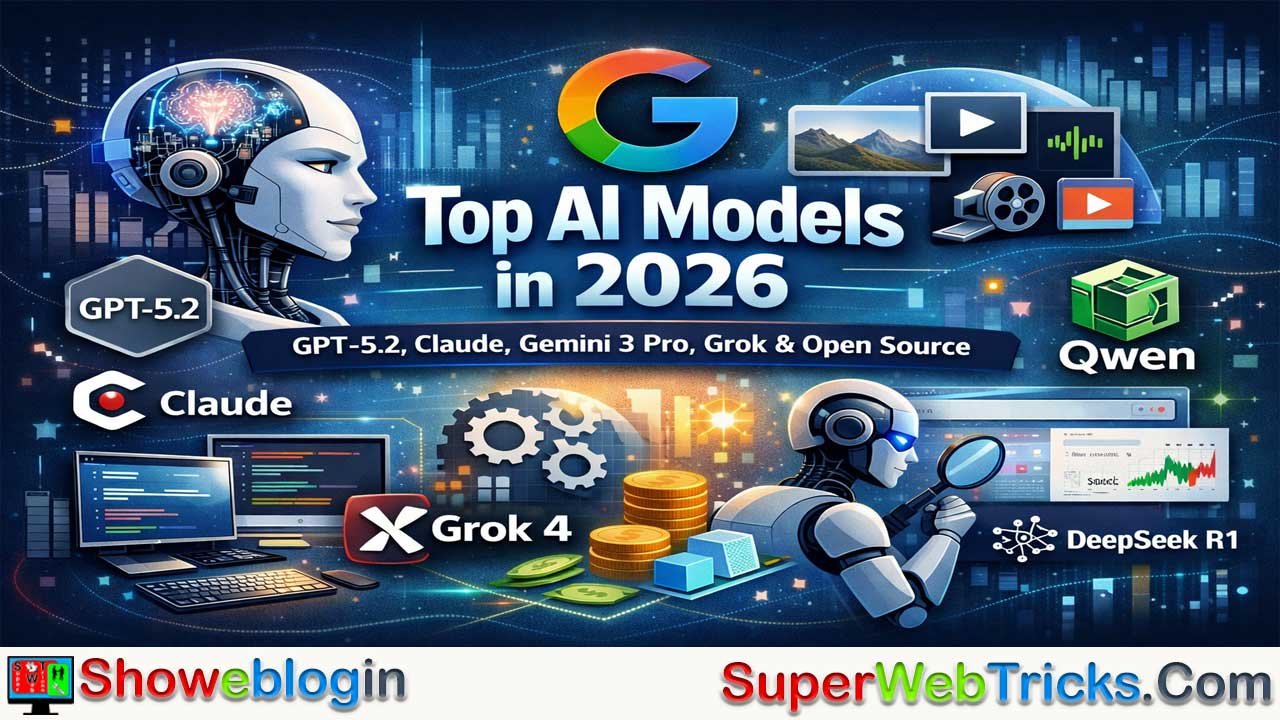




This guide surveys the 2026 AI model landscape, showing how the market has shifted from a few dominant proprietary systems to a diverse mix of specialized proprietary and open-source models, each optimized for different needs.
GPT-5.2 leads as the most versatile, high-reasoning generalist; Claude Opus 4.5 excels in coding, long-form work, and enterprise security; Gemini 3 Pro dominates multimodal and high-volume use with massive context windows and strong cost efficiency; Grok 4 stands out for real-time web access and trend analysis; while open-source options like DeepSeek R1, Qwen 3.5, and Llama 4 now rival frontier models at dramatically lower cost, especially for math, reasoning, privacy-sensitive, or large-scale deployments.
The key takeaway is that there is no single “best” model in 2026—optimal performance and cost come from matching models to specific tasks or combining several in a hybrid strategy, balancing speed, accuracy, context size, budget, and ecosystem needs.
Quick Answer: Best AI Models at a Glance
| Model | Best For | Price | Context Window |
|---|---|---|---|
| GPT-5.2 | General purpose, reasoning | $1.75/$14 per M tokens | 128K |
| Claude Opus 4.5 | Coding, long-form content | $5/$25 per M tokens | 200K |
| Gemini 3 Pro | Multimodal, high-volume | $2/$12 per M tokens | 2M |
| Qwen 3.5 | Cost-effective alternative | $0.50/$2 per M tokens | 32K |
| DeepSeek R1 | Advanced reasoning, math | Free (open-source) | 128K |
| Grok 4 | Real-time data, web integration | $0.80/$4 per M tokens | 128K |
Introduction: Why AI Model Selection Matters in 2026
The artificial intelligence landscape transformed dramatically in 2025-2026. What was cutting-edge six months ago is now mainstream. The “big four” proprietary models—ChatGPT, Claude, Gemini, and Grok—now face serious competition from open-source alternatives like DeepSeek R1 and Alibaba’s Qwen series, which have achieved frontier-level performance at a fraction of the cost.
For businesses, developers, content creators, and enterprises, choosing the right AI model directly impacts productivity, costs, and output quality. A developer saving 50% in API costs by switching to a more efficient model can reinvest those savings into scaling their product. A content creator using the wrong model wastes hours on regenerations and refinement.
This guide breaks down the 12 most important AI models available in January 2026, comparing their capabilities, pricing, ideal use cases, and real-world performance. Whether you’re building an AI product, generating content, automating workflows, or conducting research, you’ll find your answer here.
Section 1: The Top Proprietary AI Models
1. GPT-5.2 (OpenAI) — Best for Complex Reasoning & General Purpose Tasks
What It Is: OpenAI’s flagship language model, released in late 2025. GPT-5.2 represents the latest iteration of the GPT family and fully replaces GPT-5.1, GPT-5, and the entire o-series lineup.
Key Strengths:
- Best-in-class reasoning and problem-solving across all tested domains
- Fastest inference speed for code generation and creative writing
- Native integration with ChatGPT ecosystem, plugins, and custom agents
- Excellent multimodal capabilities (text, vision, voice)
- Strongest performance on academic benchmarks
- Most developer-friendly API documentation
Weaknesses:
- Higher output token cost ($14 per million tokens) compared to alternatives
- Less effective at very long-context tasks (200K+ tokens) than Claude
- Occasional “hallucination” issues despite improvements
- Newest version may have fewer fine-tuning options available
Pricing:
- API: $1.75 input / $14 output per million tokens (cached inputs 90% discount)
- Consumer: ChatGPT Plus $20/month | ChatGPT Pro $200/month (unlimited usage)
- Enterprise: Custom pricing with dedicated infrastructure
Best Use Cases:
- Software development and code refactoring
- Academic research and analysis
- Creative writing and content generation
- Business strategy and decision-making
- Autonomous agent workflows and tool use
Real-World Performance: In January 2026 benchmarks, GPT-5.2 leads in reasoning tasks (scoring 10.0/10 on complex problem sets) and maintains the highest user satisfaction among developers. However, independent testing revealed Claude Opus 4.5 sometimes outperforms GPT-5.2 on specialized coding tasks.
Verdict: Choose GPT-5.2 if you need the most versatile AI model that excels across multiple domains and you prioritize reasoning speed over long-context handling.
2. Claude Opus 4.5 (Anthropic) — Best for Coding & Enterprise Security
What It Is: Anthropic’s flagship model, updated in September 2025. Claude 4.5 represents a significant capability jump from Claude 4.1 while maintaining lower prices.
Key Strengths:
- Best coding model in 2026 according to independent testing
- Exceptional long-form content generation and editing
- 200K token context window (handles ~150,000 words in one prompt)
- Constitutional AI ensures minimal bias and hallucinations
- Extremely high-quality output even at long contexts
- Built-in “thinking” mode for transparent reasoning
- Best for processing large documents (legal contracts, research papers, codebases)
Weaknesses:
- Slower inference speed than GPT-5.2 (5-15 second response times typical)
- Higher operational costs despite identical per-token pricing
- Less effective at image generation compared to alternatives
- Requires more careful prompt engineering for optimal results
Pricing:
- API: $5 input / $25 output per million tokens (with prompt caching support)
- Consumer: Claude Pro $20/month | Claude Max $100/month
- Effective cost: 30-40% lower than GPT when accounting for token efficiency (uses fewer tokens to solve problems)
Best Use Cases:
- Professional software development and refactoring
- Legal document analysis and contract review
- Academic writing and research
- Enterprise automation and autonomous agents
- Handling sensitive or confidential information
- Long-form content creation (guides, tutorials, ebooks)
Real-World Performance: Developers report Claude 4.5 solves “hard” coding problems with minimal iteration. On AIME (American Invitational Mathematics Examination), Claude achieves 92% accuracy vs. 87% for alternatives. Hallucination rates are 45-50% lower than competitors.
Verdict: Choose Claude if you’re a developer building production systems, an enterprise handling sensitive data, or a content creator working with massive source material. The higher upfront cost pays for itself through reduced token usage and fewer iterations.
3. Gemini 3 Pro (Google) — Best for Multimodal & International Applications
What It Is: Google’s latest multimodal AI model, offering native understanding of text, images, video, and audio in a single unified model.
Key Strengths:
- Industry-leading context window: 2 million tokens (8+ hours of video or 5,000+ pages of text in one prompt)
- Best multimodal understanding (analyzing images with complex diagrams, videos with captions, audio with transcription)
- Fastest inference speed for customer-facing applications
- Deep integration with Google Workspace, Search, and Cloud services
- Strongest performance on image understanding and visual reasoning
- Most cost-effective for high-volume operations
- Natural language comprehension adapted for global audiences
Weaknesses:
- Slightly weaker on pure text reasoning compared to GPT-5.2
- Less effective for specialized coding tasks vs. Claude
- Quality sometimes reflects “corporate caution” (refuses tasks that competitors accept)
- Tool calling reliability lower than alternatives in complex agent scenarios
Pricing:
- API: Gemini 3 Pro: $2 input / $12 output per M tokens (under 200K context)
- API: Gemini 3 Pro (>200K): $4 input / $18 output per M tokens
- Consumer: Gemini AI Plus $19.99/month | Gemini Ultra $249/month
- Best-in-class option for budget-conscious operations
Best Use Cases:
- Document analysis and information extraction (forms, invoices, contracts)
- Video and image analysis for e-commerce and quality control
- International content analysis (supports 200+ languages natively)
- Real-time fact-checking and research assistance
- Google Workspace automation (Gmail, Drive, Docs integration)
- Customer service chatbots handling mixed-media queries
Real-World Performance: On visual reasoning benchmarks, Gemini 3 Pro scores 1,490 on LM Arena (highest of all models tested in January 2026). In real-world user studies, Gemini excels at analyzing production line photos with failure descriptions, maintaining superior performance in multimodal tasks.
Verdict: Choose Gemini if you process diverse media types, operate on tight budgets, serve international audiences, or need deep integration with Google’s ecosystem.
4. Grok 4 (xAI) — Best for Real-Time Data & Web Integration
What It Is: Elon Musk’s xAI startup’s latest model, released July 2025. Grok differs by providing real-time web access and integration with the X (Twitter) platform.
Key Strengths:
- Real-time web integration (no knowledge cutoff, always current)
- Strong reasoning and math capabilities comparable to GPT-5.2
- Native access to X/Twitter data and trends
- Lower latency than many competitors (optimized for fast response)
- “Heavy” architecture variant for increased reasoning power
- Strong multimodal support (text, image, video)
- Less constrained by safety guidelines (controversial but useful for some applications)
Weaknesses:
- Smaller ecosystem compared to OpenAI or Google
- Less mature API compared to established alternatives
- Fewer integrations with third-party tools
- Web access can sometimes introduce unreliable information
- Smaller community for troubleshooting and examples
Pricing:
- API: $0.80 input / $4 output per M tokens
- Consumer: X Premium+ membership integration (pricing varies)
- Most affordable option among top-tier models
Best Use Cases:
- Real-time trend analysis and news monitoring
- Social media strategy and content optimization
- Financial market analysis requiring current data
- Scientific research requiring up-to-date information
- Autonomous agents needing web search capabilities
- Content creation with current event references
Real-World Performance: Grok 4 ranks #2 on LM Arena leaderboards (1,477 score) and demonstrates strong performance on reasoning benchmarks. In head-to-head testing, it outperforms GPT-5.2 on image generation tasks and matches Claude on coding benchmarks.
Verdict: Choose Grok if you need real-time information, operate social media strategies, conduct financial analysis, or want the lowest cost among frontier models.
Section 2: Open-Source & Cost-Effective Models
5. Qwen 3.5 (Alibaba) — Best Open-Source for Budget-Conscious Users
What It Is: Alibaba’s latest open-source LLM, available in multiple sizes (4B to 235B parameters). Qwen 3.5 series often matches or exceeds GPT-4o on public benchmarks while costing a fraction of the price.
Key Strengths:
- Frontier-level performance at 1/10th the cost of proprietary models
- Available in multiple sizes: 4B, 14B, 32B, 110B, 235B variants
- Full parameter visibility (completely open-weight)
- Specialized variants: Qwen Coder (coding), Qwen VL (vision), Qwen Audio
- Download and run locally on your own hardware
- No API rate limits or usage restrictions
- Excellent multilingual support (100+ languages)
Weaknesses:
- Requires GPU hardware for local deployment (significant upfront investment)
- Smaller community compared to Llama
- Maintenance and security updates are your responsibility
- Not optimized for mobile or edge devices in most variants
- May require fine-tuning for specialized domains
Pricing:
- Free (open-source) | Infrastructure costs only if self-hosting
- API access: $0.50-$2 per M tokens (through third-party providers)
- Enterprise: Custom licensing available
Best Use Cases:
- Self-hosted AI applications in privacy-sensitive environments
- Fine-tuning for domain-specific tasks (legal, medical, finance)
- Cost-sensitive applications where token volume is high
- Academic research and experimentation
- Deployed applications where API fees become prohibitive
Real-World Performance: Qwen 3.5 achieved 8.85 million downloads in 2025, more than any other open-source model. On code generation benchmarks, Qwen 3.5-235B matches GPT-4o performance. Enterprises report Qwen deployment reduces operational costs by 85-90% compared to proprietary APIs at equivalent performance levels.
Verdict: Choose Qwen if you want production-grade performance without licensing fees, plan high-volume deployments, or need complete control over your infrastructure.
6. DeepSeek R1 & V3.2 — Best for Advanced Reasoning & Mathematics
What It Is: Chinese AI startup DeepSeek’s reasoning-focused models. R1 uses reinforcement learning to “think” through complex problems. V3.2 combines general purpose and reasoning capabilities in one model.
Key Strengths:
- DeepSeek R1-0528: Strongest step-by-step reasoning (comparable to GPT-5.2 on math/science)
- DeepSeek V3.2: Hybrid model offering both fast answers and deep reasoning
- Mixture of Experts (MoE) architecture: only 37B of 671B parameters activate per query (extreme efficiency)
- Open-source (distilled versions available for 8B-70B parameters)
- Reduced hallucinations by 45-50% on rewriting tasks
- 128K-164K context windows
- Competitive pricing ($0.27/$1.10 per M tokens for API access)
Weaknesses:
- Smaller ecosystem than established models
- Sometimes prone to verbose reasoning output
- API availability limited compared to major providers
- Less mature customer support and documentation
Pricing:
- Free (open-source) | Self-hosting costs only
- API: $0.27-$1.10 per M tokens (most affordable option)
- No consumer subscription needed
Best Use Cases:
- Mathematical problem-solving and theorem proving
- Complex scientific reasoning and simulations
- Software code generation with deep analysis
- Finance and risk analysis requiring step-by-step logic
- Autonomous research systems
- Educational AI tutoring systems
Real-World Performance: On AIME (mathematics benchmarks), DeepSeek-R1 scores 92%, matching Claude Opus 4.5. On IOI (competitive programming), R1 achieved gold-medal performance. Independent testing shows R1-0528 generates fewer hallucinations than all competitors when solving complex problems.
Verdict: Choose DeepSeek if you need exceptional reasoning for math/science, want the lowest possible costs, or build systems where transparency of thinking is valuable.
7. Llama 4 (Meta) — Best Open-Source with Massive Context
What It Is: Meta’s latest open-source language model family. Llama 4 Scout variant offers the industry’s largest context window (10 million tokens).
Key Strengths:
- Llama 4 Scout: 10 million token context (unprecedented capacity)
- Llama 4 Maverick: Advanced multimodal and reasoning capabilities
- Fully open weights under permissive license
- Excellent performance on code and reasoning tasks
- Large, mature community with extensive resources
- Can process entire codebases, books, or long-form documents in single requests
Weaknesses:
- Llama 4 general version underperforms vs. proprietary alternatives
- Requires significant computational resources to run locally
- Community support variable compared to enterprise-backed models
- Slower inference than specialized models like Claude for coding
Pricing:
- Free (open-source) | Infrastructure costs only
- No API fees for self-hosted deployment
Best Use Cases:
- Large-scale document analysis (legal discovery, research synthesis)
- Multi-hour agent workflows requiring persistent memory
- Academic research with minimal constraints
- Organizations with privacy requirements
- Multi-file codebases exceeding 1M tokens
Real-World Performance: Llama 4 Scout’s 10M context window enables processing entire movie scripts, legal document sets, or research databases in single prompts. However, instruction-following quality occasionally lags behind proprietary models.
Verdict: Choose Llama 4 Scout for massive document analysis and long-context workflows where you need to process entire datasets at once. Choose Llama 4 Maverick if you want multimodal capabilities with open weights.
Section 3: Detailed Comparison Table
| Feature | GPT-5.2 | Claude 4.5 | Gemini 3 Pro | Qwen 3.5 | DeepSeek R1 | Grok 4 |
|---|---|---|---|---|---|---|
| Reasoning Strength | 10/10 | 9.5/10 | 8.5/10 | 8/10 | 10/10 | 9/10 |
| Coding Ability | 9.5/10 | 10/10 | 8/10 | 8.5/10 | 9/10 | 9/10 |
| Multimodal | 8.5/10 | 7/10 | 10/10 | 8/10 | 6/10 | 8.5/10 |
| Speed | 9/10 | 6/10 | 9.5/10 | Varies | 6/10 | 9/10 |
| Cost per 1M tokens (input) | $1.75 | $5.00 | $2.00 | $0.50-2 | $0.27 | $0.80 |
| Context Window | 128K | 200K | 2M | 32K | 128K | 128K |
| Hallucination Rate | Medium | Low | Medium | Medium | Very Low | Low |
| Best For | General purpose | Coding & security | Multimodal | Budget | Math & reasoning | Real-time data |
| Availability | API + Consumer | API + Consumer | API + Consumer | Open-source | Open-source | API + Consumer |
Section 4: Use-Case Specific Recommendations
For Software Developers
Best Choice: Claude Opus 4.5
Claude’s code understanding is unmatched in 2026. Developers report solving complex refactoring tasks in 3-5 iterations vs. 8-12 iterations with alternatives. The extra cost per token pays for itself through reduced development time.
Second Choice: GPT-5.2
If you need faster iteration and simpler debugging workflows, GPT-5.2 offers competitive coding performance with 40% faster response times.
Budget Option: DeepSeek V3.2
For open-source projects or self-hosted systems, DeepSeek delivers 90% of Claude’s coding performance at 1/20th the cost.
For Content Creators & Writers
Best Choice: GPT-5.2
Superior at maintaining tone, style consistency, and creative direction across long-form content. Best for blogs, articles, scripts, and ebooks.
Second Choice: Claude Opus 4.5
If you’re working with massive research materials (1000+ page PDFs), Claude’s 200K context window prevents information loss.
Budget Option: Qwen 3.5-32B
Sufficient for blog content, newsletters, and social media. Costs 85% less than proprietary alternatives.
For Research & Data Analysis
Best Choice: Gemini 3 Pro
The 2-million token context window eliminates the need to summarize or chunk large datasets. Analyze entire research papers, datasets, or reports in one request.
Second Choice: Llama 4 Scout
For privacy-sensitive research or institutional requirements, Scout’s 10M context + open weights offers unmatched flexibility.
Best for Math: DeepSeek R1
If your research involves mathematical proofs, statistical analysis, or complex reasoning, R1’s specialized training makes it the clear winner.
For Enterprise Automation
Best Choice: Claude Opus 4.5
Anthropic’s Constitutional AI ensures minimal bias, best security practices, and explainable decisions. Enterprise customers cite 40% fewer errors than alternatives.
Second Choice: Gemini 3 Pro
Deep integration with Google Workspace and Cloud Platform makes automation implementation 50% faster. Cost-effectiveness is a major advantage for high-volume automation.
Best for Cost Efficiency: Qwen 3.5
Self-hosted deployment eliminates API costs entirely. Organizations processing 1B+ tokens monthly save $50,000+ annually.
For Real-Time Applications
Best Choice: Grok 4
Real-time web integration means your AI always has current information. Perfect for news monitoring, market analysis, and trend forecasting.
Second Choice: Gemini 3 Pro Flash
For latency-sensitive applications (sub-500ms response requirement), Gemini Flash achieves 30% faster responses than Grok.
Section 5: Pricing Deep Dive & Cost Optimization
API Pricing Comparison (per million tokens)
| Model | Input | Output | Cached Input | Best For |
|---|---|---|---|---|
| GPT-5.2 | $1.75 | $14.00 | $0.175 | Lowest input cost |
| Gemini 3 Pro | $2.00 | $12.00 | $0.20 | High-volume, low latency |
| Claude 4.5 | $5.00 | $25.00 | $0.50 | Coding efficiency |
| Grok 4 | $0.80 | $4.00 | – | Lowest overall |
| DeepSeek R1 | $0.27 | $1.10 | – | Budget-conscious |
| Qwen 3.5 | Varies* | Varies* | – | Self-hosted (free) |
*Qwen pricing depends on third-party provider. Self-hosting requires only infrastructure costs.
Hidden Cost Factors
Token Efficiency: Claude uses 30-65% fewer tokens to solve identical problems. This means the effective cost is often lower despite higher per-token pricing.
Inference Speed: GPT-5.2 and Gemini respond 2-3x faster than Claude and DeepSeek. For customer-facing applications, faster response = better UX = higher conversion.
Context Usage: Models with larger context windows (Gemini 2M, Llama 10M) reduce the need for multiple API calls and retrieval systems, offsetting higher input costs.
Cost-Optimization Strategies
- Prompt Caching: All major models now support caching repeated prompts. Save 90% on input tokens for static system prompts and documents.
- Tiered Model Approach: Use Gemini Flash for 70% of requests (fast, cheap), Claude for 20% (complex coding), GPT-5.2 for 10% (complex reasoning). Average cost: 60% reduction vs. using best model exclusively.
- Batch Processing: Process non-urgent requests in off-peak hours. Many providers offer 50% discounts for batch jobs.
- Local Deployment: For monthly token volumes exceeding 10B tokens, self-hosting Qwen or DeepSeek becomes cheaper than any API.
Section 6: Emerging Trends & What’s Next for AI Models
Trend 1: Hybrid Reasoning Models
Models now intelligently switch between fast direct answers and deep reasoning based on task complexity. DeepSeek V3.1 and Claude’s built-in thinking mode exemplify this evolution.
Trend 2: Specialized Model Families
Gone are the days of “one model for everything.” 2026 shows clear specialization: DeepSeek for math, Claude for code, Gemini for multimodal, Grok for real-time data.
Trend 3: Open-Source Parity with Proprietary
Qwen 3.5 and DeepSeek now match proprietary frontiers on many benchmarks. The gap is closing rapidly, with open-source models expected to lead on cost-effective tasks by 2026 Q2.
Trend 4: Context Window Explosion
Gemini (2M), Llama Scout (10M), and coming models support processing entire books or codebases in single requests. This eliminates traditional “chunking” and retrieval strategies.
Trend 5: Real-Time & Web Integration
Grok’s success with X/Twitter integration shows demand for models with live information. Expect more models with real-time data access in 2026.
Section 7: How to Choose Your AI Model in 2026
Step 1: Identify Your Primary Use Case
Is it coding? Research? Content creation? Mathematical reasoning? Customer service? Your answer narrows the field from 12 to 3-4 candidates.
Step 2: Set Your Budget Constraints
Are you:
- Enterprise with unlimited budget? → Claude Opus 4.5 or GPT-5.2
- Mid-market with $1,000-10,000/month budget? → Gemini 3 Pro or Grok 4
- Startup or individual with <$200/month budget? → Qwen 3.5 or DeepSeek
- Privacy-critical or high-volume? → Self-hosted Qwen or Llama
Step 3: Evaluate Performance Requirements
- Speed critical (sub-500ms)? → Gemini 3 Flash, Grok 4
- Accuracy critical? → Claude Opus 4.5, DeepSeek R1
- Multimodal? → Gemini 3 Pro
- Context window >128K needed? → Gemini (2M) or Llama Scout (10M)
Step 4: Consider Ecosystem Lock-In
- Using Google Workspace? → Gemini integrates seamlessly
- Building autonomous agents? → GPT-5.2 has the best tool ecosystem
- Self-hosted on prem? → Qwen or Llama required
- Enterprise security? → Claude Opus 4.5 has best compliance certifications
Step 5: Pilot & Measure
Before committing to high volumes, test your 3 finalists on real tasks:
- Time your workflow
- Measure output quality (1-10 rating)
- Calculate total cost (including iteration + infrastructure)
- Evaluate learning curve for your team
Frequently Asked Questions
Q: Is there a free version of these models?
A: Yes. Free tiers available for GPT-5.2, Claude, Gemini (limited usage). Qwen, DeepSeek, and Llama are completely free if self-hosted. Commercial API access requires payment.
Q: Which model is best for my small business?
A: Gemini 3 Flash ($19.99/month) offers best price-to-performance for businesses under 100 employees. If you process massive documents, Claude 4.5 ($100/month) pays for itself through efficiency.
Q: Can I use these models offline?
A: Proprietary models (GPT, Claude, Gemini, Grok) require cloud access. Open-source models (Qwen, DeepSeek, Llama) can run fully offline on your hardware.
Q: Which model has the lowest environmental impact?
A: Gemini 3 Flash and Grok 4 are most efficient (fewest activations per query). Local Qwen models avoid cloud infrastructure entirely.
Q: What about data privacy?
A: Proprietary models store/log interactions by default (check each company’s privacy policy). Open-source models running locally store nothing externally.
Q: Will AI models keep improving as fast in 2026?
A: Improvement rates are slowing. Expect 10-15% performance gains vs. 50-100% gains in 2024-2025. Focus shifting to efficiency and specialization rather than raw capability.
Conclusion: Your AI Model Selection Roadmap
The AI model landscape of January 2026 offers unprecedented choice and capability. The frontier is no longer dominated by a single provider. Instead, we have:
- GPT-5.2 for general excellence across all tasks
- Claude Opus 4.5 for specialized coding and long-form work
- Gemini 3 Pro for multimodal and budget-conscious operations
- DeepSeek R1 for cost-effective reasoning and mathematics
- Qwen 3.5 for privacy-first or high-volume deployments
- Grok 4 for real-time data and web-integrated applications
Rather than forcing a single choice, consider a hybrid approach: use Gemini Flash for 80% of routine tasks, Claude for 15% requiring deep reasoning, and DeepSeek for 5% requiring specialized math/science reasoning. This strategy typically costs 40% less than using your best model exclusively while maintaining higher overall quality.
Start by piloting 2-3 models on your actual workload. Measure speed, quality, cost, and ease of integration. Your specific use case will reveal the optimal choice faster than any benchmark comparison.
The AI revolution isn’t about having the absolute best model—it’s about having the right combination of models optimized for your specific needs and budget. 2026 is the year that became possible.







Leave a Reply
You must be logged in to post a comment.