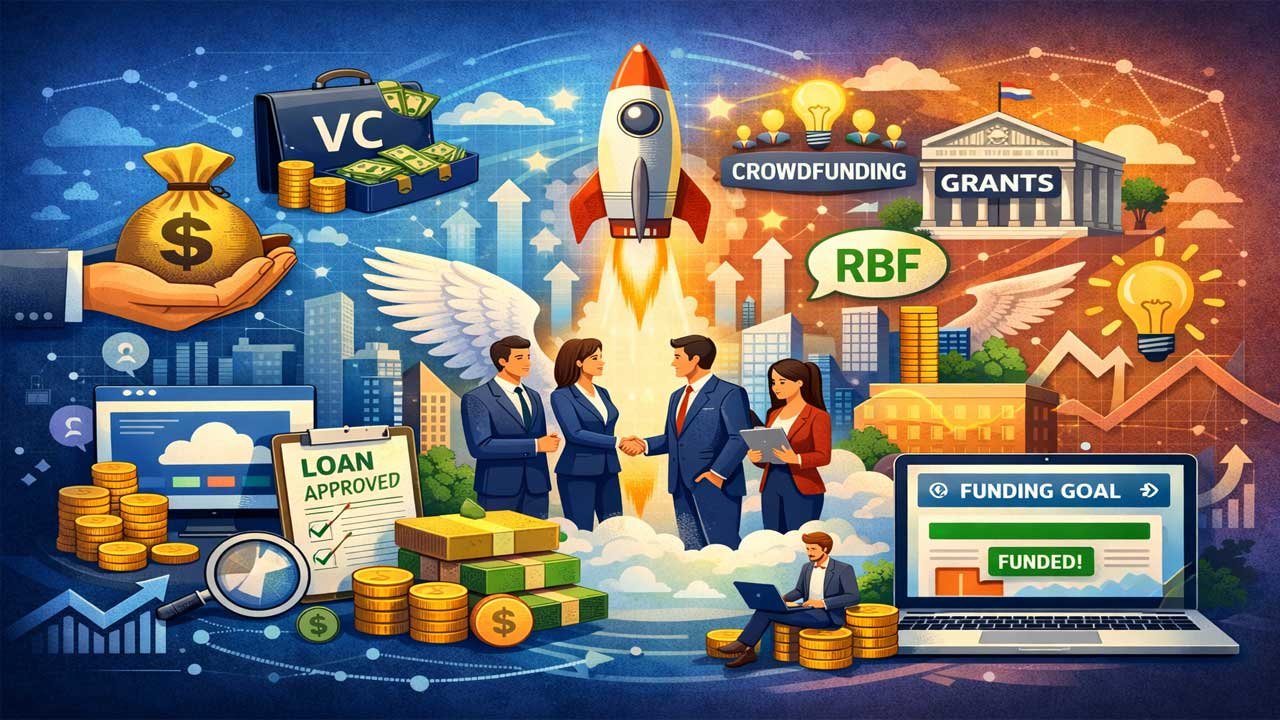






In 2026, launching or scaling a tech startup requires smart, stage-appropriate funding. This guide explores the best small business loans and startup financing options for tech ventures — from term loans and lines of credit to revenue-based financing, angel investors, and government grants.
Each option serves a unique purpose based on your startup’s maturity, revenue, and growth goals. Founders should balance equity and debt, maintain clean financials, and present a clear pitch highlighting traction and recurring revenue. The right mix of funding platforms, grants, and flexible capital can accelerate growth without sacrificing control or equity.
| Aspect | Details |
|---|---|
| Focus Year | 2026 |
| Main Topic | Small business loans and startup funding for tech ventures |
| Target Audience | Tech founders, SaaS startups, and digital entrepreneurs |
| Funding Types Covered | Term loans, lines of credit, revenue-based financing, crowdfunding, angel & VC funding, grants |
| Ideal For | SaaS, IT services, AI, and high-growth tech startups |
| Key Benefits | Access capital without heavy dilution, flexible repayment, faster growth |
| Funding Platforms | Startup funding marketplaces, angel networks, VC portals |
| Government Support | Grants, startup schemes, and innovation funding programs |
| Best Options by Stage | Early: grants & incubators; Growth: RBF & term loans; Scale: VC & venture debt |
| Success Factors | Clean financials, recurring revenue, traction metrics, and solid pitch deck |
| Common Mistakes | Wrong loan type, ignoring cost of capital, poor documentation |
| Goal | Help founders choose the right funding mix to grow while keeping control |
Best Small Business Loans and Startup Funding Platforms for Tech Ventures in 2026
Launching or scaling a tech startup in 2026 needs smart funding.
This guide explains the best small business loans and startup funding platforms for tech ventures. The focus is on easy language, high-intent keywords, and clear next steps.
Why Funding Matters for Tech Startups in 2026
Tech businesses grow fast but need capital.
You may need money for:
- Product development
- Cloud and SaaS tools
- Hiring developers and marketers
- Patents and legal work
- Scaling servers and infrastructure
Choosing the right funding source saves time, money, and equity.
The wrong choice can slow growth or dilute your ownership.
Types of Small Business Funding for Tech Ventures
There is no single “best” funding option.
It depends on your stage, revenue, and risk tolerance.
Main funding types for tech startups in 2026:
- Small business term loans
- Business lines of credit
- Revenue-based financing
- Startup funding platforms and marketplaces
- Angel investors and VC platforms
- Government grants and startup schemes
- Crowdfunding and equity crowdfunding
Each has pros, cons, and ideal use cases.
1. Small Business Term Loans for Tech Startups
Term loans are classic small business loans.
You borrow a fixed amount and repay over a fixed period with interest.
When term loans are a good fit
- You have some revenue and financial history
- You run an established SaaS or IT service business
- You want predictable monthly payments
- You do not want to give away equity
Pros
- Fixed interest rates and payment schedule
- Suitable for equipment, hiring, or expansion
- Builds business credit
- Often cheaper than credit cards
Cons
- Tough for pre-revenue startups
- Requires documents and underwriting
- May need collateral or personal guarantee
Tips to improve approval chances
- Maintain clean bank statements
- Separate business and personal accounts
- Prepare a simple pitch deck and plan
- Show recurring revenue or contracts if you run a SaaS startup
Use this for: scaling a working tech product, hiring team members, or upgrading infrastructure.
2. Business Line of Credit for Tech Ventures
A business line of credit is flexible funding.
You get a maximum limit and pay interest only on the amount used.
Best for
- Managing cash flow
- Covering short-term gaps
- Handling delayed client payments
- Paying vendors and subscriptions
Pros
- Use only when needed
- Faster approval than big term loans
- Revolving credit for ongoing needs
Cons
- Rates can be higher than standard loans
- Limits may be low for very early startups
This suits agencies, IT services, and SaaS companies with variable cash flow.
3. Revenue-Based Financing for SaaS and Tech Startups
Revenue-based financing (RBF) is a popular option for tech ventures.
You get capital now and repay as a fixed percentage of monthly revenue.
Why tech founders like RBF
- No equity dilution
- No fixed EMI
- Payments match your revenue
- Fast underwriting for recurring revenue businesses
Ideal for
- SaaS businesses with MRR or ARR
- Subscription apps and platforms
- Online products with predictable cash flow
Pros
- Founder-friendly, no board control
- Suits bootstrapped startups
- Can stack with other funding sources
Cons
- Not ideal for pre-revenue ideas
- Effective cost can be high if growth is slow
Use this if your SaaS startup has stable recurring revenue but you want to keep full control.
4. Startup Funding Platforms & Marketplaces (2026)
Startup funding platforms connect founders with lenders, investors, or backers.
They help tech startups compare multiple options in one place.
What these platforms usually offer
- Small business loans
- Revenue-based financing
- Angel and VC access
- Crowdfunding and equity crowdfunding
- Grants and alternative finance
Key benefits
- Faster matching with relevant funding
- Single application usable with many partners
- Better chance to find niche options for tech ventures
How to use these platforms effectively
- Prepare a short pitch deck
- Keep updated financials and projections
- Showcase clear traction: users, MRR, growth
- Highlight your unique value and tech edge
Search for “startup funding platforms for tech founders” or “marketplace for SaaS funding” to find updated options in your region.
5. Angel Investors & VC Funding Platforms for Tech Startups
For high-growth tech ventures, equity funding can be powerful.
Angel investors and venture capital (VC) back startups with great potential.
When to seek angel or VC funding
- You target a large market
- You can scale globally
- You need significant capital for growth
- You are ready to give up some equity
Pros
- Large funding rounds
- Strategic guidance and network
- Strong signal to market and future investors
Cons
- Loss of full control and ownership
- Pressure for fast growth and exit
- Detailed due diligence and long process
Platforms and communities to explore
- Online angel networks
- Early-stage VC matching platforms
- Demo day and accelerator portals
- Startup pitch communities
Focus on clear metrics: growth rate, retention, LTV, CAC, and unit economics.
Investors care about scale, not just ideas.
6. Government Grants & Startup Schemes (2026)
Many governments support tech innovation and small businesses.
These schemes can offer grants, subsidies, or low-interest loans.
Why grants are powerful
- Non-dilutive funding
- May include mentorship and incubation
- Great for deep tech, AI, cybersecurity, or R&D projects
Typical requirements
- Detailed project proposal
- Clear innovation or social impact
- Compliance with local rules and taxes
Search for terms like:
- “tech startup scheme 2026 + your country”
- “innovation grant for AI startups”
- “government funding for SaaS business”
Grants take time but can reduce your funding risk.
7. Crowdfunding & Equity Crowdfunding for Tech Ventures
Crowdfunding lets you raise money from many backers online.
You can use it for early product validation and marketing.
Main types
- Reward-based crowdfunding
- Equity crowdfunding
When it works well
- You have a compelling product idea
- You can explain your solution to non-technical users
- You are willing to invest time in marketing your campaign
Pros
- Great for product pre-orders
- Builds early community and buzz
- Can attract media and investor interest
Cons
- Heavy effort on campaigns and storytelling
- Not all campaigns hit funding targets
- Fulfilment risk if you make physical products
This option suits consumer-facing tech products, gadgets, and apps.
Best Funding Option by Stage of Tech Startup
| Stage of Startup | Best Funding Types | Key Focus |
|---|---|---|
| Idea / Pre-MVP | Grants, friends & family, small crowdfunding | Build prototype and validate idea |
| Early MVP / First Users | Startup platforms, small loans, incubator programs | Product-market fit |
| Growing SaaS / MRR | Revenue-based finance, lines of credit, term loans | Scale and optimize unit economics |
| High-Growth Tech | Angel funding, VC platforms, large RBF or venture debt | Global expansion and hiring |
How to Choose the Best Small Business Loan for Your Tech Venture
Use a simple framework to decide.
1. Check your stage and revenue
- Pre-revenue: focus on grants, incubators, small personal funds
- Early revenue: consider startup lending and platforms
- Strong MRR: explore RBF, term loans, and lines of credit
2. Decide on equity vs. debt
- Want to keep control: debt, grants, RBF
- Comfortable with dilution: angels and VCs
3. Compare true cost and flexibility
- Look at APR or total cost of capital
- Check repayment flexibility for slow months
- Avoid products that will crush cash flow
4. Prepare strong documentation
- Clean financials (even simple spreadsheets)
- Clear product story and unique edge
- Evidence of traction: users, reviews, growth charts
A solid pitch increases your approval chances across all platforms.
Key Factors Lenders and Platforms Look At in 2026
To get the best small business loan or funding in 2026, focus on:
- Credit profile (business and sometimes personal)
- Monthly revenue and bank statement health
- Recurring revenue for SaaS and subscription models
- Churn rate and retention
- Unit economics and path to profitability
- Industry risk and competition
Even if you are a new startup, clean records and clear metrics help.
How Tech Startups Can Attract Funding Online
You can also use content and SEO to attract investors and lenders.
Simple steps:
- Build a clean, fast website with a “Startup Funding” or “Investor Relations” section
- Publish case studies, growth metrics, and tech explainers
- Use keywords like “fast-growing SaaS startup”, “AI-powered platform”, and “B2B tech solution”
- Show clear CTAs for investors and partners
This builds credibility when lenders or investors research your brand online.
Common Mistakes Tech Founders Make When Seeking Funding
Avoid these errors:
- Applying for the wrong type of loan for your stage
- Ignoring the cost of capital and just chasing “fast approval”
- Mixing business and personal expenses
- Not tracking metrics like MRR, churn, and CAC
- Taking money from misaligned investors
Think long term.
Smart capital is more important than fast capital.
Action Plan: How to Secure Funding for Your Tech Startup in 2026
Follow this simple, step-by-step plan:
- Define your funding goal and timeline
- Map your current stage: idea, MVP, revenue, or scale
- Choose 2–3 main funding paths (for example: RBF + startup platform + grant)
- Prepare a short deck, basic financials, and product demo
- Apply through startup funding platforms and trusted lenders
- Speak with at least a few investors or lenders before deciding
- Compare cost, control, and risk before signing anything
Conclusion: The Best Funding Strategy for Tech Ventures in 2026
The best small business loans and startup funding platforms for tech ventures in 2026 are those that match your stage, revenue, and growth plans.
Use term loans and lines of credit for stable, growing tech businesses.
Use revenue-based financing for SaaS and subscription startups.
Use funding platforms, angel investors, VCs, and grants if you are building a high-growth tech venture.
Mix these wisely to scale faster while protecting your equity and control.
FAQs
What are the best funding options for tech startups in 2026?
The best options include small business term loans, lines of credit, revenue-based financing, startup funding platforms, angel investors, VC funding, government grants, and crowdfunding.
Why do tech startups need funding in 2026?
Tech startups need capital for product development, hiring, infrastructure, cloud tools, and scaling operations in competitive markets.
Which funding option is best for early-stage tech startups?
Early-stage startups should focus on grants, incubator programs, crowdfunding, and startup funding platforms to validate their ideas.
What is a small business term loan?
It’s a fixed loan repaid over a set period with interest, ideal for startups with steady revenue that don’t want to give away equity.
When should a tech startup choose a term loan?
When it has recurring revenue, a clear business plan, and wants predictable monthly payments without losing ownership.
What is a business line of credit?
It’s a flexible funding source where startups can borrow up to a set limit and pay interest only on the used amount.
When is a business line of credit useful for tech ventures?
It’s best for managing cash flow gaps, delayed payments, or covering short-term expenses like tools and vendor bills.
What is revenue-based financing (RBF)?
RBF allows startups to raise money now and repay as a percentage of monthly revenue instead of fixed EMIs.
Why is RBF popular among SaaS startups?
It offers flexibility, no equity dilution, and payments that adjust based on revenue, making it ideal for subscription-based businesses.
Can pre-revenue startups apply for revenue-based financing?
No, RBF works best for startups with steady monthly or annual recurring revenue (MRR/ARR).
What are startup funding platforms?
These are online marketplaces connecting founders with lenders, investors, and funding options across loans, grants, and equity financing.
How do startup funding platforms help tech founders?
They save time by offering multiple funding options in one place and improving matching based on the startup’s profile and traction.
What should founders prepare before applying on funding platforms?
A short pitch deck, financial statements, traction data, and a clear value proposition.
What are angel investors and VC funding?
Angel investors and venture capitalists provide equity funding to startups with high growth potential in exchange for ownership shares.
When should startups approach angel or VC investors?
When they’re scaling fast, targeting large markets, and ready to exchange equity for significant growth capital.
What are the pros of VC funding?
Large capital access, strategic mentorship, and strong industry networks.
What are the cons of VC funding?
Loss of control, pressure for rapid scaling, and long due diligence processes.
What are government grants and startup schemes?
These are non-dilutive funding programs offering financial aid, mentorship, or incubation support for innovation-driven startups.
Why are government grants beneficial for tech startups?
They don’t require equity, reduce risk, and often come with training, mentoring, or infrastructure support.
How can startups find relevant government grants in 2026?
Search online for “tech startup grants 2026” or “innovation schemes” specific to your country or region.
What is crowdfunding for tech startups?
It’s a way to raise capital from many individual backers online, often in exchange for early access, rewards, or equity.
When does crowdfunding work best?
When the startup has a compelling, easy-to-explain product and a strong marketing plan to attract backers.
What is equity crowdfunding?
It allows backers to invest in exchange for ownership shares, combining community funding with real equity participation.
What are the advantages of crowdfunding?
It validates product-market fit, builds early buzz, and can attract future investors or media attention.
What are the common challenges in crowdfunding?
Reaching the funding goal, managing campaign marketing, and fulfilling product promises post-campaign.
How do I decide between equity and debt funding?
If you want to retain control, choose debt or RBF. If you’re okay with dilution for larger capital, consider angels or VCs.
What factors affect loan approval for tech startups?
Credit score, business financials, recurring revenue, cash flow stability, and bank statement history.
How can SaaS startups increase their funding chances?
Show recurring revenue, customer retention, low churn, and a clear path to profitability.
What documentation do lenders usually ask for?
Business bank statements, income proof, tax filings, a simple business plan, and financial projections.
Can a pre-revenue startup still get funding?
Yes, through grants, incubators, friends and family funding, or small crowdfunding campaigns.
How do I compare funding options effectively?
Evaluate based on interest rate, repayment flexibility, equity dilution, and total cost of capital.
What are the biggest funding mistakes tech founders make?
Choosing the wrong funding type, ignoring the true cost, mixing personal and business expenses, and not tracking metrics.
How can I attract investors online?
Build a professional website, share performance metrics, publish case studies, and use SEO keywords related to growth and innovation.
What are key metrics investors look for in tech startups?
MRR, ARR, churn rate, customer acquisition cost (CAC), lifetime value (LTV), and growth rate.
Which funding types suit bootstrapped startups?
Revenue-based financing, business lines of credit, and government grants are ideal for founders wanting to retain control.
How can startups combine different funding types?
Mix grants, RBF, and term loans for balanced growth while keeping equity intact.
What is venture debt?
It’s a loan offered to VC-backed startups, allowing them to extend their runway without further equity dilution.
Why should startups care about the cost of capital?
High interest or equity loss can hurt long-term profitability and limit future funding flexibility.
How long does it take to secure startup funding?
Depending on type, it can range from a few days for online loans to several months for VC or grant approvals.
What’s the best funding mix for a SaaS startup in 2026?
Use revenue-based financing for growth, a business line of credit for cash flow, and consider grants for innovation projects.
What makes a strong startup pitch deck for funding?
Highlight traction, revenue, market potential, team strength, product differentiation, and financial forecasts.
How can I avoid losing equity early?
Use loans, RBF, and grants until your valuation increases, then seek equity investors on better terms.
What’s the role of startup accelerators in funding?
They provide mentorship, initial capital, and access to investor networks in exchange for small equity stakes.
Can startups get multiple funding rounds from different sources?
Yes, combining debt, equity, and grant funding is common as startups progress through different growth stages.
What’s the final takeaway for tech founders seeking funding in 2026?
Choose smart, stage-based funding that aligns with your growth goals. Prioritize flexibility, cost efficiency, and long-term control over your venture.












Leave a Reply
You must be logged in to post a comment.