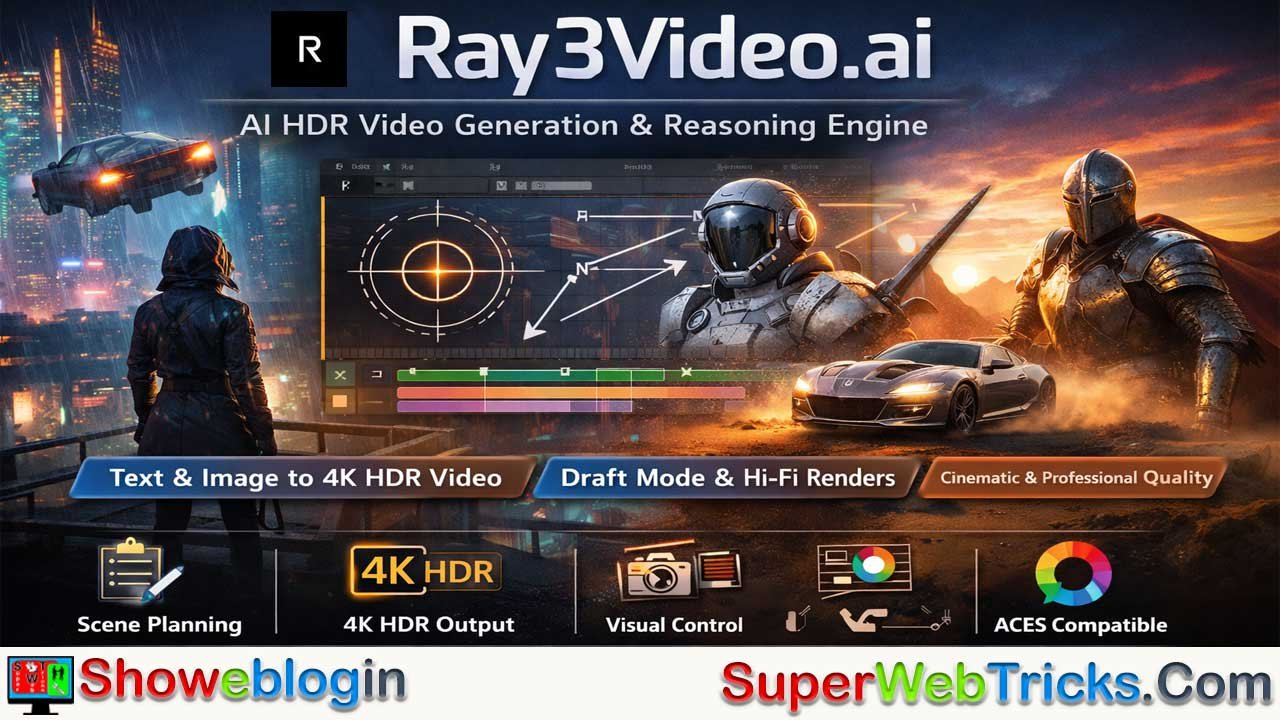





Ray3Video.ai is a professional-grade AI video generation platform powered by the reasoning-driven Ray3 model, designed to turn text, images, or clips into short, cinematic HDR videos with greater control and consistency than typical prompt-only tools.
It combines advanced scene planning, physics awareness, and self-evaluation with a native 10–16-bit HDR pipeline that supports 4K output and EXR export for ACES-compatible color grading and VFX workflows. Built for filmmakers, marketers, and creative teams, it offers text-to-video, image-to-video, video-to-video, visual annotations for director-style control, and a two-stage workflow with fast Draft Mode for ideation and Hi-Fi mode for final renders.
With integrations into platforms like Adobe Firefly and Luma Dream Machine, Ray3 fits into professional production pipelines, excelling in pre-visualization, advertising, concept design, and short cinematic sequences, though it currently focuses on shorter clips and can require significant compute for high-end HDR outputs.
| Category | Details |
|---|---|
| Product Name | Ray3Video.ai |
| Type | AI Video Generation Platform |
| Core Model | Ray3 (Reasoning-driven video model) |
| Input Types | Text-to-video, Image-to-video, Video-to-video |
| Output Quality | Up to 4K HDR (10–16-bit) |
| Export Formats | Standard video files, 16-bit EXR sequences |
| Key Feature | Reasoning engine for scene planning & motion consistency |
| Workflow Modes | Draft Mode (fast previews), Hi-Fi Mode (final HDR render) |
| Visual Control | Frame annotations, camera path sketching |
| Integrations | Adobe Firefly, ACES workflows, Luma Dream Machine |
| Best For | Filmmakers, marketers, pre-viz, concept design |
| Clip Length | Short clips (approx. up to 10 seconds) |
| Pricing | Free tier + paid professional plans (varies by platform) |
Ray3Video.ai – AI Video Generator with 4K HDR, EXR Export & Reasoning Engine
Ray3Video.ai is an advanced AI video generation platform that turns text descriptions, images, or video clips into short, cinematic HDR videos using a reasoning‑driven model called Ray3. It targets filmmakers, storytellers, marketers, and creators who want studio‑grade visuals, faster concepting, and more control than typical “prompt‑only” video tools.
What Ray3Video.ai actually is
Ray3 is described as a “reasoning video model” that can understand intent, plan sequences, and critique its own outputs instead of just converting text into frames. The system combines this reasoning layer with a native high‑dynamic‑range (HDR) pipeline so it can generate 10–16‑bit video suitable for professional color‑grading and post‑production.
Unlike many consumer‑oriented AI video generators, Ray3 is explicitly aimed at professional workflows: storyboards and pre‑viz, concept tests, marketing spots, and cinematic sequences that may later be refined in tools like Adobe Premiere or other ACES‑compatible pipelines.
Core capabilities at a glance
From official product and partner pages, Ray3 Video AI emphasizes several standout capabilities:
- Native HDR video generation (10, 12, and 16‑bit) with EXR export for studio pipelines.
- Reasoning‑driven generation that can “think,” interpret nuanced prompts, and self‑evaluate drafts.
- Text‑to‑video and image‑to‑video workflows, including keyframes and video‑to‑video modifications.
- Draft Mode for fast, low‑cost previews and Hi‑Fi mode for final 4K HDR renders.
- Visual annotation tools, letting you draw or mark up frames to control layout, motion, and character behavior without heavy prompt engineering.
- Advanced physics, motion realism, and character consistency across frames and scenes.
- Integrations and compatibility with creative tools, including Adobe Firefly/Creative Cloud and ACES‑based color workflows.
How Ray3Video.ai works in practice
At a high level, Ray3’s workflow looks like this:
- Input
You provide a natural‑language prompt (“a cyberpunk city with flying cars in the rain”), upload reference images/video, or both. You can optionally add visual annotations (sketching camera paths, character positions, or motion arrows) directly on images. - Draft Mode (fast exploration)
The model generates quick draft videos several times faster than full‑quality renders, so you can explore multiple concepts, refine prompts, and adjust annotations cheaply. - Reasoning and iteration
Ray3’s reasoning layer interprets your intent, evaluates early drafts, and iterates to improve motion, composition, and adherence to instructions. - Hi‑Fi / HDR render
When you’re satisfied with direction, you switch to high‑fidelity mode to produce a final HDR clip, with options like 4K resolution and 16‑bit EXR frame export for grading and compositing. - Export & integration
The resulting video can be downloaded as standard video files or as HDR/EXR sequences that slot into Adobe or ACES‑compatible production pipelines.
For AI tool users, this means Ray3 behaves more like a “creative collaborator” that you guide with prompts, scribbles, and iterations rather than a one‑shot prompt‑in/prompt‑out generator.
Advanced reasoning engine
A key differentiator is Ray3’s reasoning layer, which goes beyond standard diffusion‑based video generation:
- It can interpret complex, multi‑step prompts and maintain logical progression across frames (e.g., a character walking, then turning, then reacting).
- The model “thinks” in both language and visual tokens, allowing it to plan scenes and evaluate its own drafts for quality before finalizing a result.
- This reasoning extends to physics and spatial logic, so objects tend to move consistently and respect gravity, collisions, and basic real‑world behavior.
External reviewers who tested Ray3 highlight stronger instruction following, better physics, and improved consistency compared to earlier models, while also noting that complex prompts can still produce occasional reasoning errors or awkward scenes.
HDR pipeline and image quality
Ray3’s visual pipeline is explicitly built around native HDR:
- It generates videos in high bit‑depth formats (10, 12, or 16‑bit) to preserve detail in shadows and highlights.
- Creators can export sequences as 16‑bit EXR frames aligned with ACES color management, making them suitable for serious grading, VFX, and finishing.
- There is support for converting standard‑dynamic‑range (SDR) content into HDR, upgrading existing clips or lower‑end generations.
- Real‑world demos emphasize cinematic contrast, accurate specular highlights, and color nuance, which are crucial for advertising, film, and high‑end social content.
If you’re used to purely web‑only AI tools that output compressed SDR MP4s, this HDR/EXR pipeline is a major step up for professional workflows.
Visual annotation and control
Ray3 supports a more “director‑like” workflow via visual annotations:
- You can draw or scribble on images to indicate character blocking, camera movement, object paths, or compositional changes.
- The reasoning engine interprets these marks as instructions, giving you fine control without writing extremely detailed prompts.
- This is especially useful for pre‑visualization, motion design, product shots, and any scene where timing, framing, and path‑of‑action matter.
This means you can combine textual directions (“orbit around the character”) with quick sketches and let the model reconcile both into a coherent result.
Draft Mode vs Hi‑Fi output
Ray3’s workflow is explicitly split into Draft Mode and high‑fidelity output:
- Draft Mode
- Up to 5× faster than full‑quality renders, optimized for exploration and ideation.
- Lower cost, so you can test many prompts, camera moves, or compositions before committing.
- Ideal for collaborative sessions where you want rapid feedback and iteration.
- Hi‑Fi / Pro Mode
- 4K HDR options and higher bit‑depth outputs, suitable for final delivery or serious post‑production.
- Tied into the HDR neural pipeline and EXR export for professional color grading and compositing.
This separation aligns well with the way agencies and studios already work: rough pre‑viz first, then polished renders once creative direction is locked.
Integrations and workflow compatibility
Ray3 is designed to fit into existing creative stacks rather than replace them:
- Adobe ecosystem: Adobe announced Ray3 as integrated into Adobe Firefly, allowing creators to generate Ray3 videos directly within Adobe’s environment.
- Other creative tools: Documentation and marketing stress compatibility with Adobe workflows, ACES color pipelines, and standard NLEs and compositing tools.
- Third‑party platforms: Ray3 powers or integrates with platforms like Luma AI’s Dream Machine, which exposes Ray3 features (drafting, HDR, annotations) through its own interface.
- API access: Some Ray3‑branded sites mention APIs to embed Ray3 video generation into your own apps and creative tools, targeting SaaS builders and enterprise users.
For advanced AI tool users, this means you can think of Ray3 as both a standalone creative surface and an engine you can wire into larger workflows or products.
Typical use cases
Based on official descriptions and integrations, Ray3 Video AI is positioned for several main categories of work:
- Film and TV pre‑visualization
Quickly block out complex scenes, camera moves, and lighting ideas before investing in full 3D or live‑action shoots. - Advertising and brand content
Generate product shots, cinematic promos, and social ads with high‑end lighting and motion, then refine them in your usual editing/grading tools. - Game, VFX, and concept design
Produce moving concept art, test environment ideas, or show motion and interaction concepts for pitches and internal reviews. - Content creators & influencers
Create eye‑catching intros, loops, and story snippets optimized for platforms like YouTube, TikTok, and Instagram. - Education & explainers
Turn scripted lessons or scripts into visual stories, especially when you need abstract visuals or controlled environments. - Corporate and product demos
Generate polished walkthroughs and hero sequences for hardware, software products, or services with strong visual narratives.
Because Ray3’s reasoning emphasizes narrative coherence and physics, it is particularly strong wherever motion logic and story flow are more critical than perfect photorealism in every frame.
Plans and pricing structure
At the time of available documentation, Ray3’s official pricing pages emphasize tiers rather than fixed public price points:
- Starter
- Daily free credits.
- 1080p HDR video generation.
- Access to core text‑to‑video features and community resources.
- Professional / Creator‑oriented tier
- 4K HDR generation.
- Image‑to‑video and advanced features like Draft Mode.
- Commercial license and priority support for business use.
Some partner platforms (e.g., Dream Machine) gate Ray3 access behind their own subscriptions, so effective pricing can depend on where you’re using the model. Always check the active pricing on the Ray3Video or host platform site, as credits, limits, and tiers can change.
Strengths and current limitations
Where Ray3 stands out
- Production‑grade HDR: Native 10–16‑bit HDR and EXR export are still rare in AI video tools and make Ray3 unusually suitable for pro color and VFX work.
- Reasoning and consistency: Strong performance on physics, character consistency, and complex motion compared with earlier generation models like Ray2.
- Creative control: Visual annotation plus Draft Mode provide a fast loop for art directors and technical artists to “steer” results rather than roll the dice on prompts.
- Ecosystem fit: Integrations with Adobe Firefly and Luma Dream Machine, plus ACES workflows, reduce friction for existing pro teams.
Constraints and caveats
- Clip length: Official partners note that Ray3 currently focuses on short clips (up to around 10 seconds) rather than full‑length sequences, which may require stitching and editing for longer narratives.
- Computation and cost: High‑fidelity HDR output is compute‑intensive; Draft Mode helps, but large projects can still consume significant credits or budget.
- Reasoning isn’t perfect: Independent reviewers point out that complex, abstract prompts can still produce odd motion, compositional artifacts, or misinterpretations, especially on first drafts.
- Evolving UX: Because Ray3 appears across multiple front‑ends (Ray3 sites, Dream Machine, Adobe), the exact interface and controls can vary, and features may roll out at different times on each.
Getting started with Ray3Video.ai
Tool directories and product pages outline a fairly standard onboarding flow for Ray3 Video AI:
- Access the platform
Go to the Ray3 Video AI site (Ray3Video.ai or its associated Ray3 video portals) or a host platform like Luma Dream Machine that offers Ray3 access. - Create an account / choose a plan
Sign up, then either stay on a free/daily‑credit tier or pick a paid plan if you need 4K HDR, commercial rights, or higher limits. - Start with text‑to‑video
Begin by entering a clear, concise prompt and using default settings; rely on Draft Mode to generate multiple options quickly. - Add references and annotations
Upload reference images or clips, then use annotation tools to sketch camera moves, positions, or motion hints directly on frames. - Iterate in Draft Mode
Review drafts, refine prompts, adjust annotations, and experiment with different seeds or camera styles while costs and generation times are low. - Render final HDR output
Once you lock creative direction, switch to high‑fidelity/HDR settings and export your video or EXR frame sequence for editing and grading. - Integrate into your pipeline
Bring the outputs into editing, compositing, or delivery tools—Adobe Premiere/After Effects, DaVinci Resolve, or other ACES‑capable systems—for finishing.
Practical tips for AI tool power users
Building on Ray3’s documented capabilities, here are concrete ways to get better results:
- Design prompts as shot descriptions
Treat prompts like a director’s shot note: subject, action, environment, camera, and mood (e.g., “Handheld close‑up of a tired runner at sunrise, shallow depth of field, warm light”). This leverages Ray3’s strength in understanding intent and motion. - Use Draft Mode aggressively
Reserve high‑fidelity renders for ideas that already work in Draft Mode; use fast drafts to iterate framing, pacing, and blocking. - Lean on annotations for precision
When prompts alone aren’t giving you the camera path or composition you want, sketch arcs, arrows, and positions; Ray3 is specifically built to interpret these. - Plan for stitching and editing
Because clips are short, think in “beats” or shots, then stitch sequences in your NLE; use Ray3 for each beat rather than an entire story in one generation. - Exploit HDR and EXR when quality matters
For anything client‑facing or cinematic, export EXR/16‑bit HDR and do proper grading instead of relying on default SDR exports. - Prototype interaction and physics‑heavy scenes
Where physics and motion logic are critical—crowds, vehicles, dynamic camera moves—Ray3’s reasoning and physics engine give a clearer sense of feasibility before committing to full production.
If you’re already comfortable with other AI tools (image generators, chat models, or simpler video AIs), Ray3Video.ai essentially offers a higher‑end option: more control, better HDR quality, and deeper reasoning, at the cost of slightly more setup and a workflow that mirrors real film and post‑production pipelines.
FAQs about Ray3Video.ai
What is Ray3Video.ai?
Ray3Video.ai is an AI-powered video generation platform that creates short cinematic HDR videos from text prompts, images, or video clips using a reasoning-driven model called Ray3.
How is Ray3 different from other AI video generators?
Unlike basic prompt-to-video tools, Ray3 uses a reasoning engine to understand intent, plan scenes, maintain motion consistency, and improve physics realism across frames.
Does Ray3Video.ai support HDR and professional formats?
Yes, it supports native 10–16-bit HDR video generation and allows export as 16-bit EXR sequences compatible with ACES color workflows and professional grading pipelines.
What is Draft Mode in Ray3?
Draft Mode is a faster, lower-cost rendering option designed for rapid concept testing and iteration before generating a final high-quality HDR output.
Can I control camera movement and composition?
Yes, Ray3 includes visual annotation tools that let you draw camera paths, mark character positions, and guide motion directly on frames for more precise control.
What types of input does Ray3 support?
Ray3 supports text-to-video, image-to-video, and video-to-video workflows, allowing users to generate or modify clips using prompts and references.
How long are the videos Ray3 can generate?
Ray3 currently focuses on short clips, typically up to around 10 seconds, which can be stitched together in editing software for longer sequences.
Who is Ray3Video.ai best suited for?
It is designed for filmmakers, marketers, creative agencies, concept artists, and content creators who need high-quality cinematic visuals and professional post-production compatibility.
Does Ray3 integrate with other creative tools?
Yes, it integrates with platforms such as Adobe Firefly and supports workflows compatible with Adobe Premiere, After Effects, and ACES-based color pipelines.
Is there a free version of Ray3Video.ai?
Ray3 offers access through free or trial tiers with limited credits, while advanced features like 4K HDR and commercial rights are typically available on paid plans.






Leave a Reply
You must be logged in to post a comment.