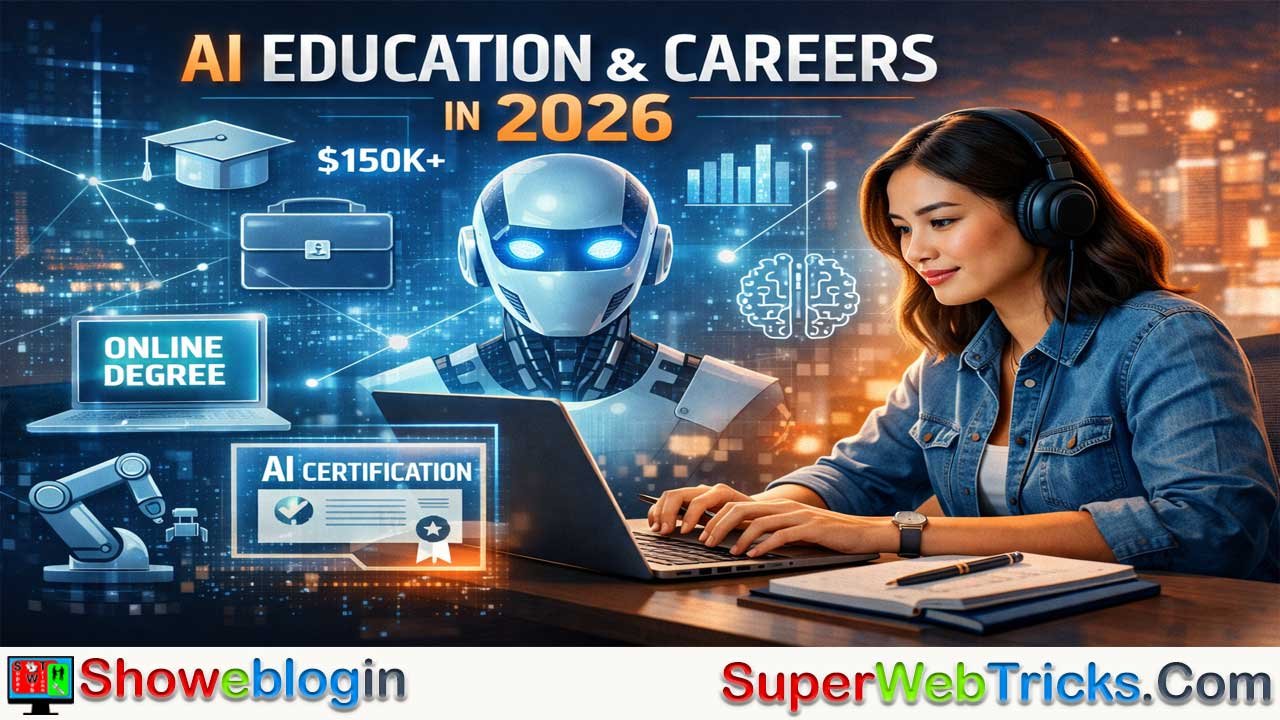






AI education is critical for career success in 2026 as artificial intelligence reshapes every major industry and drives soaring demand for skilled professionals, with salaries and advancement opportunities significantly outpacing traditional roles.
Online AI degrees and certifications make this training accessible and flexible, allowing learners to gain in-demand skills in machine learning, data science, and generative AI without pausing their careers. Top universities like Stanford and Georgia Tech offer rigorous, affordable online master’s programs, while certifications from companies such as Google, IBM, Microsoft, and AWS provide faster, practical skill validation.
Degrees deliver deep theoretical foundations and long-term career leverage, while certifications enable rapid upskilling and specialization. Choosing the right path depends on career goals, background, budget, and time, but investing in AI education consistently yields strong returns through higher pay, faster promotions, and long-term relevance in an AI-driven economy.
| Category | Information |
|---|---|
| Why AI Matters (2026) | AI skills are essential across all industries; AI job postings up 74% YoY; AI roles command premium salaries |
| Salary Potential | Entry-level AI roles: ~$95K; AI engineers avg: ~$153K; Senior roles: $180K–$250K |
| Top Institutes for Online AI Degrees | Stanford, Georgia Tech, UIUC, Columbia, Duke, Johns Hopkins, UT Austin, Texas A&M, ASU, Purdue |
| Degree Cost & Duration | $9,000–$25,000 total; typically 2–3 years |
| Best For (Degrees) | Career transformation, leadership roles, research, long-term growth |
| Top AI Certifications | Google AI Essentials, Azure AI Fundamentals, IBM AI Engineering, AWS AI Practitioner, Google ML Engineer, PMI-CPMAI |
| Certification Cost & Time | Free–$800; 10–100+ hours; days to months |
| Best For (Certifications) | Fast upskilling, practical skills, budget/time constraints |
| Degrees vs Certifications | Degrees = depth & prestige; Certifications = speed & flexibility |
| Industries Hiring | Tech, healthcare, finance, retail, manufacturing, automotive |
| Work Trends | Strong demand for remote AI roles |
| Career Impact | AI credentials enable faster promotions, higher pay, and leadership eligibility |
| Best Choice Depends On | Career goals, technical background, budget, time availability |
AI skills drive career success in 2026. Companies pay premium salaries for AI talent. Online education makes AI training accessible to everyone. This guide covers the best online AI degrees and certifications for career advancement.
Why AI Education Matters in 2026
AI transforms every industry. Healthcare uses AI for diagnosis. Finance uses AI for fraud detection. Retail uses AI for personalization. Manufacturing uses AI for quality control. The demand for AI professionals grows exponentially.
LinkedIn reports AI job postings increased 74% year-over-year. Glassdoor shows AI engineer salaries averaging $153,000 annually. Career advancement requires proven AI credentials. Employers value degrees from accredited online programs. Certifications demonstrate practical skills.
AI literacy becomes mandatory in 2026. Schools integrate AI into curricula. Businesses require AI competency. Professionals must upskill to remain competitive. Online learning offers flexible pathways to acquire these skills without career interruption.
Best Online Artificial Intelligence Degrees 2026
Top universities now offer fully online AI degrees. These programs provide comprehensive technical foundations. Students learn machine learning, deep learning, natural language processing, and computer vision.
The following table ranks the best online AI master’s programs for 2026 based on curriculum quality, faculty expertise, career outcomes, and affordability.
| Rank | University | Program | Tuition | Duration | Best For |
|---|---|---|---|---|---|
| 1 | Stanford University | Online MSCS – AI Specialization | $18,000-$22,000 | 2-3 years | Technical depth, research focus |
| 2 | Georgia Tech | Online MSCS – ML Specializations | $10,000-$12,000 | 2-3 years | Affordability, rigorous academics |
| 3 | UIUC | Online MCS – AI Track | $12,000-$15,000 | 2-3 years | Computer science foundation |
| 4 | Columbia University | Online MSCS – AI Focus | $21,000-$25,000 | 2-3 years | Ivy League credential |
| 5 | Duke University | Online MEng AI for Product Innovation | $20,000-$24,000 | 2 years | Product management focus |
| 6 | Johns Hopkins University | Online MSAI | $18,000-$22,000 | 2-3 years | Applied research, government work |
| 7 | UT Austin | Online MSAI | $10,000-$13,000 | 2-3 years | Value, edX partnership |
| 8 | Texas A&M University | Online MSAI | $11,000-$14,000 | 2 years | Technical grounding |
| 9 | Arizona State University | Online MS-AIB | $13,000-$16,000 | 2 years | Business applications |
| 10 | Purdue University | Online MSAI | $9,000-$12,000 | 2-5 years | Flexibility, multiple majors |
Stanford ranks #1 for its comprehensive AI curriculum. The program covers robotics, deep learning, and NLP. Students learn from AI pioneers like Andrew Ng. Georgia Tech offers similar quality at half the cost. Their OMSCS program revolutionized online computer science education.
UIUC joins the top tier in 2026. Their online MCS program emphasizes AI engineering. Columbia provides Ivy League credentials with strong technical content. Duke focuses on product innovation. This appeals to entrepreneurs and product managers.
Johns Hopkins leverages its Applied Physics Laboratory. Students gain practical AI engineering experience. UT Austin partners with edX. This provides affordable access to quality education. Texas A&M offers thorough technical training. ASU uniquely combines AI with business applications. Purdue provides maximum flexibility for working professionals.
Best AI Certifications 2026
Certifications offer faster, focused AI skill development. They cost less than degrees. Professionals earn certifications in weeks or months. Employers value certifications from major tech companies.
The following table compares the leading AI certifications for 2026.
| Certification | Provider | Cost | Time | Level | Career Impact |
|---|---|---|---|---|---|
| Google AI Essentials | Google/Coursera | $49/month | Under 10 hours | Beginner | Quick overview for all roles |
| Azure AI Fundamentals (AI-900) | Microsoft | $99 exam | 30-40 hours | Beginner | IT professional credential |
| IBM AI Engineering Professional | IBM/Coursera | $196-$294 | 4-6 months | Intermediate | Hands-on AI development |
| AWS Certified AI Practitioner | Amazon | $100 exam | 40-60 hours | Intermediate | Cloud AI specialization |
| Google Professional ML Engineer | $200 exam | 100+ hours | Advanced | Enterprise ML leadership | |
| IBM Generative AI Engineering | IBM/Coursera | $294 | 6 months | Intermediate | Generative AI applications |
| AI for Everyone | DeepLearning.AI | Free-$49 | 6-10 hours | Beginner | Business strategy focus |
| PMI-CPMAI | PMI | $500-$800 | 30+ hours | Intermediate | AI project management |
Google AI Essentials provides the fastest AI introduction. The course teaches practical AI applications. Azure AI Fundamentals offers more technical depth. It covers core AI concepts and Azure services. IBM AI Engineering teaches full AI system development. Students build and deploy machine learning models.
AWS Certified AI Practitioner targets developers. The certification focuses on AWS AI services like Bedrock and SageMaker. Google Professional ML Engineer represents the gold standard. It requires extensive hands-on experience. Candidates must solve real problems using Google Cloud.
IBM Generative AI Engineering addresses the hottest trend. Students learn to build applications with large language models. AI for Everyone serves non-technical professionals. Andrew Ng designed this course for business leaders. PMI-CPMAI launched in 2025. It remains the only AI-specific project management certification.
Key Differences: Degrees vs Certifications
Degrees provide comprehensive education. They require 30-45 credits. Students take 10-15 courses. Programs last 2-3 years. Degrees cost $10,000-$25,000. They deliver deep theoretical foundations. Universities provide career services and alumni networks. Degrees carry more prestige with employers.
Certifications offer targeted skill validation. They require 10-100 hours of study. Students complete 1-6 courses. Programs last days to months. Certifications cost $49-$800. They emphasize practical applications. Tech companies provide direct credentialing. Certifications update faster to reflect new technologies. They allow rapid skill acquisition.
Choose a degree for career transformation. Select a certification for skill enhancement. Budget constraints favor certifications. Time constraints favor certifications. Long-term career goals favor degrees.
How to Choose the Right Program
Consider your career goals. Technical roles require deep programming skills. Business roles need AI strategy knowledge. Research positions demand theoretical foundations. Product management benefits from applied AI training.
Assess your background. Computer science degrees suit technical professionals. Business degrees help managers. Non-technical backgrounds need beginner-friendly programs. Prior experience accelerates advanced program completion.
Evaluate your budget. Stanford and Columbia cost $20,000+. Georgia Tech and Purdue cost under $12,000. Certifications range from free to $800. Employer tuition assistance reduces costs. ROI justifies investment in premium programs.
Check your schedule. Full-time workers need asynchronous courses. Part-time students can handle synchronous sessions. Some programs require 20+ hours weekly. Others need only 5-10 hours. Flexibility varies significantly.
Research employer preferences. Some companies prefer university degrees. Others value vendor certifications. Government jobs often require accredited degrees. Startups may prioritize practical skills. Check job postings for your target roles.
Career Outlook and Salary Potential
AI careers offer exceptional growth. The Bureau of Labor Statistics projects 23% growth for computer occupations through 2032. AI specialists earn 40% more than traditional software engineers. Entry-level AI roles start at $95,000. Senior AI engineers earn $180,000+. AI product managers earn $140,000-$200,000. AI research scientists earn $150,000-$250,000.
Industries hiring AI talent include technology, healthcare, finance, automotive, and manufacturing. Geographic hotspots include Silicon Valley, Seattle, New York, Boston, and Austin. Remote work opportunities expanded dramatically. Many AI roles now offer full remote options.
Certifications accelerate promotions. AI-certified professionals advance 30% faster. Degrees open senior leadership paths. AI expertise becomes mandatory for CTO and VP Engineering roles. Business leaders with AI credentials stand out. The PMI-CPMAI certification specifically prepares AI project leaders.
Conclusion
AI education drives career success in 2026. Online degrees and certifications provide flexible pathways. Stanford and Georgia Tech lead degree programs. Google and IBM certifications offer practical skills. Choose based on your goals, background, and budget. The investment pays dividends through higher salaries and faster advancement.
Start your AI learning journey today. Enroll in a beginner certification. Research degree programs. Speak with admissions counselors. Review employer requirements. The AI revolution rewards prepared professionals. Your career advancement begins with the right education choice.





Leave a Reply
You must be logged in to post a comment.