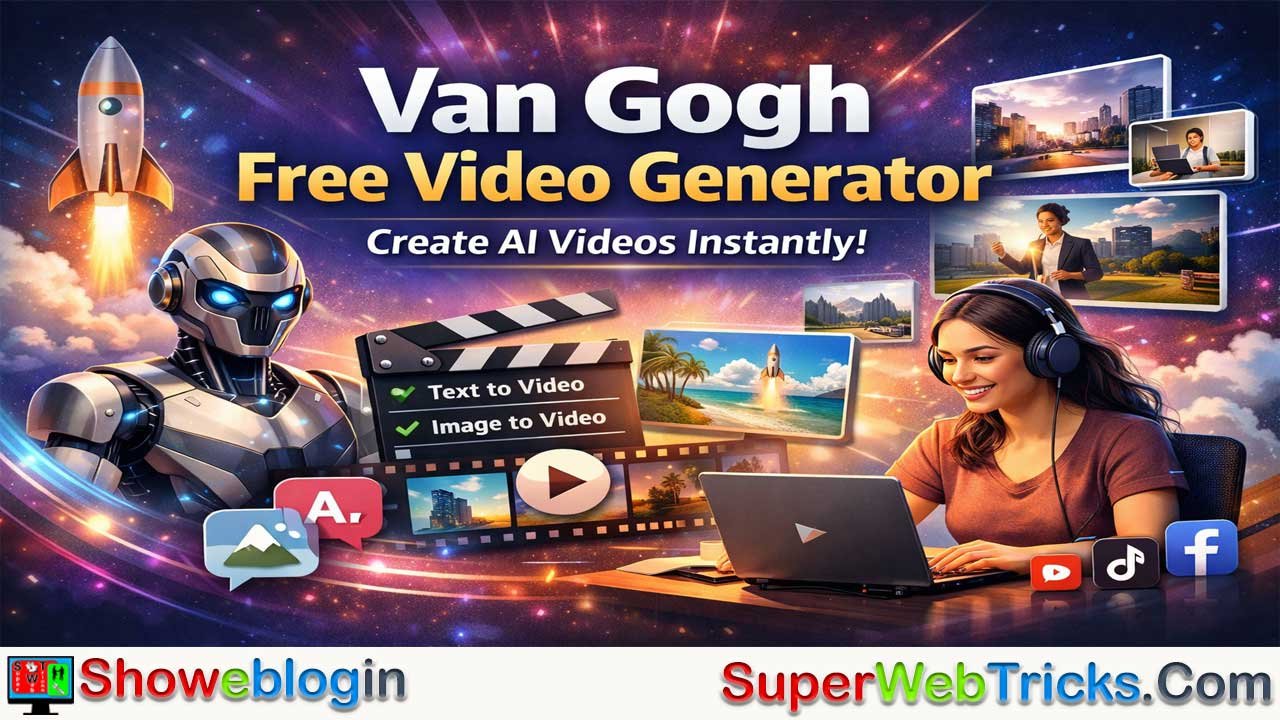

Generative AI has changed video creation by making it faster, easier, and more accessible. Tools like the Van Gogh Free Video Generator allow users to create videos from text or images using AI, without expensive software, technical skills, or even signing up.
The platform uses multimodal AI and scene-based generation to produce consistent, high-quality videos with smooth motion and no watermarks, which is rare for free tools. Compared to traditional video editing or other AI platforms, it focuses on simplicity, accessibility, and fast production. It is widely useful for digital marketing, social media content, faceless YouTube channels, and educational videos because creators can quickly turn scripts or ideas into short videos.
Its freemium model, commercial usage rights, and quick generation time make it a cost-effective alternative to traditional production methods. Overall, the tool represents a shift toward democratized video creation, where anyone can produce professional-looking content with minimal effort and cost.
| Category | Information |
|---|---|
| Tool Name | Van Gogh Free Video Generator |
| Website | freevideogenerator.io |
| Type | AI Video Generation Tool |
| Main Functions | Text-to-Video and Image-to-Video creation |
| Access | Freemium (basic features free) |
| Sign-Up Requirement | No sign-up required for basic use |
| Watermark | No watermark on generated videos |
| Video Structure | Scene-based generation for storytelling |
| Frame Rate | Up to 30 FPS |
| Primary Users | Marketers, content creators, educators, small businesses |
| Key Benefits | Fast video creation, easy interface, low cost |
| Commercial Use | Full commercial usage rights available |
| Common Uses | Social media videos, YouTube Shorts, faceless channels, educational content |
How Van Gogh Free Video Generator Makes AI Video Creation Easy and Free
The emergence of generative artificial intelligence has fundamentally altered the trajectory of digital content production, transitioning the medium from a labor-intensive manual craft to an algorithmically assisted creative process. Central to this shift is the democratization of video synthesis, a domain previously gated by significant hardware requirements and steep learning curves. Within this landscape, the Van Gogh Free Video Generator, accessible primarily through its official domain at freevideogenerator.io, represents a specific paradigm of high-accessibility, low-friction creative tooling designed for a diverse spectrum of users ranging from independent marketers to scientific educators.
The historical development of video synthesis has been marked by a move away from traditional non-linear editing environments toward autonomous and semi-autonomous generative models. Traditional software suites necessitate significant financial investments and professional expertise; for instance, standard industrial tools for motion graphics often require annual subscriptions exceeding several hundred dollars, paired with a learning period that typically spans six to twelve months of dedicated study.
In contrast, the Van Gogh Free Video Generator positions itself as an innovative AI-powered tool that allows users to effortlessly create high-quality videos by leveraging advanced text-to-video and image-to-video architectures. This transition is particularly critical for content creators who require professional-grade output without the overhead of conventional production cycles, particularly in the rapidly evolving markets for short-form video and educational media.
Technical Foundations of the Van Gogh AI Architecture
The technical framework of the Van Gogh Free Video Generator is rooted in multimodal synthesis, allowing for the ingestion of various data types to inform the final rendered output. The platform operates on a freemium model, providing a baseline of utility that is accessible without initial financial commitment or even the requirement of a sign-up process, while simultaneously offering robust features for professional-tier requirements. This “no-sign-up” philosophy represents a significant divergence from the industry standard, where data collection often precedes tool utility. By removing this barrier, the platform facilitates immediate creative experimentation, a quality highly valued by agile marketing teams and casual creators alike.
The core capabilities of the platform are segmented into distinct operational modes that address the primary needs of modern digital storytelling. The text-to-video function transforms natural language prompts into cohesive video sequences, while the image-to-video capability allows for the animation of static visual assets while maintaining stylistic and compositional integrity. Furthermore, the platform utilizes a scene-based logic, which is essential for building complex visual narratives that go beyond isolated clips. This structural approach ensures that temporal consistency is maintained across multiple frames, addressing one of the primary historical challenges of generative AI.
| Feature Category | Capability Description | Primary Use Case | Access Model |
|---|---|---|---|
| Text-to-Video | Conversion of semantic prompts into cinematic sequences. | Storyboarding and rapid social media content creation. | Freemium / No Sign-Up |
| Image-to-Video | Animating static assets using AI-driven motion estimation. | Revitalizing historical photos or travel photography. | Freemium |
| Scene-Based Logic | Generation of content in narrative blocks or scenes. | Long-form educational and explainer videos. | Freemium |
| Video Effects | Integrated AI enhancements and stylistic animations. | Enhancing raw generative output for professional use. | Freemium |
The “Van Gogh” nomenclature itself suggests an emphasis on artistic style and visual fidelity. While the tool is capable of producing photorealistic results, its inclusion in directories alongside animation and creative storytelling tools indicates a focus on aesthetic quality. This is particularly relevant in the context of “faceless” content creation, where the visual “vibe” or style of the video is as critical as the message itself. By offering integrated video effects and animation capabilities, the platform provides a comprehensive suite of creative tools that empower users to produce “stunning” results from simple inputs.
Comparative Analysis of the Generative Video Landscape
To understand the specific strategic value of the Van Gogh Free Video Generator, it must be situated within the broader competitive landscape of 2025 and 2026. The market is currently populated by several established platforms, including Seedance, Kling AI, and Runway ML, each offering varied degrees of control, cost, and technical complexity. While tools like Runway ML are often cited for their advanced cinematic controls—such as “Act One” motion capture—they are also noted for their steep learning curves and significant subscription costs.
The Van Gogh Free Video Generator, by comparison, emphasizes accessibility and the removal of common technical hurdles. One of its most frequently highlighted features is the absence of watermarks on generated content, a feature that is often reserved for paid tiers in competing platforms like Seedance or Ghost Cut AI. This lack of watermarking is a critical differentiator for professional users who intend to use the generated media in client-facing work or formal marketing presentations without the “amateur” branding associated with free-tier software.
| Platform | Watermark Status (Free) | Sign-Up Requirement | Primary Model Strength |
|---|---|---|---|
| Van Gogh Free Video Generator | None | No Sign-Up | Accessibility and user intent recognition. |
| Seedance 2.0 | Present / Varies | Yes | Audio-visual synchronization and multi-shot logic. |
| Kling AI | Usually Present | Yes | Realistic motion and lip-sync capabilities. |
| Ghost Cut AI | Present | Yes | Specialized AI video editing and background removal. |
| Runway ML | Present | Yes | Professional-grade cinematic controls and VFX. |
The performance of these tools is often measured by their ability to maintain “3D awareness” and “commercial-grade consistency”. In this regard, the Van Gogh platform is recognized for its “interactive AI philosophy,” which suggests a more dynamic and responsive relationship between user input and visual output than the rigid, command-based systems of the past. This philosophy allows the AI to better interpret the underlying intent of a prompt, leading to results that align more closely with the user’s creative vision.
Strategic Applications in Digital Marketing and Content Creation
The utility of freevideogenerator.io extends across several high-growth industries, with digital marketing being a primary beneficiary. The platform’s ability to generate professional videos with “no watermarks” makes it an ideal solution for businesses looking to enhance their daily operations through AI integration. For instance, a luxury brand might use the tool to create evocative visual social media captions or promotional materials that emphasize craftsmanship over raw technical specs, thereby increasing conversion rates by significant margins.
The YouTube Shorts and Faceless Channel Opportunity
A significant trend in the creator economy is the rise of “faceless” channels on platforms like YouTube and TikTok. These channels rely on high-volume production of engaging, visually stimulating content, often without the presence of a human presenter. The Van Gogh Free Video Generator serves as a linchpin in the workflow for these creators, who often utilize a multi-AI pipeline to achieve rapid scale.
The specialized workflow for generating viral short-form content typically involves the following stages:
- Trend Identification: Using platform-native discovery tools to find high-velocity topics within a specific niche.
- Scripting with LLMs: Utilizing tools like Gemini or ChatGPT to generate scripts that include strong hooks, surprising facts, and loop-back statements.
- Visual Synthesis: Loading these scripts into the Van Gogh Free Video Generator to produce 45-60 second clips that align with the narrative beats of the script.
- Optimized Distribution: Applying AI subtitle generators and scheduling the posts to hit peak audience engagement times.
The “scene-based” generation capability is particularly useful here, as it allows creators to specify distinct visual environments for different segments of a script, such as an “intro,” a “conflict,” and a “resolution”. This level of narrative structure was previously difficult to achieve in free generative tools, which often produced a single, unvarying loop of motion.
Educational and Scientific Communication
Beyond marketing, the platform has demonstrated significant value in the field of educational and scientific communication. One notable application involves the translation of complex environmental health research into digestible video content for the general public. For example, researchers have used the tool to create explainer videos regarding the migration of toxic PFAS “forever chemicals” from consumer products into human systems.
In these contexts, the video format is a “powerful medium” for health education, as it allows abstract or concern-heavy topics—such as how chemicals move through sweat—to be visualized in a way that is easily understood by everyday consumers. The platform’s ability to create “beautiful educational videos” with minimal technical expertise makes it an essential bridge between the scientific community and the broader public.
Economic Foundations and Licensing Structures
The economic model of the Van Gogh Free Video Generator is central to its widespread adoption. By operating as a freemium service that offers “full commercial rights” for its output, the platform removes the legal and financial barriers that often stifle small-scale innovation. Whether a project is for business, education, or personal use, the explicit grant of commercial usage rights ensures that users can monetize their creations without fear of intellectual property disputes.
The cost-benefit analysis of using an AI-driven tool like Van Gogh versus traditional production methods reveals a dramatic disparity in resources.
| Metric | Traditional Motion Graphics | Freelancer Path | Van Gogh Free Video Generator |
|---|---|---|---|
| Software Cost | $276 – $700+ / year | $50 – $400+ per video | $0 (Freemium) |
| Learning Time | 6 – 12 Months | Ongoing Coordination | Minutes to Hours |
| Turnaround Time | 2 – 8 Hours per Video | Days to Weeks | 2 – 5 Minutes |
| Licensing | Individual / Enterprise | Varies by Contract | Full Commercial Rights |
This economic restructuring allows for a “fail-fast” creative strategy, where ideas can be visualized and tested in the marketplace with nearly zero sunk cost. This is particularly relevant for startups and small content agencies that lack the capital for large-scale production but require high-quality video to remain competitive in social media algorithms.
User Interface and Interactive Philosophy
The user experience (UX) of freevideogenerator.io is designed around the principle of “minimal technical expertise”. Unlike tools that require the installation of complex rendering software or the management of local hardware resources, this platform operates as a web-based service that “actually does things” based on natural language commands. This “interactive philosophy” is frequently praised by users who describe the experience as “wonderful” and “easy,” especially for tasks like creating travel recap videos or documenting road trips.
The platform’s responsiveness to user intent is a significant advancement over earlier generative models. Instead of following “rigid commands,” the AI interprets the semantic meaning of a prompt to generate “professional videos without watermarks” that reflect the user’s specific goals. This allows for a more iterative creative process, where a user can adjust their prompt to refine the output until it meets their exact needs.
Workflow Mastery and Practical Implementation
For professional users, the effective implementation of the Van Gogh Free Video Generator involves a deliberate workflow that balances AI automation with human creative direction. The process typically begins on the official website, where users can choose between text-to-video or image-to-video entry points.
- Prompting and Generation: Users input their desired outcome (e.g., “Create a 45-second motivational Short about overcoming procrastination”). The AI then generates the script and visual storyboard, often in a matter of minutes.
- Visual Refinement: If the generated visuals require adjustment, users can utilize built-in tools for “custom removal” of backgrounds or the application of specific “video effects”.
- Export and Deployment: Once the video is generated, it can be exported and uploaded directly to platforms like YouTube or Instagram. Because there are “no hidden fees or usage limits” on certain tiers, this can be done repeatedly to build content volume.
This workflow is supported by an underlying technology that manages “frame rates” (up to 30 fps) and “video dimensions” automatically, ensuring that the output is ready for immediate consumption on modern digital displays.
Technical Nuances: Resolution, Frame Consistency, and Continuity
A critical technical challenge in AI video generation is the maintenance of continuity across frames. Early models often suffered from “morphing” or visual artifacts where subjects would change appearance midway through a clip. The Van Gogh platform addresses this through “innovative” technology designed to produce “high-quality” results that maintain professional standards.
While specific maximum durations can vary based on the user’s plan, the platform is capable of generating “stunning, scene-based videos” that go beyond the 3-5 second limitations of more basic tools. The inclusion of features such as “automatic scene detection” and “AI-powered enhancements” suggests an architecture that utilizes temporal attention mechanisms to ensure that the motion remains fluid and the subject remains consistent throughout the duration of the video.
| Technical Specification | Van Gogh Performance | Industry Standard (Free Tier) |
|---|---|---|
| Max Resolution | Professional / High Quality | 480p – 720p |
| Watermark | None | Almost Always Present |
| Motion Quality | Smooth / 30 FPS Target | Variable / Often Jittery |
| Subject Continuity | High / Scene-Based Logic | Low / Single-Clip Focus |
The platform’s ability to produce “watermark-free” results in “standard definition” or better on its free tier is a rare commodity in the 2026 AI landscape. This technical generosity is likely a strategic move to build a large user base and demonstrate the platform’s utility before upselling users to more advanced features such as 4K resolution or unlimited processing time.
Ethical Considerations and the Future of AI Video
As generative video tools become more accessible, the industry faces new questions regarding the authenticity of digital media. The ease with which the Van Gogh tool can create “suspiciously perfect” content means that the line between human-captured reality and AI-synthesized fiction is becoming increasingly blurred. This has led to the development of secondary tools such as “AI text humanizers” and “AI detectors” designed to help users identify synthetic media.
Furthermore, the “no sign-up” and “completely free” nature of the tool, while excellent for user growth, presents challenges for maintaining quality and preventing abuse. The broader market trend, as seen in platforms like Seedance 2.0 or Ghost Cut AI, is to eventually implement “search query limits” or “credit-based” systems to manage the significant computational costs associated with video synthesis.
However, the current trajectory of the Van Gogh Free Video Generator suggests a commitment to the “interactive AI philosophy” that prioritizes the user’s intent and creative freedom. As the technology continues to mature, we can expect the platform to integrate even more advanced features, such as “synchronized dialogue” and “audio-visual synthesis,” further narrowing the gap between accessible web tools and high-end professional software.
Conclusions and Practical Recommendations
The Van Gogh Free Video Generator (freevideogenerator.io) represents a paradigm shift in how digital media is conceptualized and produced. By removing the traditional barriers of cost, technical complexity, and administrative friction (such as sign-up requirements), it has democratized the ability to create professional-grade video content for a global audience.
For professional users and creators, the platform offers a unique set of strategic advantages:
- Accessibility: The ability to generate “watermark-free” videos without a sign-up process allows for unmatched speed in content production.
- Commercial Viability: Full commercial rights ensure that the output can be used in marketing, education, and professional services without legal encumbrance.
- Narrative Strength: The “scene-based” generation logic enables the creation of cohesive stories, which is essential for effective communication in fields like health education and scientific research.
- Economic Efficiency: By reducing production costs to near zero, the platform empowers small businesses and independent creators to compete in a high-velocity digital economy.
As the field of generative cinematography continues to evolve, tools that prioritize user intent and accessibility will likely remain at the forefront of the industry. The Van Gogh Free Video Generator is not merely a tool for creating visuals; it is a catalyst for a new era of digital storytelling where the power of professional video is accessible to anyone with a browser and an idea. Creators are encouraged to explore the platform’s capabilities early, leveraging its current free and watermark-free status to build high-impact content libraries before the inevitable shift toward more restrictive industry models occurs.
FAQs
What is the Van Gogh Free Video Generator?
Van Gogh Free Video Generator is an AI-powered online tool that creates videos from text prompts or images. It allows users to generate professional-looking videos quickly without advanced editing skills.
Do I need to create an account to use the tool?
No, the platform offers a no-sign-up option for basic use. Users can start creating videos directly from the website without registering.
Can I create videos from text prompts?
Yes, the tool includes a text-to-video feature that converts written prompts into complete video scenes using AI.
Does the free version add a watermark to videos?
No, one of the key advantages of the platform is that it can generate videos without adding watermarks, even on the free tier.
What types of videos can I create with it?
You can create social media videos, YouTube Shorts, marketing content, educational explainers, and faceless channel videos.
Can I use the generated videos for commercial purposes?
Yes, the platform provides commercial usage rights, allowing users to use the videos for marketing, business, or monetized content.
How long does it take to generate a video?
Most videos are generated within a few minutes depending on the prompt and video length.
Is the tool suitable for beginners?
Yes, the platform is designed to be simple and beginner-friendly. Users only need to enter a prompt or upload an image to start creating videos.
What is the image-to-video feature?
The image-to-video feature animates static images using AI motion generation, turning photos or graphics into dynamic video clips.
Who can benefit from using this AI video generator?
Content creators, marketers, educators, small businesses, and social media managers can benefit from the tool because it simplifies video production and reduces costs.


Leave a Reply
You must be logged in to post a comment.