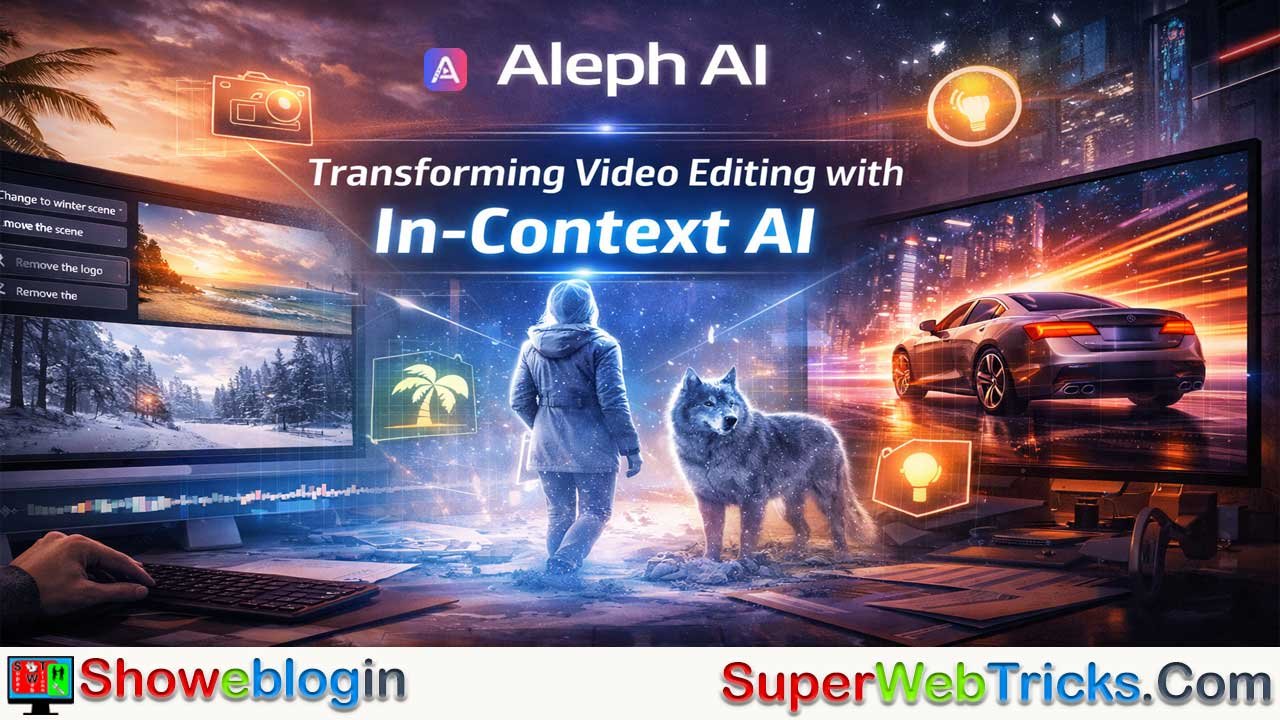





Aleph AI is a cloud-based video platform that lets users edit and transform existing footage using simple text prompts. Instead of creating videos from scratch, it uses “in-context” modeling to understand the original scene and then change objects, lighting, backgrounds, or camera angles while keeping motion realistic.
Users can upload common video or image formats and get results in about 30 to 60 seconds. The tool can remove objects, replace items, adjust style, and even create new camera views without reshooting. It is affordable and designed for both professionals and beginners.
Unlike Aleph, Aleph Alpha, or Aleph Zero, this platform focuses only on video editing and visual effects. Overall, it makes high-end video production faster, cheaper, and easier for creators and businesses.
| Feature | Description | User Benefit |
|---|---|---|
| Platform | Cloud-based AI video editor | No high-end hardware needed |
| Editing Method | In-context, text-driven video manipulation | Edit existing footage intelligently |
| Object Manipulation | Add, remove, or replace objects | Saves manual rotoscoping time |
| Camera Control | Generate new angles from footage | Avoid costly reshoots |
| Style & Lighting | Adjust environment, weather, time of day | Full creative control over scene |
| Multi-Tasking | Handle multiple edits in one pass | Faster production and iteration |
| Supported Formats | MP4, AVI, MOV, WMV, JPG, PNG, WEBP | Works with standard video/image files |
| Processing Time | 30–60 seconds per complex edit | Quick results for modern workflows |
| Accessibility | Beginner-friendly interface with natural language prompts | Easy for both professionals and newcomers |
| Commercial Use | Outputs royalty-free videos | Ready for marketing, social media, and campaigns |
| Security | Enterprise-grade encryption, auto-delete | Protects user content and privacy |
| Price | ~$15.92/month | Affordable high-end visual effects |
Aleph AI: In-Context Video Editing with AI-Powered Scene Transformation
The world of digital cinematography and post-production is currently undergoing a structural transformation characterized by the shift from manual, frame-by-frame manipulation to semantic, natural-language-driven synthesis. Central to this evolution is the emergence of Aleph AI, a platform that distinguishes itself through its specific architectural commitment to “in-context” video modeling.
As the global AI video market is projected to expand from a valuation of $3.86 billion in 2024 to an estimated $42.29 billion by 2033—representing a compound annual growth rate of —the introduction of tools that can understand and manipulate existing footage becomes a primary driver of industry efficiency. Aleph AI, accessible via its official portal at alephai.app, represents a pivotal development in this trajectory, offering creators a cloud-based environment to edit, transform, and generate video content using straightforward text prompts without the prohibitive costs or technical barriers traditionally associated with high-end visual effects.
The Architectural Genesis of In-Context Modeling
The traditional approach to generative video often involved “blank canvas” generation, where models like the early iterations of Gen-2 or the conceptual Sora synthesized pixels from a prompt without a foundational reference. Aleph AI represents a departure from this method by functioning as a “state-of-the-art in-context video model,” a term introduced by its technological partners at Runway in July 2025.
This distinction is critical for professional users because it implies the system’s ability to interpret the geometric and temporal logic of existing footage before applying transformations. This capability allows the system to function less like a creative agent acting in isolation and more like a master restorer or a digital director who can modify a scene’s lighting, characters, or environment while maintaining the underlying physics of the original shot.
The platform is designed to handle high-compute tasks in a cloud environment, which democratizes access to sophisticated visual generation engines. Users can upload standard video formats such as MP4, AVI, MOV, and WMV, or even static images in JPG, PNG, and WEBP formats, to serve as the context for the AI’s generative processes. The engine’s efficiency is demonstrated by its processing speed, with most complex edits being completed in a 30 to 60-second window. This rapid turnaround is essential for modern content production workflows, where iteration cycles are becoming increasingly compressed.
Functional Specifications and Technical Capabilities
Aleph AI provides a suite of tools that address the most labor-intensive aspects of traditional post-production. Its core visual generation engine is capable of performing multiple editing tasks concurrently, allowing a user to change a background, alter an object’s appearance, and modify the lighting in a single processing cycle. This multi-tasking capability is rooted in a robust understanding of space and lighting, which ensures that newly added or modified elements appear natural and integrated rather than superimposed.
| Feature | Technical Description | User Benefit |
|---|---|---|
| Object Manipulation | Intelligent addition, removal, or transformation of video elements. | Eliminates manual rotoscoping and complex masking. |
| Dynamic Camera Control | Generates new perspectives and angles from existing footage. | Allows for “reshooting” scenes digitally without production costs. |
| Style & Lighting Adjustment | Semantic control over environment, weather, and time of day. | Provides high-level creative control over scene atmosphere. |
| Simultaneous Editing | Ability to handle multiple complex modifications in one pass. | Drastically reduces processing time and iteration lag. |
| Format Support | Compatibility with MP4, AVI, MOV, WMV, JPG, PNG, WEBP. | Seamless integration with existing professional workflows. |
The Mechanics of Intelligent Object Manipulation
One of the most significant hurdles in video editing has always been the removal of objects from moving scenes. Traditionally, this required a frame-by-frame approach known as rotoscoping, where an editor would manually mask an object and then use “content-aware fill” techniques to reconstruct the background. Aleph AI automates this entire process through its intelligent object manipulation feature.
By providing a simple text instruction, such as “remove the reflections from the window” or “replace the dog with a wolf,” the system identifies the object across the temporal dimension and performs the necessary inpainting to ensure the background remains consistent.
The system’s ability to maintain “motion continuity” and “visual realism” is a byproduct of its internal representation of the scene’s 3D structure. When an object is modified, the AI does not just change the pixels; it recalculates how light should interact with the new object given the environment’s source of illumination.
In practical applications, such as removing a brand logo from a moving vehicle, the system may require specific prompts to handle complex textures—for example, “seamlessly remove the circular logo, matching the car’s metallic texture and reflections”—highlighting that professional-grade results are often the result of precise semantic guidance.
Dynamic Camera Control and Coverage
The ability to generate new camera angles directly from existing footage represents a paradigm shift in how coverage is acquired in filmmaking. Typically, if a director realizes during the editing phase that a specific angle—such as a dramatic low-angle shot—is missing, the only solution is an expensive reshoot.
Aleph AI’s dynamic camera control allows the user to synthesize these missing perspectives by prompting the AI to “generate a low-angle shot” from a standard medium shot. The system maintains the character’s motion and the lighting of the original scene while projecting the visual data onto a new virtual camera path.
This functionality is particularly revolutionary for social media content creators and small-scale marketing teams who often work with limited camera setups. By using Aleph AI, a single piece of footage can be transformed into a multi-cam sequence, providing the visual variety and professional polish that was previously the domain of high-budget productions.
User Experience and Workflow Optimization
Aleph AI is positioned as a tool for both experienced professionals and beginners, offering a user-friendly interface that masks the complexity of its underlying visual engine. The workflow is designed around the principle of natural language interaction, where the quality of the output is directly tied to the clarity of the prompt. For AI tool users, the process involves a four-stage progression that emphasizes iterative refinement.
The Art of the Semantic Prompt
In the Aleph AI ecosystem, the prompt is the primary interface. Unlike traditional software that uses sliders and dials, the user describes the desired outcome in natural language. Research into the platform’s performance suggests that descriptive prompts of approximately 20 to 30 words yield the most precise results. This “art of the prompt” requires users to think about the scene in terms of subject, action, environment, and style.
From Upload to Commercial Export
The production cycle within the platform starts with the upload of footage. Because the system is cloud-based, users are not limited by their local hardware’s GPU capacity. Once the video is processed, the resulting output is a high-quality, royalty-free MP4 file. Crucially for business users, these outputs are cleared for commercial use, making Aleph AI a viable solution for marketing campaigns, e-learning platforms, and social media advertising.
The platform’s commitment to security is reflected in its data management policies. Files are deleted after processing, and the system employs enterprise-grade encryption to ensure that the content remains the property and the secret of the creator. This is a vital consideration for industries such as finance or healthcare, where data privacy is paramount.
Comparative Market Positioning
For users navigating the competitive landscape of AI-powered video tools, it is necessary to evaluate Aleph AI against other specialized platforms. While some tools excel at narrative generation or avatar creation, Aleph AI carves out a niche in advanced visual manipulation and scene transformation.
| Tool | Monthly Cost | Primary Strength | Format Support |
|---|---|---|---|
| Aleph AI | $15.92 | In-context editing and camera synthesis | MP4, AVI, MOV, WMV |
| Vace AI | N/A | All-in-one editing and advanced effects | MP4, MOV, AVI |
| Lucy Edit AI | $7.99 | Text-guided object swapping and color changes | Built on VAE + DiT stack |
| Tutorial.ai | $18.00 | Screen recording and automated tutorial generation | Specialized for workflows |
| PlugXR | $9.00 | Augmented reality and spatial computing | Virtual showrooms |
Distinguishing the “Aleph” Brand
A potential source of confusion for users is the existence of several prominent entities sharing the “Aleph” name. It is imperative to distinguish Aleph AI (the video platform) from other specialized AI and technology companies to ensure appropriate tool selection and procurement.
One of the most notable is Aleph, an AI-native platform for Financial Planning & Analysis (FP&A). This entity is a spreadsheet-first platform that helps finance teams unify data from disparate systems into a single source of truth. Founded by Albert Gozzi and Santiago Perez De Rosso, and backed by major VCs like Khosla Ventures and Bain Capital, it focuses on financial modeling rather than visual media. Its architecture inserts a central data layer between source systems and spreadsheets, offering features like bi-directional sync and no-code transformations.
Another distinct entity is Aleph Alpha, a European powerhouse in “sovereign AI”. This company focuses on technological independence for government and healthcare sectors, offering flexible deployment on-premise or in private clouds. Their primary innovation is “AtMan” (Attention Manipulation), a technology that provides explainability by tracing AI outputs back to specific sentences in source documents. While Aleph AI focuses on creative video, Aleph Alpha focuses on auditable and verifiable linguistic reasoning.
Finally, Aleph Zero is a privacy-focused public blockchain designed for enterprise and DeFi applications. It utilizes a peer-reviewed consensus protocol (AlephBFT) capable of nearly 90,000 transactions per second. This infrastructure-level technology is entirely separate from the generative video domain.
The Mathematical Foundation of Generative Continuity
The seamless transitions and visual realism produced by Aleph AI are underpinned by sophisticated mathematical models, likely utilizing a Diffusion Transformer (DiT) architecture. This approach combines the spatial modeling capabilities of traditional diffusion models with the temporal attention mechanisms of transformers.
In such a system, the video is first compressed into a lower-dimensional latent space using a Variational Autoencoder (VAE). The diffusion process then operates on this latent representation. For a given video sequence , the model learns to reverse a noise process, guided by a text prompt . The objective function for training such a model can be represented as:
Here, represents the latent video representation at time step , and is the denoising model that predicts the noise added to the sequence. To ensure temporal coherence—meaning the video doesn’t flicker or change inconsistently—the attention mechanism must look across frames:
In this context, (query, key, value matrices) include temporal dimensions, allowing the AI to “remember” the appearance of an object in frame 1 when it is generating frame 24. This is what enables Aleph AI to maintain “motion preservation” and “visual consistency” even during complex environmental changes.
Economic Implications and the Future of Visual Prototyping
The democratization of high-end visual effects through Aleph AI has profound implications for the unit economics of content production. Traditionally, visual effects were the domain of specialized teams with six-figure software budgets. By offering these capabilities for a monthly subscription—cited in some reports at approximately $15.92 per month—Aleph AI allows single creators to prototype and execute ideas that were previously impossible.
Impact on Pre-Visualization and Marketing
In professional filmmaking, pre-visualization (previz) is the process of mapping out complex sequences before filming begins. Aleph AI’s ability to generate new camera angles and alter environments in seconds makes it an ideal tool for content prototyping and previz. Directors can test how a scene might look under different lighting conditions or from different perspectives without leaving the editing room.
For the marketing sector, the ability to rapidly transform existing product footage into localized content is a game-changer. A single advertisement filmed in a sunny environment can be transformed into multiple versions featuring different weather conditions or backgrounds to suit various global markets, all through simple text prompts. This efficiency significantly reduces the costs associated with international campaign deployment.
Challenges and Future Trajectory
Despite its significant advances, Aleph AI—and the broader generative video field—still faces challenges in maintaining absolute character consistency across long sequences. While clothing details and facial features can occasionally shift in early versions, the rapid pace of development suggests that these limitations are temporary. The integration of “pose and motion preservation” technology is a key area of current innovation aimed at solving these consistency issues.
As the market for AI video tools continues its staggering growth, we can expect Aleph AI to further refine its “in-context” capabilities. Future iterations may include deeper integration with spatial computing platforms, allowing for the transformation of 2D video into fully navigable 3D environments. For the 50,000 creators currently on the platform, the journey is just beginning, as Aleph AI continues to turn “impossible” edits into “done” in seconds.
Conclusion: Strategic Value for the Modern Creator
Aleph AI represents a unique intersection of creative freedom and technological precision. By focusing on the manipulation of existing footage rather than just the generation of new imagery, it provides a level of control that is essential for professional applications. Whether it is removing an unwanted object, shifting a scene’s atmosphere, or creating entirely new camera coverage, the platform empowers users to think about video as a plastic medium that can be reshaped at will.
For AI tool users, the strategic advantage lies in the platform’s ability to compress weeks of work into minutes of processing. By leveraging the official website at alephai.app, creators can access a visual engine that is both powerful enough for professional VFX and accessible enough for social media prototyping. As the distinction between “filmed” and “generated” continues to blur, Aleph AI stands as a foundational tool in the new era of semantic cinematography.
The platform’s success is a testament to the power of in-context modeling—a technique that respects the history of the footage while enabling its future transformation. For the professional user, this means a reliable, secure, and commercially viable path to producing studio-quality content at scale. In the rapidly expanding $42 billion dollar market for AI video, Aleph AI is not just a tool; it is an architectural milestone in the quest for total visual autonomy.
FAQs about Aleph AI
What is Aleph AI?
Aleph AI is a cloud-based video editing platform that uses in-context, text-driven AI to transform and edit existing footage.
How does in-context video editing work?
The AI analyzes the original video scene, including objects, lighting, and motion, and applies changes while keeping the footage realistic.
Which video and image formats does Aleph AI support?
It supports MP4, AVI, MOV, WMV for videos, and JPG, PNG, WEBP for images.
Can Aleph AI create new camera angles?
Yes, it can generate new perspectives from existing footage without the need for reshoots.
How quickly does Aleph AI process edits?
Most complex edits are completed in 30 to 60 seconds.
Do I need advanced hardware to use Aleph AI?
No, the platform is cloud-based, so you only need a standard device with internet access.
Is Aleph AI suitable for beginners?
Yes, it features a user-friendly interface and uses natural language prompts, making it accessible to both beginners and professionals.
Can I use Aleph AI outputs for commercial purposes?
Yes, videos generated by Aleph AI are royalty-free and cleared for commercial use.
How secure is Aleph AI with my files?
Files are deleted after processing, and the system uses enterprise-grade encryption to protect user content.
How much does Aleph AI cost?
The subscription is approximately $15.92 per month, making advanced visual effects affordable.
What kind of edits can Aleph AI perform?
It can remove or replace objects, adjust lighting and style, and apply multiple complex edits in a single pass.
How is Aleph AI different from other Aleph companies?
Aleph AI focuses on video editing and visual effects, unlike Aleph (FP&A software), Aleph Alpha (AI for government and healthcare), or Aleph Zero (blockchain).










Leave a Reply
You must be logged in to post a comment.