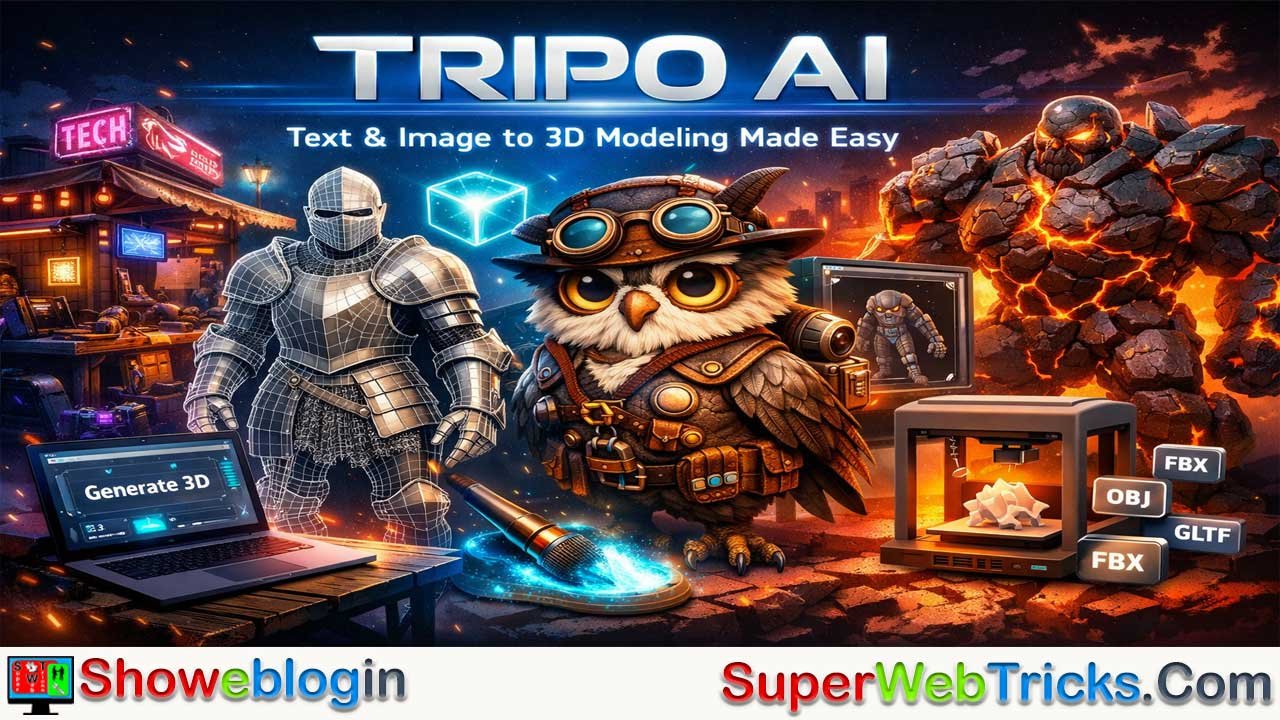





Tripo AI shows how 3D modeling has become much easier in 2026. In the past, creating 3D models required months of learning complex software like Maya or ZBrush. Now tools like Tripo let users generate models from text or images in seconds.
The platform has a simple workspace with features such as Text-to-3D, Image-to-3D, and editing tools like Magic Brush and Smart Segmentation. Its Smart Mesh system creates cleaner, optimized models that are ready for games or animation without heavy fixing. It can also auto-rig characters and export models to tools like Blender, Unity, or 3D printers.
Although it still struggles with very complex machinery or clear text textures, Tripo AI greatly speeds up the 3D workflow and makes 3D creation accessible to beginners, artists, game developers, and hobbyists.
| Information | Details |
|---|---|
| Tool Name | Tripo AI |
| Type | AI 3D Modeling Platform |
| Main Features | Text-to-3D, Image-to-3D, Smart Mesh, Magic Brush, Auto-Rigging |
| Generation Speed | Drafts in ~20 seconds |
| Smart Mesh Speed | ~5 seconds optimized mesh generation |
| Polygon Count | Standard ~50k, Ultra mode up to ~1.2M |
| Editing Tools | Magic Brush, Smart Segmentation |
| Animation | Auto-Rigging with built-in animation library |
| Export Formats | GLB/GLTF, FBX, OBJ, STL, USDZ |
| Integrations | Blender, Unity, Unreal Engine |
| Best For | Game developers, concept artists, marketers, 3D printing hobbyists |
| Pricing | Starts around $12/month with credit system |
| Limitations | Struggles with complex machinery and detailed text textures |
How Tripo AI Is Changing 3D Modeling for Game Developers and Artists
The world of 3D modeling used to be a fortress. To enter, you needed months of training, a mastery of complex software like Maya or ZBrush, and the patience of a saint to handle retopology and UV mapping. Fast forward to early 2026, and that fortress hasn’t just been breached—it’s been democratized.
As someone who has dabbled in game development and digital art for years, I’ve watched the “AI 3D” space with a mix of excitement and healthy skepticism. Early tools often produced what I called “digital melted wax”—blobs that looked vaguely like your prompt but were a nightmare to actually use in a project. Then I spent a month deep-diving into Tripo AI.
What I found wasn’t just another generator; it was a shift in how we think about the 3D pipeline. This is my first-hand account of navigating the current state of Tripo, from the lightning-fast “Smart Mesh” updates to the high-fidelity “Ultra” outputs.
First Impressions: The “Studio” Experience
When you first log into the Tripo web interface, it doesn’t feel like a simple “prompt and pray” tool. It feels like a workspace. The dashboard is divided into distinct zones: Text-to-3D, Image-to-3D, and the Tripo Studio.
The UI is remarkably clean for a tool that handles such heavy lifting. You aren’t buried in menus. Instead, the focus is on the viewport. One of the first things that struck me was the speed of the interface itself; loading assets and previewing models in the browser is snappy, which is a testament to how they’ve optimized their web-based 3D engine.
The Credit Reality
Tripo operates on a credit system. For about $12/month, you get a baseline of credits (roughly 200–500 depending on the current promotion). While that might sound low if you’re used to “unlimited” text AI, you have to remember that 3D generation is computationally expensive. In my experience, 200 credits are enough for a hobbyist to prototype an entire small scene, but power users will definitely want to look at the higher-tier plans that offer 3,000+ credits.
Testing the “Text-to-3D” Engine: From Words to Wireframes
I started with a classic test: a “Cyberpunk street vendor stall, neon signs, cluttered with tech parts.”
I hit “Generate,” and within 20 seconds, four distinct drafts appeared. This is the “Draft” phase. It’s meant for rapid iteration. You don’t spend credits on these initial low-poly previews, which is a huge win for the user. It allows you to refine your prompt without the “buyer’s remorse” of wasting currency on a bad interpretation.
Once I picked the best silhouette, I clicked “Refine.” This is where the magic happens. The AI takes that rough shape and calculates the intricate geometry and PBR (Physically Based Rendering) textures.
The Result
The output was surprisingly coherent. In older versions of AI tools, thin objects like signposts or wires would often break or merge into the background. Here, the “Smart Mesh” architecture ensured that the signs were distinct planes and the clutter had recognizable shapes.
Image-to-3D: The “Concept Artist’s Best Friend”
This is arguably Tripo’s strongest feature. I uploaded a 2D character design I’d generated in Midjourney—a stylized “Steampunk Owl Mechanic.”
The challenge with Image-to-3D is depth. How does the AI know what the back of the owl looks like? Tripo 3.0 uses a multi-view diffusion model that “imagines” the hidden angles based on its training on millions of 3D objects.
The Workflow:
- Upload: I dropped in my .png file.
- Generation: It took about 90 seconds to produce the high-poly model.
- The “Ultra” Leap: I decided to toggle Ultra Mode. This pushed the face count from a standard 50k to nearly 1.2 million polygons.
The detail was breathtaking. The brass gears on the owl’s vest had actual depth, and the feathers weren’t just a flat texture—they were sculpted into the geometry. If you are a 3D printing enthusiast, this “Ultra” setting is your best friend. The meshes come out “watertight,” meaning they are solid volumes ready for a slicer like Cura or PrusaSlicer without needing hours of mesh repair.
The Game-Changer: Smart Mesh P1.0
For a long time, the biggest complaint about AI 3D was the “topology.” Usually, AI generates a “triangle soup”—millions of disorganized triangles that make it impossible to animate or edit the model later.
In my recent tests of Tripo’s Smart Mesh P1.0, they’ve addressed this head-on. Instead of a dense, unstructured mess, the system now attempts to generate a mesh that follows the “flow” of the object.
Comparison: Standard vs. Smart Mesh
| Feature | Standard (V3.1) | Smart Mesh (P1.0) |
|---|---|---|
| Generation Time | 3-4 Minutes | ~5 Seconds |
| Face Count | ~2,000,000 (Dense) | ~10,000 (Optimized) |
| Topology | Messy / Requires Retopo | Clean / Game-Ready |
| Use Case | Film, 3D Printing | Games, AR/VR, Web |
I tested this with a simple “Knight in plate armor.” The Smart Mesh version was incredible. The joints (knees, elbows) were triangulated in a way that actually made sense for animation. I didn’t have to spend three hours in Blender “retopologizing” the mesh. I could just export it and go.
Refining the Vision: The Magic Brush and Segmentation
One of the coolest additions to the Tripo Studio is the suite of editing tools. Often, the AI gets the shape right but the colors slightly off.
The Magic Brush
This isn’t just a paint tool. It’s an AI-assisted texturing brush. If I wanted the owl mechanic’s goggles to be “glowing blue glass” instead of “dull grey,” I could simply paint over that area and type a prompt for that specific part. The AI then re-renders the PBR maps for just that section, adjusting the roughness and metallic values to match the material.
Smart Segmentation
Tripo can now automatically “break” your model into logical parts. When I generated a humanoid robot, I used the Segmentation tool. With one click, the AI identified the head, torso, arms, and legs as separate sub-objects. This is vital if you want to swap out parts in a game or apply different materials to different sections without fighting with selection tools in external software.
Bringing it to Life: Auto-Rigging & Animation
For most of us, a static 3D model is only half the battle. We want it to move.
Tripo’s Auto-Rigging (v2.5) is a minor miracle. I took a generated character—a “Lava Golem”—and hit the “Rigging” button.
- Time: About 60 seconds.
- Cost: 20 credits.
- Process: The AI analyzes the mesh, places a skeleton (bones) inside it, and performs “weight painting” (deciding which part of the mesh moves with which bone).
I then selected a “Victory Dance” animation from their built-in library. Watching my freshly-minted Golem bust a move right there in the browser was one of those “the future is here” moments. The deformations were smooth. There was no “clipping” (where the mesh folds into itself) at the shoulders or hips, which is usually the hallmark of a bad rig.
Pipeline Integration: Leaving the Browser
A tool is only as good as its ability to talk to other tools. Tripo doesn’t try to be a “walled garden.”
The Blender DCC Bridge
As a Blender user, this is my favorite part of the ecosystem. You can download the Tripo Bridge add-on. Once installed, you don’t even need to manually download and import files. You click “Send to Blender” on the website, and the model (with all its textures and rigging) appears in your Blender viewport instantly.
Export Formats
Tripo supports the “Big Five” of 3D formats:
- GLB/GLTF: Perfect for web and AR (ready for Shopify or Instagram filters).
- FBX: The industry standard for Unity and Unreal Engine.
- OBJ: High-compatibility format for almost any 3D software.
- STL: The go-to for 3D printing.
- USDZ: Essential for Apple Vision Pro and iOS AR experiences.
Is It Worth It? The Verdict
After a month of using Tripo, I’ve found that my workflow has fundamentally changed. I no longer start a project by staring at a blank screen in Blender. I start in Tripo.
Who is this for?
- Indie Game Devs: You can populate a world with “background props” (barrels, crates, lamp posts) in minutes rather than days.
- Concept Artists: It allows you to quickly see if a 2D design works in 3D space before committing to a final painting.
- 3D Printing Hobbyists: The Image-to-3D feature is a “cheat code” for creating custom miniatures from 2D reference art.
- Marketers: Creating AR-ready product models from a single photo is now a 5-minute task.
Where it still struggles:
- Hyper-Complex Machinery: If you need a car engine with 500 moving parts, Tripo (or any AI) isn’t there yet. It’s better at “organic” or “artistic” shapes than high-precision engineering.
- Text within Textures: While getting better, the AI still occasionally struggles to render perfectly legible text on 3D signs (though the “Magic Brush” can fix this).
Showeblogin Final Thoughts
Tripo AI has moved past being a “cool toy.” In 2026, it is a legitimate 3D Workspace. It bridges the gap between the “idea” and the “asset” with a speed that is frankly a little scary.
If you’ve ever felt intimidated by 3D modeling, my advice is simple: Head over to the official site, upload a photo of something on your desk, and see what happens. The barrier to entry has officially been lowered.
FAQs about Tripo AI
What is Tripo AI?
Tripo AI is an artificial intelligence platform that generates 3D models from text prompts or images. It helps users quickly create assets for games, animation, AR, and 3D printing without advanced modeling skills.
How does Tripo AI create 3D models?
Tripo AI uses AI diffusion models trained on millions of 3D objects. It interprets text descriptions or images and generates a 3D mesh with textures and geometry automatically.
What is Smart Mesh in Tripo AI?
Smart Mesh is a feature that creates optimized and clean 3D topology. It reduces unnecessary polygons and produces models that are easier to animate, edit, or use in game engines.
Can Tripo AI convert images into 3D models?
Yes, Tripo AI has an Image-to-3D feature that turns 2D images into detailed 3D models. It predicts hidden angles and depth to create a complete 3D object.
Does Tripo AI support animation or rigging?
Yes, Tripo AI includes an auto-rigging feature that adds a skeleton to character models. This allows users to apply animations directly without manual rigging.
What file formats can be exported from Tripo AI?
Tripo AI supports several common 3D formats including GLB, GLTF, FBX, OBJ, STL, and USDZ, making it compatible with many 3D software tools and game engines.
Is Tripo AI suitable for beginners?
Yes, Tripo AI is designed for beginners and professionals alike. Its simple interface and automated tools make 3D creation much easier than traditional modeling software.
What are the limitations of Tripo AI?
Tripo AI may struggle with very complex mechanical designs or precise engineering models. It can also sometimes produce unclear text on textures within the generated models.












Leave a Reply
You must be logged in to post a comment.