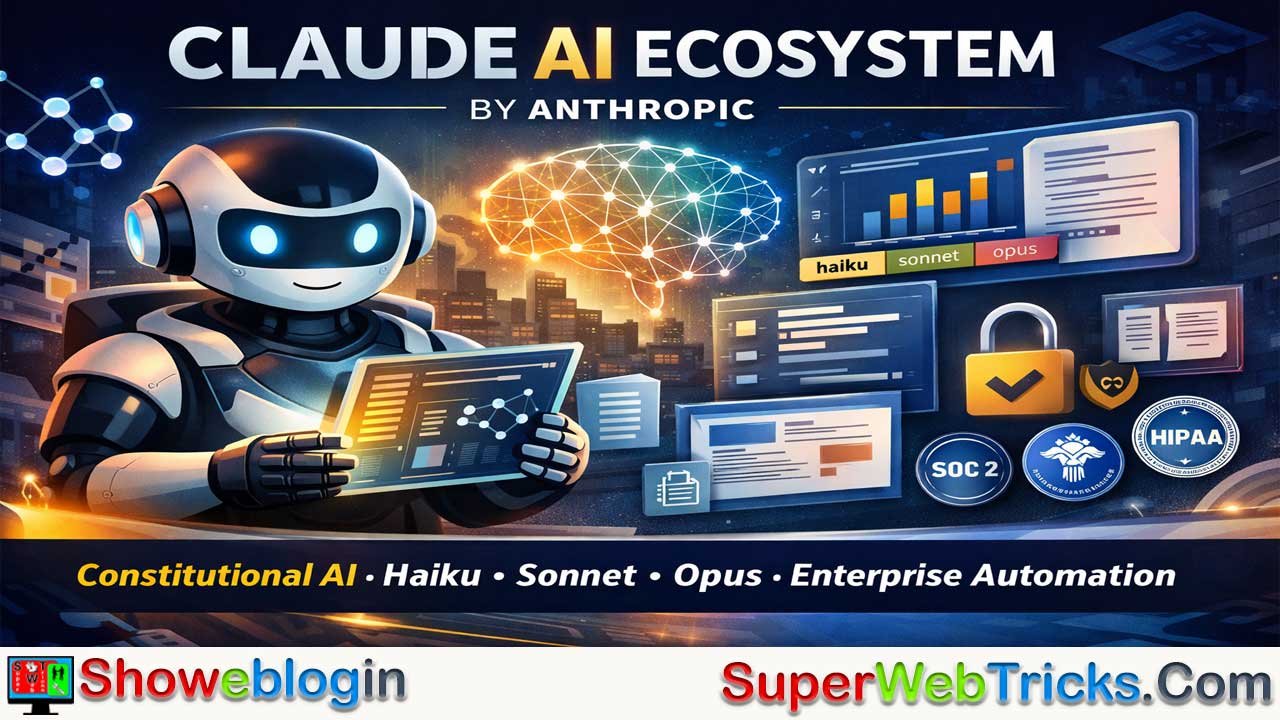






The Claude AI ecosystem, created by Anthropic and available through Claude.ai, has evolved from a simple chatbot into a powerful AI “thinking partner.” It is built using a safety-focused method called Constitutional AI, where the model follows clear ethical rules instead of relying only on human feedback.
The system uses a four-tier priority structure that puts safety and ethics before helpfulness. The Claude family includes three main models: Haiku for fast and cheap tasks, Sonnet for everyday professional work, and Opus for complex reasoning and research. The platform also offers tools like Artifacts for interactive content, Projects for managing knowledge, and advanced reasoning modes for solving difficult problems.
With features such as large context windows, agent teams, and developer tools like Claude Code, it supports coding, research, and enterprise automation. Strong security standards and compliance certifications make it suitable for industries like healthcare and finance. Overall, Claude focuses on reliability, safety, and transparency, making it an important AI platform for professional use.
| Category | Information |
|---|---|
| Platform | Claude AI |
| Developer | Anthropic |
| Core Method | Constitutional AI (rule-based ethical alignment) |
| Main Access | Claude.ai web platform |
| Model Tiers | Haiku (fast), Sonnet (balanced), Opus (most powerful) |
| Context Window | Up to 1 million tokens (beta) in advanced models |
| Key Features | Artifacts workspace, Projects knowledge base, Extended & Adaptive Thinking |
| Developer Tools | Claude Code CLI, Agent Teams, Computer Use automation |
| Main Use Cases | Coding, research, automation, enterprise workflows |
| Security & Compliance | SOC 2, HIPAA support, GDPR alignment, ISO certifications |
| Target Users | Individuals, developers, enterprises |
| Key Advantage | Strong safety, transparency, and high-quality reasoning |
Inside Claude AI: Constitutional AI, Model Tiers, and Future of AI Workspaces
The emergence of the Claude AI ecosystem, centered on the foundational portal at https://claude.ai/, represents a fundamental shift in the trajectory of large language models from reactive chatbots to proactive thinking partners. Developed by Anthropic, a Public Benefit Corporation founded by former OpenAI researchers, Claude is engineered with a primary emphasis on safety, reliability, and interpretability.
As of 2026, the ecosystem has matured into a multi-tiered infrastructure supporting individual productivity, enterprise-scale automation, and agentic software development through a unique methodology known as Constitutional AI. This analysis explores the technical architecture, functional capabilities, and strategic implications of the Claude series, providing a professional overview of its role in the modern artificial intelligence landscape.
The Genesis of Constitutional AI and the Safety-First Paradigm
The defining characteristic of the Claude models is the use of Constitutional AI (CAI), a training methodology designed to align the system with high-level normative principles without relying exclusively on large-scale human feedback. Unlike traditional Reinforcement Learning from Human Feedback (RLHF), which can inadvertently mirror the biases or inconsistencies of human labelers, CAI embeds a set of explicit, human-readable rules—a “constitution”—directly into the model’s training objective. This approach allows the model to critique its own responses and refine them according to the specified ethical framework.
The 2026 update to Claude’s Constitution reflects an unprecedented effort to democratize AI values through the Collective Constitutional AI (CCAI) project. By engaging a representative sample of approximately 1,000 participants via the Polis online deliberation platform, Anthropic identified consensus values that now supplement the expert-written principles.
The resulting framework emphasizes objectivity, impartiality, and a refusal to engage in paternalistic oversight, balancing user autonomy with the prevention of significant harm. This constitutional structure is not merely a filter but a core component of the model’s reasoning process, enabling it to act as a “conscientious objector” when faced with instructions that violate its foundational tiers.
The Four-Tier Priority Hierarchy of the 2026 Constitution
The model operates under a rigorous hierarchy that dictates its behavior when values conflict. This system ensures that safety and ethics take precedence over helpfulness.
| Tier | Objective | Functional Implications |
|---|---|---|
| Tier 1 | Broad Safety | Preventing catastrophic misuse, including assistance with bioweapons or the undermining of human oversight mechanisms. |
| Tier 2 | Broad Ethics | Maintaining high standards of honesty, sensitivity to moral uncertainty, and virtuous agency in complex decision-making. |
| Tier 3 | Policy Compliance | Adhering to specific Anthropic-issued guidelines regarding medical advice, cybersecurity requests, and jailbreaking mitigations. |
| Tier 4 | Genuinely Helpful | Maximizing substantive value for the end-user while remaining within the constraints of the higher tiers. |
This architectural alignment serves a dual purpose: it minimizes the risk of harmful outputs and enhances the model’s transparency for regulators and enterprise customers. By adhering to these principles, Claude is positioned as a uniquely stable platform for regulated industries, such as healthcare and financial services, where the consequences of model hallucination or ethical lapses are severe.
Taxonomic Overview of the Claude Model Family
The current iteration of the Claude ecosystem is powered by a diverse family of models, categorized into three performance tiers: Haiku, Sonnet, and Opus. Each tier represents a different optimization point on the spectrum of intelligence, speed, and cost, allowing users to select the most appropriate tool for their specific operational requirements.
Claude Haiku: The Efficiency Frontier
Claude Haiku is the most compact and rapid model in the lineup, designed for high-throughput tasks where latency and cost-efficiency are paramount. As of the 4.5 release, Haiku has incorporated “Extended Thinking” capabilities, allowing it to tackle more complex logic than its predecessors while maintaining a performance profile suitable for real-time applications. It is frequently deployed for automated content moderation, large-scale data classification, and supporting sub-agent pipelines in multi-agent workflows.
Claude Sonnet: The Professional Workhorse
Claude Sonnet serves as the primary model for most users on https://claude.ai/, offering a sophisticated balance of advanced reasoning and operational speed. In 2025 and 2026, Sonnet 3.5 and 3.7 became industry benchmarks for coding and tool use, often matching or exceeding the performance of significantly larger flagship models from competitors. The current Sonnet 4.6 iteration introduces “Adaptive Thinking,” which enables the model to dynamically allocate computational effort based on the perceived difficulty of a task, optimizing the cost-to-intelligence ratio.
Claude Opus: The Flagship Reasoning Engine
Claude Opus is the most capable model in the family, engineered for tasks that demand deep analytical reasoning, complex system design, and the synthesis of vast amounts of information. With the release of Opus 4.6, the model now supports a 1-million-token context window in beta, allowing it to ingest and reason across massive datasets, such as entire repositories of code or thousands of pages of legal documentation. Opus is particularly effective in environments where precision is critical and the cost of an error outweighs the cost of a high-latency, high-token-count response.
Model Specifications and Operational Costs (2026 Update)
Professional implementation requires an understanding of the per-token pricing and technical limits of each tier.
| Feature | Claude 4.5/4.6 Haiku | Claude 4.5/4.6 Sonnet | Claude 4.6 Opus |
|---|---|---|---|
| Input Price (per MTok) | $0.80 – $1.00 | $3.00 | $5.00 – $10.00 |
| Output Price (per MTok) | $4.00 – $5.00 | $15.00 | $25.00 – $37.50 |
| Context Window | 200,000 tokens | 200K (1M beta) | 1,000,000 tokens (beta) |
| Max Output Tokens | 8,192 | 64,000 | 128,000 |
| Ideal Use Case | Real-time chat, basic scripting | Production-level coding, general work | Architectural planning, deep research |
The User Interface as a Collaborative Workspace
The official website, https://claude.ai/, has evolved beyond a conversational interface to become a sophisticated collaborative environment. The platform integrates several features—Artifacts, Projects, and Memory—that bridge the gap between AI generation and professional workflow integration.
Artifacts: The Interactive Prototyping Panel
Artifacts represent a significant innovation in user experience, allowing Claude to present substantial, standalone content in a dedicated window alongside the chat. When a user requests code, a technical diagram, or a data visualization, Claude generates an interactive preview that can be viewed and iterated upon in real-time. This environment supports:
- Web Prototyping: Generating functional React components or HTML/CSS/JS websites that users can interact with immediately within the browser.
- Visual Analysis: Creating scalable SVG graphics or Mermaid flowcharts that illustrate complex processes or organizational structures.
- Data Dashboards: Transforming uploaded CSV or XLSX data into interactive charts and Gantt boards for project tracking.
In 2026, Artifacts became even more powerful with the addition of persistent storage. This allows AI-powered artifacts to save state across sessions, enabling the creation of custom productivity tools, such as journals or habit trackers, that maintain user data without requiring external database management. Furthermore, through the Model Context Protocol (MCP), Artifacts can now connect to external tools like Slack, Asana, and Google Workspace, allowing the AI to read and write data directly from the interactive panel.
Projects: Contextual Knowledge Bases
For professional users managing complex workflows, the Projects feature on https://claude.ai/ provides a mechanism for persistent context management. By creating a project, a user can define a set of instructions and upload a library of reference materials that Claude will automatically consider in every interaction within that project. This “knowledge grounding” is essential for:
- Technical Documentation: Uploading entire API documentations or coding style guides (CLAUDE.md) to ensure consistency across development tasks.
- Market Research: Maintaining a repository of internal reports, competitor analyses, and customer personas to ground marketing content in factual reality.
- Academic Work: Managing a library of research papers and meeting notes to facilitate the synthesis of complex ideas over multiple sessions.
Optimized File Handling and Context Management
The utility of Projects and the standard chat interface is governed by technical boundaries related to file size and token consumption.
| Environment | Max Files | Per-File Size Limit | Processing Detail |
|---|---|---|---|
| Standard Chat | 20 files | 30 MB | Best for quick analysis or single documents. |
| Project Knowledge Base | Unlimited | 30 MB | Limited only by the 200K total token window. |
| Files API (Beta) | N/A | 500 MB | Designed for massive data ingestion in enterprise apps. |
To maximize the efficiency of the 200,000-token context window, users are advised to convert spreadsheets to CSV format, which strips unnecessary formatting tokens and allows the model to process more actual data. For large PDFs, Claude extracts text by default; however, multimodal PDFs can be processed to allow the model to “see” and interpret charts, graphs, and images embedded in the text.
Advanced Reasoning Modes: From Thinking to Execution
A major leap in the Claude 4.5 and 4.6 generations is the introduction of advanced reasoning modes that allow the model to allocate more time and computation to difficult problems. This “test-time compute” scaling is the engine behind Claude’s industry-leading performance in coding and mathematics.
Extended Thinking and Effort Controls
Extended Thinking gives Claude a “scratchpad” where it can reason through a problem, check for errors, and explore multiple potential solutions before generating a final response. This mode is visible to the user, providing a transparent window into the model’s logic and increasing trust in its outputs.
Developers and power users on the Pro and Max plans can control this process through “Effort” parameters :
- Max Effort: Instructs the model to use the maximum possible number of “thinking tokens” to solve the most complex architectural or mathematical problems.
- High Effort: The default for Opus models, ensuring thorough reasoning for typical professional tasks.
- Medium/Low Effort: Reduces latency and cost for simpler queries where deep deliberation is unnecessary.
Adaptive Thinking and Context Compaction
In the latest 4.6 release, the introduction of Adaptive Thinking allows Claude to autonomously determine the necessary level of deliberation. The model evaluates the complexity of the prompt and “thinks” only as much as required, preventing over-investment in simple tasks like routine email drafting.
Complementing this is the Context Compaction feature (currently in beta), which addresses the “context wall” encountered in long-running conversations. As a session approaches the context window limit, the system automatically summarizes the history into a concise block, preserving essential information while freeing up token space for new input. This enables effectively “infinite” conversations for multi-month projects.
Agentic Autonomy and the Evolution of the Workspace
The transition of Claude from a text generator to an autonomous agent is facilitated by three key technologies: Claude Code, Computer Use, and Agent Teams.
Claude Code: The Terminal-Native Engineer
Claude Code is a command-line interface (CLI) that allows the model to operate directly within a developer’s local file system. It can read, write, and execute code, manage Git repositories, and run test suites autonomously. Unlike a standard chat interface, Claude Code is designed for agentic tasks, such as “Identify the root cause of this bug, write a fix, run the tests to verify, and submit a pull request”.
Developers configure Claude Code’s behavior using specialized markdown files:
- CLAUDE.md: Defines project-specific coding standards, architecture decisions, and preferred libraries.
- SKILLS.md: Allows users to package repeatable workflows that the agent can use across different sessions.
Agent Teams and Parallel Workflows
The Claude 4.6 architecture introduces Agent Teams, which allow a single session to spin up multiple, independent Claude instances working in parallel. A “lead” agent coordinates the strategy, while “teammate” agents handle execution on different parts of a project simultaneously. This parallelization allows for a fundamentally different way of working: one agent can analyze a database schema while another drafts API documentation and a third writes unit tests. These agents communicate via a secure “Mailbox Protocol,” ensuring that they stay synchronized without bloating the primary context window.
Computer Use: Bridging the Digital Divide
Through its “Computer Use” capability, Claude 3.5 Sonnet and newer models can interact with any standard desktop application. By interpreting screenshots and issuing virtual mouse clicks and keystrokes, the model can navigate legacy software, fill out web forms, and move data between disparate applications that lack official APIs. This is particularly useful for:
- Quality Assurance: Automating the testing of user interfaces across different screen resolutions and browsers.
- Administrative Automation: Managing data entry tasks that require navigating multiple tabs and windows in a non-standardized environment.
Strategic Benchmarks and Competitive Analysis
In the 2026 frontier model landscape, Claude models—particularly the Opus 4.6 and Sonnet 4.5/4.6 variants—are evaluated against competitors like OpenAI’s GPT-5.2 and Google’s Gemini 3. While competition is fierce, Claude distinguishes itself in several critical domains.
Software Engineering and Code Quality
Claude Opus 4.6 leads the industry in autonomous software engineering, achieving an 80.9% score on the SWE-bench Verified benchmark. This score, which measures a model’s ability to resolve real-world GitHub issues, places Opus ahead of GPT-5.2 (80.0%) and Gemini 3 Pro (76.2%).
More importantly, analysis of code quality by organizations like SonarSource suggests that Claude models produce more secure and maintainable code. Claude Opus 4.6 and Sonnet 4.5 demonstrate significantly lower rates of resource management leaks and concurrency errors compared to GPT-5.2, which, while powerful, generates nearly double the number of concurrency issues per million lines of code.
Abstract Reasoning and Robustness
On the ARC-AGI-2 benchmark—a measure of a model’s ability to solve novel logic problems that it likely has not encountered in its training data—Claude Opus 4.6 achieved a score of 37.6%. This is a massive improvement over previous generations and significantly higher than the results from GPT-5.1 (17.6%) and Gemini 3 Pro (31.1%).
Furthermore, Claude’s constitutional training makes it industry-leading in its resistance to prompt injection attacks. Testing shows an attack success rate of just 4.7% for Claude Opus 4.5, compared to 12.5% for Gemini 3 Pro and 21.9% for GPT-5.1. This robustness is a critical factor for enterprise deployments that must protect against malicious user input.
Domain-Specific Performance Metrics
Professional users should consider the following comparative data when selecting a model for specialized tasks.
| Benchmark | Model: Claude Opus 4.6 | Model: GPT-5.2 | Model: Gemini 3 Pro |
|---|---|---|---|
| AIME 2025 (Math) | 92.8% | 100.0% | 95.0% |
| Terminal-Bench 2.0 | 65.4% | 47.6% (v5.1) | 54.2% |
| MMMLU (Knowledge) | 90.8% | 91.0% (v5.1) | 91.8% |
| Humanity’s Last Exam | 43.2% | ~41.0% | 43.0% |
Enterprise Governance, Security, and Compliance
For organizations deploying AI at scale, the technical capabilities of a model are only as valuable as the security framework surrounding them. Anthropic has designed the Claude ecosystem to meet the most stringent global standards for data protection and regulatory compliance.
Certification Stack for 2026
Claude maintains a comprehensive set of certifications that allow it to be used in high-security environments.
- SOC 2 Type II: Verification by independent auditors that Anthropic’s security controls operate effectively over time, providing assurance for enterprise procurement teams.
- HIPAA Compliance: Available for Enterprise customers via a signed Business Associate Agreement (BAA), enabling the secure processing of Protected Health Information (PHI).
- GDPR Alignment: Anthropic provides a standard Data Processing Agreement (DPA) and ensures that user data is processed only for the intended purposes and never for training foundational models on Team/Enterprise plans.
- ISO 27001 & ISO 42001: Certifications for Information Security Management and Artificial Intelligence Management Systems, respectively.
- FedRAMP High: Authorization for use by US federal agencies, indicating a level of security suitable for highly sensitive unclassified government data.
Data Residency and Subprocessor Transparency
Anthropic offers US-only inference for organizations with strict data residency requirements, albeit at a 1.1x token pricing premium. The company also maintains a public Trust Center where customers can request detailed SOC 2 reports and review the list of approved subprocessors, which includes primary infrastructure providers like AWS and Google Cloud.
Economic ROI and Pricing Strategies for Professionals
The subscription model for Claude is structured to provide clear ROI for different tiers of use. For individuals, the $20/month Pro plan is designed to pay for itself through increased efficiency in research and drafting.
Comparative ROI of Claude Subscription Tiers
An analysis of user behavior and economic value suggests the following breakdown for professional investment.
| Plan Tier | Monthly Cost | Primary Economic Value Driver | Target ROI Profile |
|---|---|---|---|
| Free | $0 | Basic summarization and email polishing. | Casual users; <5 hours/week. |
| Pro | $20 | 5x usage; Project organization; Google Workspace integration. | Power users; 20+ hours/week; saves ~10 hours/month. |
| Max 100/200 | $100 – $200 | 25x-100x usage; Extended Thinking; high-throughput coding. | Developers and analysts; eliminates need for sub-API keys. |
| Team/Ent. | $25 – $35+ | Shared knowledge bases; admin controls; BAA/Compliance. | Organizations seeking shared context and governance. |
For a developer using the Claude Code tool, the subscription effectively acts as a “cap” on expenses. While an individual using the Sonnet 4.6 model via API might spend $100–$200 per month based on token consumption, the high-tier subscriptions provide a predictable fixed cost for similar levels of agentic activity.
Strategic Synthesis and Future Outlook
The landscape of AI as viewed through the prism of https://claude.ai/ is one of increasing integration and agentic autonomy. The evolution from the “stone tablet” principles of the early Claude models to the sophisticated, public-informed 2026 Constitution demonstrates a commitment to building systems that are not just powerful, but also socially responsible and legally compliant.
For the AI tool user, the Claude ecosystem offers a unique “thinking partner” that prioritizes accuracy and security over mere responsiveness. The combination of the Artifacts interactive workspace, the Projects persistent knowledge base, and the advanced reasoning of the 4.6 model family provides a robust platform for tackling the most complex professional challenges. As the model family moves toward 1-million-token context windows and autonomous agent teams, the role of the user is shifting from “operator” to “orchestrator,” leveraging Claude’s constitutional reasoning to manage increasingly large-scale and high-stakes projects.
Ultimately, the value of Claude lies in its reliability. By conducting exhaustive research into how the model thinks and providing users with visible extended thinking, Anthropic has created an environment where the AI’s actions are interpretable and its errors are easier to diagnose. This transparency, coupled with industry-leading benchmarks and enterprise-grade security, positions Claude as a central pillar of the professional AI stack in 2026 and beyond.
FAQs about Claude AI
What is Claude AI?
Claude AI is an advanced artificial intelligence system developed by Anthropic. It is designed to help users with tasks like writing, coding, research, and automation while prioritizing safety and reliability.
How is Claude AI different from other AI models?
Claude AI focuses strongly on safety and ethical alignment through a training method called Constitutional AI. This approach allows the model to follow clear principles when generating responses.
What models are included in the Claude AI ecosystem?
The Claude ecosystem includes three main models: Haiku for fast and cost-efficient tasks, Sonnet for balanced everyday work, and Opus for complex reasoning and advanced analysis.
What can users do on Claude.ai?
Users can write content, analyze documents, generate code, create visual prototypes, manage research projects, and collaborate with AI using features like Artifacts and Projects.
What is Constitutional AI?
Constitutional AI is a training approach where AI follows a set of predefined ethical rules or principles. The system can review and improve its own answers based on these guidelines.
Who typically uses Claude AI?
Claude AI is used by individuals, developers, researchers, and enterprises for tasks such as software development, business analysis, academic research, and workflow automation.
Is Claude AI secure for enterprise use?
Yes. Claude AI supports enterprise-level security standards such as SOC 2 compliance, GDPR alignment, and HIPAA support for organizations that need strict data protection.











Leave a Reply
You must be logged in to post a comment.