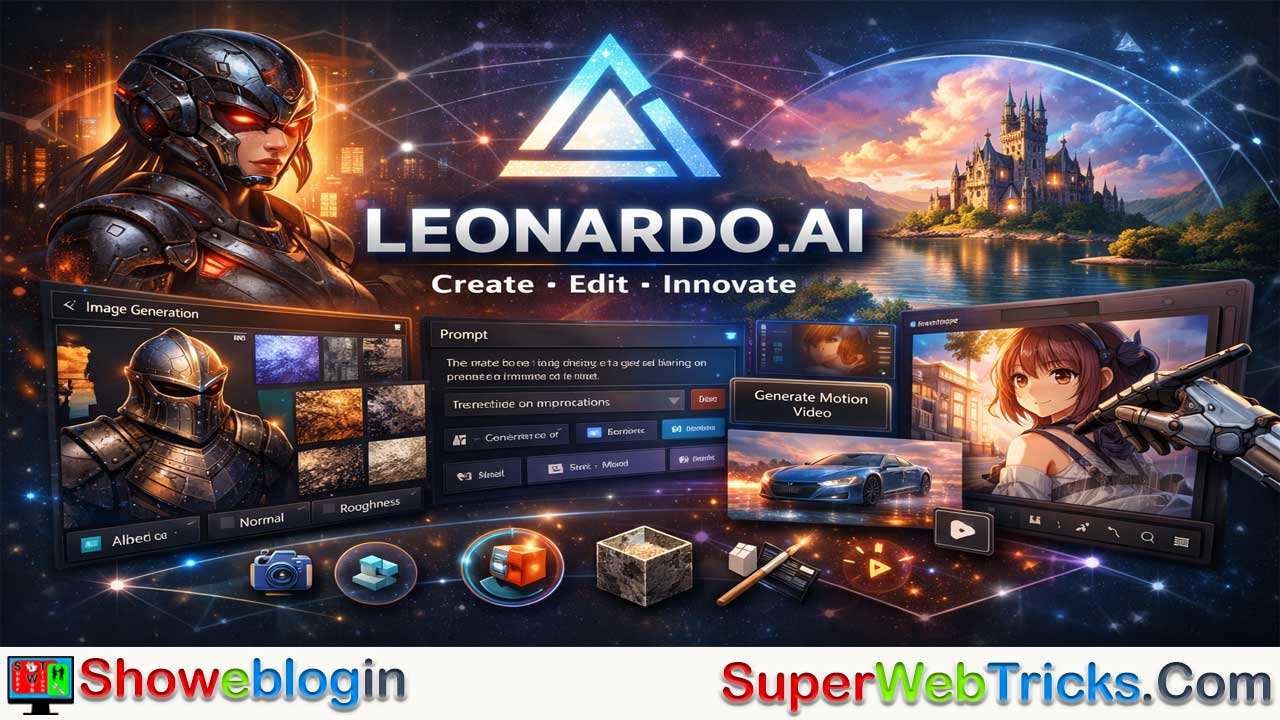




Leonardo.AI is a web-based generative AI tool that lets users create, edit, and animate images directly in a browser without needing powerful hardware. Built on Stable Diffusion, it offers a professional dashboard with features like image generation, fine-tuned models for different styles, prompt and negative prompt controls, and tools such as Alchemy, Elements, and AI Canvas for editing and expanding images.
Users get 150 free tokens daily to generate images, making it easy to experiment before paying. It also supports real-time sketch-to-image creation, motion video generation, and 3D texture creation for game assets. Compared with tools like Midjourney and DALL‑E 3, it provides more control and editing options. Overall, it is a powerful and accessible AI creative suite for artists, designers, developers, and beginners.
| Category | Details |
|---|---|
| Type | Web-based generative AI creative platform |
| Core Function | Create and edit AI images using text prompts |
| Technology Base | Built on Stable Diffusion models |
| Free Plan | 150 tokens daily for image generation |
| Main Tools | Image Generation, AI Canvas, Realtime Canvas |
| Special Features | Alchemy rendering, Elements style filters, Prompt Magic |
| Guidance Tools | ControlNet options like depth, edge, and pose guidance |
| Extra Capabilities | Motion video generation and 3D texture creation |
| Target Users | Artists, designers, marketers, and game developers |
| Competitors | Midjourney, DALL-E 3 |
| Access | Browser-based platform (no GPU needed) |
| Ownership | Users generally own generated images (based on terms and local laws) |
Mastering the Canvas of the Future: A Comprehensive Guide to Leonardo.AI
In the rapidly evolving landscape of generative artificial intelligence, few platforms have managed to strike the perfect balance between professional-grade power and consumer-level accessibility. While Midjourney dominates the conversation with its artistic “soul” and DALL-E 3 wins on simplicity, Leonardo.AI (accessible at https://app.leonardo.ai/) has carved out a massive niche as the ultimate creative suite for power users, designers, and hobbyists alike.
This article serves as an exhaustive deep dive into Leonardo.AI. Whether you are a digital artist looking to speed up your workflow, a game developer needing textures, or a marketing professional crafting social media assets, this guide will help you navigate the depths of this sophisticated platform.
What is Leonardo.AI?
Leonardo.AI is a web-based generative AI platform built primarily on the foundations of Stable Diffusion, but it is much more than a simple “wrapper.” It is a full-stack production suite that offers a GUI (Graphical User Interface) for complex AI processes that previously required technical knowledge and local GPU setups.
The platform allows users to generate high-quality images, edit them with surgical precision, create 3D textures, and even generate short video clips—all within a browser. Unlike its competitors, Leonardo.AI provides a “freemium” model that is remarkably generous, giving users 150 daily tokens to experiment with for free.
The Dashboard: Your Command Center
Upon logging into Leonardo.AI, you aren’t met with a simple chat box. Instead, you enter a professional dashboard.
- Community Feed: A constant stream of inspiration where you can see what others are creating. Crucially, you can click on any image to see the prompt, the negative prompt, the model used, and the “Seed” number. This transparency makes it one of the best learning tools in the AI space.
- Personal Feed: Where your history is stored. It’s organized, searchable, and allows for easy revisiting of past projects.
- Fine-tuned Models: This is where Leonardo shines. Instead of using a generic “AI,” you can choose specific “engines” optimized for portraits, architecture, RPG items, or photorealistic landscapes.
The Power of Fine-Tuned Models
The secret to Leonardo’s high-quality output lies in its specialized models. While you can use base models like Stable Diffusion XL (SDXL), Leonardo offers proprietary models that have been “fine-tuned” on specific datasets.
- Leonardo Vision XL: Excellent for photorealism and high-detail cinematic shots.
- Leonardo Diffusion XL: A versatile model that balances artistic flair with realism.
- AlbedoBase XL: Great for CG-style characters and smooth, 3D-rendered aesthetics.
- PhotoReal: A dedicated pipeline for generating images that are indistinguishable from real photography, handling lighting and skin textures with incredible accuracy.
Understanding the Token System
Leonardo.AI operates on a token-based economy.
- The Daily Reset: Free users receive 150 tokens every 24 hours.
- Usage Costs: A standard image might cost 1 token, but enabling advanced features like “Alchemy” or “PhotoReal” might cost 10–20 tokens per generation.
- The Advantage: This system allows users to “try before they buy” every single day, a stark contrast to platforms that require a subscription just to see the interface.
Core Feature: Image Generation
The “Image Generation” tab is where the magic happens. Here, Leonardo provides tools that give you more control than almost any other cloud-based AI.
Prompting and Negative Prompts
In Leonardo, you have a box for what you want to see and a box for what you don’t want to see (Negative Prompts). Negative prompts are essential for removing “distortions,” “extra fingers,” or “blurry backgrounds.”
Image Guidance (ControlNet)
One of Leonardo’s most powerful features is Image Guidance. This allows you to upload a reference image to guide the AI.
- Depth to Image: The AI looks at the 3D structure of your uploaded image and applies it to the new prompt.
- Edge to Image (Canny): The AI follows the outlines/edges of your reference.
- Pose to Image: If you upload a photo of someone standing in a specific pose, the AI will generate your character in that exact same stance.
Prompt Magic
For beginners who struggle with “prompt engineering,” Leonardo offers Prompt Magic. This feature automatically expands and enhances your simple prompt behind the scenes to produce more complex, aesthetically pleasing results.
The “Alchemy” Pipeline
Alchemy is Leonardo’s proprietary image-to-image and rendering pipeline. When you toggle Alchemy on, the platform uses a more sophisticated sampling method. It increases the resolution, improves the lighting, and ensures that the “intent” of the prompt is followed more strictly. It is often the difference between a “good” AI image and a “professional” one.
Elements: The “Style Filters” of AI
“Elements” are essentially Lora (Low-Rank Adaptation) weights made easy. Instead of knowing how to code or train a model, you can simply click “Add Element” and select styles like:
- Ebony & Gold: Adds a luxury, dark-thematic aesthetic.
- Toxic Wasteland: Adds a gritty, post-apocalyptic green hue.
- Gingerbread: Turns objects or characters into festive cookies.
You can stack multiple elements and adjust the “strength” of each, allowing for a level of stylistic blending that is rarely seen in other tools.
The AI Canvas: Beyond the Square
Most AI tools generate a square image and stop there. Leonardo’s AI Canvas is an “Inpainting” and “Outpainting” editor.
- Outpainting: Suppose you have a portrait but want to see the rest of the room. You can move the generation box to the edge of the image and “expand” the canvas. The AI will look at the existing image and “paint” what should come next.
- Inpainting: Did the AI generate a perfect character but with a hat you don’t like? You can mask (erase) the hat and prompt the AI to replace it with a “silver crown.”
Realtime Canvas and Gen
Leonardo recently introduced Realtime Canvas, which is a game-changer for artists. As you draw a rough sketch on the left side of the screen, the AI generates a high-quality image on the right in real-time. This allows for an iterative process where you can physically guide the composition of the image with your mouse or stylus.
Leonardo Motion: Bringing Art to Life
Not content with just static images, the platform includes Motion. With a single click on an image you’ve generated, you can select “Generate Motion Video.” You can adjust the “Motion Strength” to decide whether you want a subtle hair movement or a sweeping cinematic camera pan. This is perfect for creating social media content or “living” concept art.
3D Texture Generation
For the game developers and 3D artists, Leonardo offers a specialized tool for texturing 3D objects. You can upload an .OBJ file (like a 3D model of a sword or a building), and the AI will “wrap” it in a texture based on your prompt. It generates the Albedo, Normal, and Roughness maps, significantly cutting down the time required for asset creation.
Strategic Prompt Engineering for Leonardo.AI
To get the most out of your tokens, you need to prompt effectively. A “pro” Leonardo prompt usually follows this structure:
- Subject: (e.g., A cybernetic samurai)
- Action/Context: (e.g., standing in a rain-soaked Neo-Tokyo street)
- Lighting: (e.g., cinematic rim lighting, neon glow, volumetric fog)
- Style/Medium: (e.g., 8k resolution, shot on 35mm film, hyper-realistic, intricate detail)
- Artist References (Optional): (e.g., in the style of Hayao Miyazaki or Syd Mead)
Pro Tip: Use the Prompt Generation tool within the dashboard. Type in “A futuristic car,” and the AI will suggest 4-5 highly descriptive prompts to help you achieve a more professional look.
Commercial Rights and Subscription Tiers
For many users, the primary concern is ownership.
- Free Users: You can use your images for personal use, but your images are public by default (anyone can see them in the community feed).
- Paid Users: Tiers like “Apprentice,” “Artisan,” and “Maestro” allow for Private Generations. This is crucial for businesses and professional artists who don’t want their concepts leaked or copied before they are ready.
- Copyright: Under Leonardo’s current terms, users own the images they create (subject to local laws), but the platform provides the infrastructure.
Leonardo.AI vs. The Competition
How does it stack up?
- vs. Midjourney: Midjourney often produces more “artistic” or “abstract” results with less effort, but it lives inside Discord, which many find clunky. Leonardo offers more control, better editing tools (Canvas), and a dedicated web interface.
- vs. DALL-E 3: DALL-E 3 is better at following complex instructions (like text inside images), but it lacks the “artistic” finish and the fine-tuned model selection that Leonardo provides.
- vs. Local Stable Diffusion: Local setups are free and uncensored but require a $1,000+ GPU and technical expertise. Leonardo provides the “Stable Diffusion” power without the hardware headache.
The Future: Where is Leonardo Going?
The team behind Leonardo.AI is iterating at a breakneck pace. They are moving toward a more integrated “Creative Cloud” for AI. We can expect to see more video features, better integration with professional design software (like Photoshop plugins), and even more “Realtime” capabilities as Latent Consistency Models (LCMs) improve.
Conclusion: Why You Should Start Today
Leonardo.AI is arguably the most well-rounded AI image generator currently available. It respects the user’s need for control while providing enough automation to keep things fun for beginners.
By offering a robust free tier, a massive library of community-created models, and a suite of editing tools that go far beyond simple prompting, Leonardo has democratized digital art. Whether you are building a brand, designing a game, or just exploring the limits of your imagination, the canvas at app.leonardo.ai is waiting for you.
Final Advice for New Users:
Don’t be afraid to fail. Spend your 150 daily tokens experimenting with different “Models” and “Elements.” Look at the Community Feed, “Remix” an image you like, and see how the prompt was built. In the world of AI art, your greatest skill isn’t your ability to draw—it’s your ability to describe, iterate, and refine.
FAQs about Leonardo.AI
What is Leonardo.AI used for?
It is used to generate, edit, and enhance images using AI prompts. Users can also create videos, textures, and concept art directly in a browser.
Is Leonardo.AI free to use?
Yes. Free users receive about 150 tokens daily, which can be used to generate images and test most core features.
How is Leonardo.AI different from Midjourney?
Leonardo.AI offers more editing tools, a visual dashboard, and features like AI Canvas and model selection, while Midjourney focuses more on artistic image results.
How does Leonardo.AI compare with DALL-E 3?
DALL-E 3 is better at understanding complex prompts and text in images, while Leonardo.AI provides more creative control, models, and editing tools.
What are tokens in Leonardo.AI?
Tokens are credits used to generate images or use advanced features. Each generation costs a certain number of tokens depending on the settings.
Can beginners use Leonardo.AI easily?
Yes. Features like Prompt Magic and the community feed help beginners learn how to write prompts and generate better images.
Does Leonardo.AI support image editing?
Yes. With AI Canvas, users can perform inpainting (edit parts of an image) and outpainting (expand the image beyond its borders).
Who typically uses Leonardo.AI?
Digital artists, designers, marketers, content creators, and game developers commonly use it to create visuals, assets, and concept art.






Leave a Reply
You must be logged in to post a comment.