


I tested Hint for 30 days to see if it was more than a basic horoscope app. At first, I was skeptical about astrology. But Hint asks for your exact birth time and builds a detailed birth chart using real astronomical data.
The daily insights felt personal and practical, like warnings to pause before sending an angry message. The app mixes AI with real human astrologers, which makes the advice deeper and more thoughtful. Its palm scanning feature uses your phone camera to analyze your hand lines, which was surprisingly accurate. The relationship section also gave helpful insights about communication and emotions.
The design is clean and modern, and the guidance is honest, even on difficult days. It requires a subscription, but it feels like having a 24/7 self-awareness coach. Overall, Hint is a unique AI tool that focuses on personal growth instead of productivity.
| Category | Details |
|---|---|
| Type | AI-powered astrology & self-discovery app |
| Core Input | Exact birth date, city, and minute |
| Main Features | Personalized birth chart, Daily Insights, Relationship compatibility, Palm scanning |
| AI Role | Calculates charts, tracks planetary transits, generates daily guidance |
| Human Role | Professional astrologers answer complex personal questions |
| Palmistry Tool | Uses computer vision to scan and analyze palm lines |
| Relationship Tool | Synastry analysis (communication, emotion, attraction breakdown) |
| UX Design | Dark mode, minimalist interface, glossary for learning |
| Pricing Model | Subscription-based |
| Main Benefit | Improves self-awareness and emotional intelligence |
The Digital Oracle: My 30-Day Deep Dive into Hint App’s AI-Powered Astrology
In the hyper-accelerated world of Artificial Intelligence, we are often looking for tools that boost productivity, automate our workflows, or generate stunning visuals. But recently, a different kind of AI tool has been gaining traction—one that looks inward rather than outward. I’m talking about Hint (accessible at https://hint.app/), an AI-driven astrology and self-discovery platform that promises to bridge the gap between ancient celestial wisdom and modern computational power.
As someone who spends eight hours a day toggling between LLMs and data analytics tools, I’ve always been a bit of a “spiritual skeptic.” I viewed astrology as fun but generic—the “you will encounter a tall stranger” brand of vagueness. However, after hearing buzz about Hint’s high-precision algorithms and its integration of human expertise, I decided to conduct a month-long experiment.
Is Hint just another notification-heavy horoscope app, or is it a sophisticated personal growth engine? Here is my first-hand experience navigating the “Cosmic Weather” with Hint.
The Onboarding: Precision as a Foundation
The first thing that struck me about Hint was the onboarding process. Most “AI” tools start with a simple email sign-up. Hint starts with data. To build my “Cosmic Profile,” the app required my exact birth date, the city I was born in, and—crucially—the exact minute of my birth.
For the uninitiated, astrology is essentially a snapshot of the sky at the moment of your first breath. In the tech world, we talk about “Garbage In, Garbage Out.” If your birth time is off by even thirty minutes, the entire “dataset” of your life (the houses and the rising sign) shifts. Hint’s interface made it clear that they weren’t looking for approximations; they were looking for parameters.
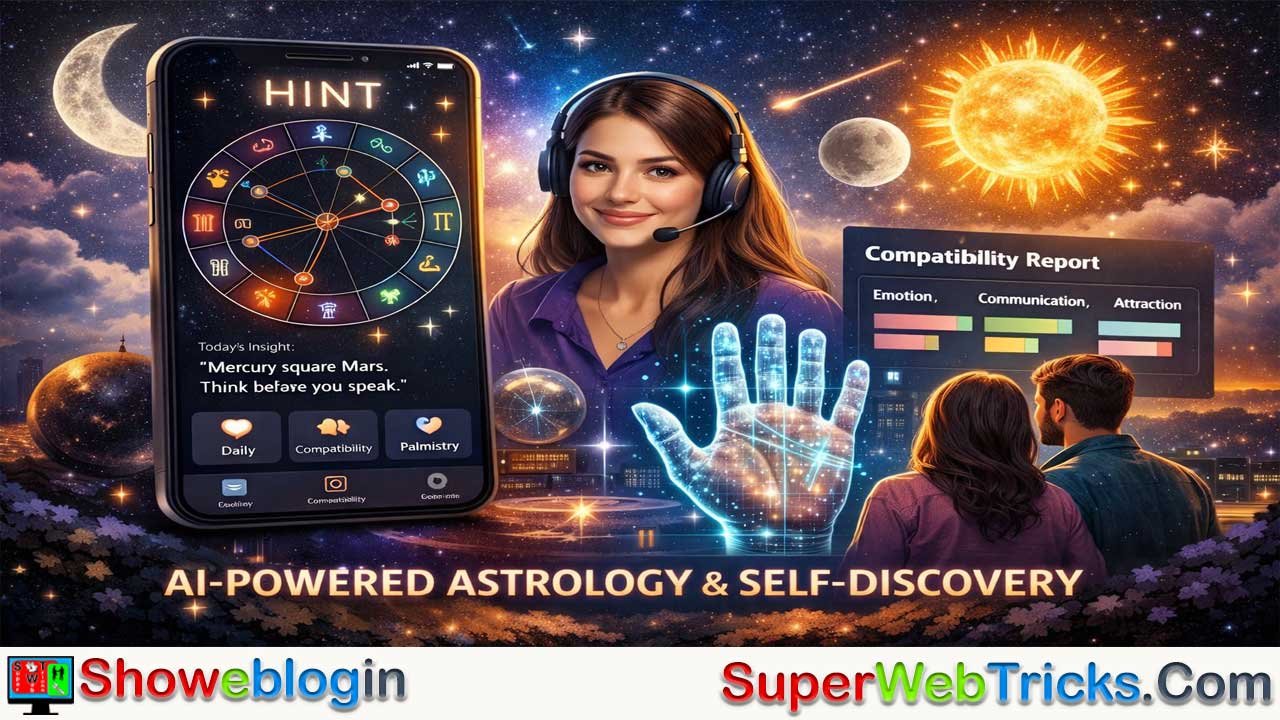
Once my data was in, the AI didn’t just spit out a paragraph of text. It generated a comprehensive astronomical map. I saw my Sun, Moon, and Rising signs, but also the more complex placements like Mercury in Scorpio and my Midheaven in Leo. For an AI user, this felt like looking at a personalized dashboard. The UI is sleek, minimalist, and devoid of the “crystal-ball” clichés that usually plague the industry.
The “Aha!” Moment: The Personal Assistant I Didn’t Know I Needed
The core of the Hint experience is the Daily Insight. This isn’t your grandfather’s newspaper horoscope. It uses a combination of planetary transits (where the planets are now) compared against your natal chart (where they were when you were born).
About four days into using the app, I received a notification: “Mercury is squaring your Natal Mars today. You might feel an impulsive urge to send a sharp email. Pause before you hit send.”
That morning, I had actually been fuming over a project delay and had drafted a particularly “spicy” Slack message to a developer. I read the Hint notification, laughed at the coincidence, and then looked at the clock. The transit was at its peak. I deleted the draft, took a walk, and sent a much more constructive message an hour later.
This was my first realization: Hint isn’t trying to predict the future; it’s providing context for the present. It’s an emotional intelligence (EQ) tool powered by astronomical data.
The Human-AI Hybrid: The “Ask an Astrologer” Feature
What separates Hint from a basic script or a generic LLM like ChatGPT is its hybrid model. While the daily insights and chart calculations are handled by AI, the app offers a direct line to professional human astrologers.
I decided to test this. I asked a complex question about my career path, specifically regarding a transition from corporate work to freelance consulting. I expected a canned response. Instead, twenty-four hours later, I received a detailed breakdown from an astrologer named Elena.
She didn’t just say, “Follow your heart.” She pointed to my Saturn Return and my 10th House placements, explaining how the current Jupiter transit was hitting my chart in a way that favored expansion but required strict discipline. The response felt like a collaborative consultation. The AI handles the “what” (the data and the math), while the human handles the “so what” (the nuance and the empathy).
For an AI enthusiast, this is the “Golden Ratio” of tech—using automation to handle the heavy lifting while leaving the high-level interpretation to a human expert.
Palmistry in the Age of Computer Vision
One of the most tech-forward features on Hint.app is the Palmistry tool. This is where the AI really flexes its muscles.
The app asks you to scan your palm using your phone’s camera. Using computer vision, it maps the lines of your hand—the Life line, Heart line, and Head line. I’ve seen “AI filters” before, but this felt different. The app provided a real-time overlay, identifying the breaks and curves in my palm with surprising accuracy.
The reading that followed was eerily specific. It noted a “forked” Heart line, suggesting a tendency to balance logic and emotion in relationships—a trait my partner has been telling me I possess for years. Whether you believe in the mystical origins of palmistry or not, the technical execution of the scan was impressive. It’s a great example of how AI can digitize “analog” spiritual practices.
Navigating Relationships: The Compatibility Engine
We’ve all seen “compatibility calculators,” but Hint’s Relationship section is a deep dive into Synastry—the art of overlaying two birth charts to see where they click and where they clash.
I invited my partner to join (the app makes it easy to share links and compare profiles). Hint doesn’t just give you a “Compatibility Score” out of 100. It breaks it down into categories:
- Communication: How your Mercuries interact.
- Emotion: How your Moons align.
- Attraction: The Venus/Mars dynamic.
It highlighted that while our emotional bond was incredibly strong, our communication styles (Square Mercury) often led to “data loss.” We tended to interpret the same words differently. Seeing this visualized as a “friction point” in an app made it much easier to discuss in real life. It removed the blame. It wasn’t “you’re being difficult”; it was “our Mercuries are squaring, let’s try to over-explain our intentions.”
The User Interface and Experience (UX)
From a purely technical standpoint, the Hint app is a masterclass in modern UX.
- Dark Mode by Default: The aesthetic is “Cosmic Chic.” It feels premium and calming.
- The “Cosmic Weather” Widget: I found myself checking the “Daily Vibe” much like I check the weather or my stock portfolio. It tells you if the day is “Productive,” “Emotional,” or “Social.”
- Education: One of Hint’s best features is its glossary. If you don’t know what a “Trine” or a “House” is, you can tap the term for a concise, AI-generated explanation. It’s a learning tool as much as a guidance tool.
The Question of AI Accuracy: Is it “Real”?
As an AI user, I have to address the “hallucination” factor. Does Hint just tell you what you want to hear?
During my 30 days, I noticed that Hint didn’t shy away from “bad” days. It wasn’t all sunshine and rainbows. Some days it warned me of low energy or potential conflict. This “honesty” in the algorithm actually increased my trust in the tool. If every day was “Your Best Day Ever!”, I would have deleted the app within a week.
Furthermore, Hint’s data is rooted in Ephemeris data—the actual mathematical positions of celestial bodies. This isn’t random number generation. It’s a specialized application of data science where the “data” is the movement of the solar system.
Comparison: Why Hint vs. ChatGPT?
I tried asking ChatGPT-4o to “Give me an astrology reading based on my birth chart.” While ChatGPT is impressive, it lacks the specialized “fine-tuning” that Hint possesses.
- Dynamic Updates: ChatGPT doesn’t know where the planets are right now in relation to your chart without a lot of manual prompting. Hint does this automatically and continuously.
- Specialized Human Feedback: You can’t ask ChatGPT for a second opinion from a human astrologer who understands the nuances of 20 years of practice.
- Visual Interaction: The palm scanning and the interactive birth chart are features an LLM simply cannot replicate in a meaningful way.
The Cost: Is the Subscription Worth It?
Hint follows a subscription model, which might be a hurdle for some. However, when you consider the cost of a single professional astrology reading (which can range from $100 to $300), the annual price of Hint becomes much more palatable. You aren’t just paying for an app; you’re paying for a 24/7 personal consultant.
For the value-conscious AI user, the ROI (Return on Investment) comes in the form of Self-Awareness. If the app helps you avoid one unnecessary argument or gives you the confidence to pitch an idea when the “Cosmic Weather” is in your favor, it has paid for itself.
Final Verdict: The Future of Personalized AI
After 30 days of using Hint.app, my skepticism has evolved into genuine appreciation. We live in a world of “Big Data” that often makes us feel like small numbers. Hint uses that same “Big Data” (the movement of the stars and the lines on our hands) to make us feel like significant individuals.
It’s an AI tool that doesn’t try to replace your brain—it tries to help you understand your heart and your habits. Whether you’re a hardcore believer in the zodiac or a tech-obsessed developer looking for a new kind of “personal dashboard,” Hint offers a unique, polished, and surprisingly insightful experience.
The Pros:
- High-precision astronomical data.
- Incredible palm-scanning technology.
- Direct access to human experts (the “killer feature”).
- Beautiful, distraction-free UI.
- Actionable daily insights that improve EQ.
The Cons:
- Requires a subscription for full access.
- The sheer amount of data can be overwhelming for beginners (though the glossary helps).
Bottom Line: If you want an AI tool that helps you debug your life rather than just your code, give Hint a try. It’s the closest thing to a “User Manual for Yourself” that I’ve found in the App Store.
FAQs about Hint
What is Hint?
Hint is an AI-powered astrology and self-discovery app that creates personalized birth charts and daily insights using your exact birth details.
How does Hint generate personalized readings?
It uses your birth date, location, and exact birth time to calculate your natal chart and compares it with current planetary movements.
Does Hint use real astrologers?
Yes. In addition to AI-generated insights, users can ask professional human astrologers detailed personal questions.
What makes Hint different from regular horoscope apps?
Hint provides precise chart calculations, real-time planetary transits, relationship compatibility analysis, and palm scanning technology instead of generic daily horoscopes.
How does the palm scanning feature work?
The app uses your phone camera and computer vision to analyze palm lines and generate a personalized palm reading.
Is Hint suitable for beginners in astrology?
Yes. It includes a built-in glossary and simple explanations to help users understand astrological terms.
Does Hint require a subscription?
Yes. Full access to features like detailed insights and astrologer consultations requires a paid subscription.
Is Hint focused on prediction or personal growth?
It focuses more on self-awareness and emotional intelligence rather than predicting fixed future events.









Leave a Reply
You must be logged in to post a comment.