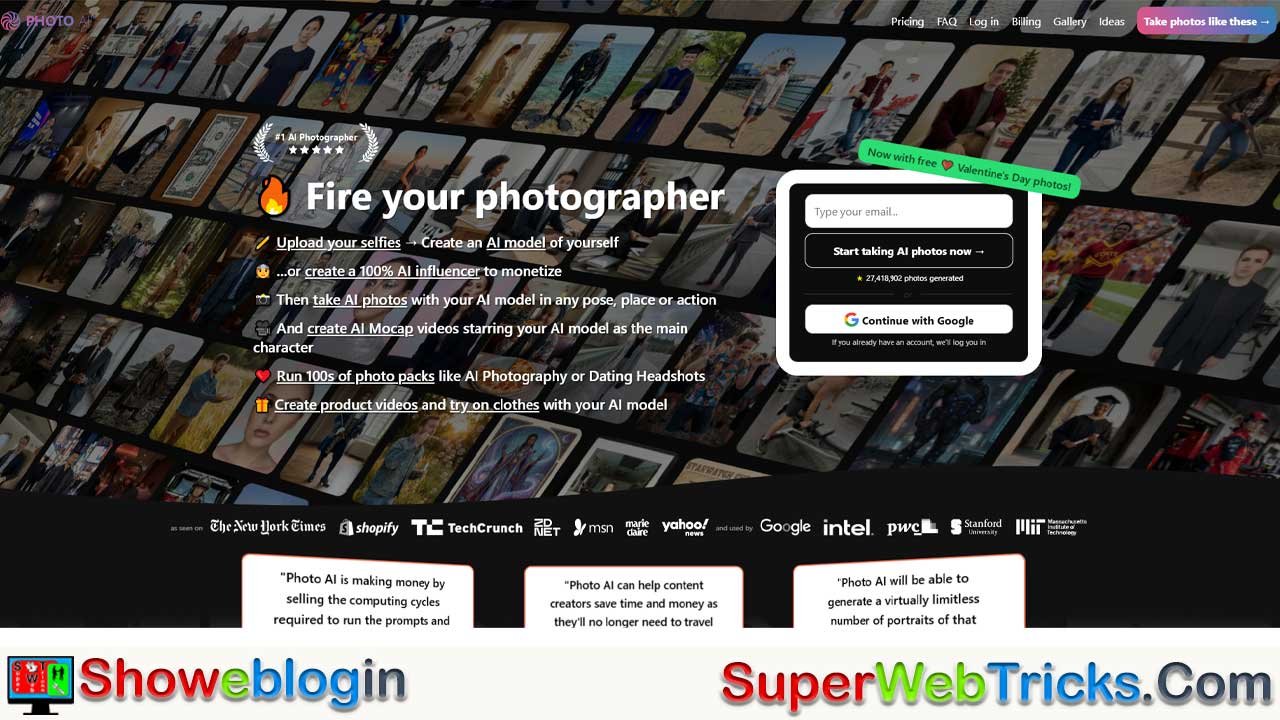


The AI photo generation landscape has exploded into a multi-billion-dollar industry, with the global AI image generator market expected to grow from $8.7 billion in 2024 to $60.8 billion by 2030—a compound annual growth rate exceeding 31%. Within this competitive ecosystem, Photo AI stands out as one of the first platforms specifically engineered to solve the problem that has plagued AI content creators for years: character consistency.
Photo AI claims to deliver the “first AI Photographer” in the world, and it’s more than marketing hype. The platform trains custom AI models from your own photos—whether they’re yours, a fictional character you’ve designed, or a completely synthetic virtual influencer—and then generates thousands of photorealistic images maintaining perfect consistency. This capability addresses a critical pain point for content creators, marketers, and e-commerce businesses struggling with traditional AI image generators that produce inconsistent results.
This guide explores Photo AI in depth, covering its revolutionary features, real-world applications, pricing structure, and how it stacks up against competitors like Midjourney, Leonardo AI, and Adobe Firefly.
What Is Photo AI?
Photo AI is a specialized AI photography platform that uses advanced machine learning to create hyper-realistic, photorealistic images of trained AI models. Unlike generic image generators that struggle with character consistency, Photo AI excels at maintaining identical facial features, expressions, and body characteristics across thousands of generated images.
The platform operates on a simple premise: upload 5-15 diverse photos of a subject (person, fictional character, or synthetic design), wait approximately 5 minutes for training, and then generate unlimited photorealistic images in virtually any scenario, setting, outfit, or style—all while maintaining perfect consistency with the original subject.
How Photo AI Works: The Training Process
The technical infrastructure underlying Photo AI is what truly differentiates it. The platform doesn’t use quick, cheap training methods. Instead, it employs the highest-quality GPU training cycles available, with users reporting that their AI models retain perfect resemblance across hundreds of variations.
Step 1: Upload Reference Images
- Select 5-15 photos of your subject
- Images should span different angles, lighting, expressions, and settings
- Diversity in the training set improves model accuracy
Step 2: Model Training (≈5 minutes)
- Photo AI processes images using advanced identity-preserving algorithms
- High-GPU-cycle training ensures superior fidelity
- Training completes faster than competitor platforms like Stable Diffusion LoRA training
Step 3: Unlimited Generation
- Once trained, generate infinite photorealistic images
- Control poses, outfits, locations, lighting, and expressions
- Access pre-designed “photo packs” for themed shoots (e.g., Valentine’s Day, business, fitness)
Photo AI’s Key Features: What Sets It Apart
1. Hyper-Realistic Character Consistency
Photo AI’s primary strength is its ability to generate multiple images of the same person or character that are indistinguishable from real photographs. The platform’s “Hyper Realism™” model produces images so lifelike that many viewers cannot detect they are AI-generated.
This consistency is especially valuable for:
- Virtual influencer creators building long-term character narratives
- E-commerce businesses showcasing products with consistent brand ambassadors
- Content creators maintaining visual coherence across platforms
2. AI Influencer Creation from Scratch
Beyond training on your own photos, Photo AI enables you to design and generate entirely synthetic virtual influencers—digital personas that never existed. You specify:
- Body type and build
- Facial features (eye color, hair style, face shape)
- Geographic origin and age
- Personality traits
Virtual influencers created this way can generate content 24/7 without geographic limitations, making them scalable alternatives to hiring human influencers.
3. Magic Edit & Generative Fill
Photo AI’s “Magic Edit” feature allows you to brush out elements from generated images and use AI to intelligently fill in the removed area. This one-click editing costs only 5 credits and enables rapid iteration without returning to external photo editing software.
4. Mocap Motion Videos
One of Photo AI’s most innovative features is Motion Capture (Mocap) technology. Upload a video showing movement—dancing, walking, gesturing, or talking—and Photo AI transfers that motion onto your AI-generated photo or influencer, creating realistic videos of your AI character performing human actions.
This has immediate applications for:
- Product demonstration videos
- Social media content (TikTok, Instagram Reels)
- Virtual avatar performances
- Marketing campaigns
5. Talking AI Videos with Custom Scripts
Generate videos where your AI model speaks custom scripts. Photo AI can convert talking videos from existing videos at a lower credit cost, or generate from images (which costs more credits initially). Features include:
- Character consistency across multiple clips
- Custom voice synthesis integration
- Script automation for batch video generation
6. AI-Powered Try-On for E-Commerce
Upload any clothing item or product image (from Shein, Zara, or any retailer), and Photo AI’s try-on model dresses your AI character in that outfit. This eliminates the need to hire physical models for product photography, making it ideal for:
- Fashion and apparel brands
- Shopify store owners
- Seasonal collection launches
- A/B testing different product presentations
7. Preset Photo Packs
Photo AI offers curated, themed photo pack collections (Valentine’s Day, business professional, fitness, luxury travel, etc.). These pre-designed shoots eliminate the need to write custom prompts. Simply select a pack, and Photo AI generates a complete set of styled images for your character, significantly reducing generation time and creative effort.
8. Batch Image Generation
For creators needing thousands of images across multiple models and styles, Photo AI’s batch generation feature streamlines the workflow. Upload multiple products, designs, or character variations and generate large-scale image libraries in parallel processing.
Photo AI Pricing: Which Plan Is Right for You?
Photo AI offers a tiered subscription model designed to accommodate both hobbyists and enterprise users. Importantly, all annual plans include significant discounts—up to 6+ months free when paying annually.
Monthly Billing Plans
| Plan | Price | Best For |
|---|---|---|
| Starter | $19/month | Beginners, basic AI photo creation, up to 1 model |
| Creator | $49/month | Content creators, higher quality outputs, 5 parallel processes |
| Pro | $199/month | Agencies, commercial use, ultra-fast processing, priority support |
Annual Billing Plans (Discounted)
| Plan | Annual Cost | Monthly Equivalent | Savings |
|---|---|---|---|
| Starter | $99/year | $8.25 | 57% off |
| Creator | $349/year | $29.08 | 41% off |
| Pro | $1,199/year | $99.92 | 50% off |
Credit System for Advanced Features
Beyond subscription tiers, Photo AI uses a credit-based system for specialized features:
| Feature | Credit Cost |
|---|---|
| Talking video (per 150 characters) | 5 credits |
| Talking video from image (premium generation) | +30 credits |
| Magic edit | 5 credits |
| Image crop/zoom | 1 credit |
| Video from image (standard) | Included in generation |
| Talking video on existing videos | Lower cost (cheaper than from image) |
Commercial Usage Rights: All plans include commercial usage rights, meaning you can monetize content generated with Photo AI—a critical distinction from competitors that reserve commercial rights for premium tiers.
Real-World Applications: Where Photo AI Creates Value
1. Virtual Influencer Monetization
The virtual influencer market has evolved from novelty to legitimate business. Major AI influencers are generating substantial income:
- Lil Miquela: $10 million annually, $8,000-$10,000+ per sponsored Instagram post
- Aitana López: €10,000+ monthly ($11,000+ USD) from brand deals with 300K+ followers
- Noonoouri: $500,000 annually
- Shudu: $2,000 per sponsored post
Photo AI enables creators to build their own virtual influencers and monetize across multiple revenue streams:
- Instagram sponsored posts ($1,000-$25,000+ per post depending on follower count)
- TikTok and YouTube Shorts monetization
- Brand collaborations and affiliate marketing
- Patreon/subscription content
- Merchandise featuring your AI character
2. E-Commerce Product Photography
Traditional product photography costs $200+ per product when accounting for studio rental, photographer fees, model costs, and post-production. Photo AI reduces this to $2 per product.
Business Impact:
- Conversion Rate Improvement: E-commerce brands using AI product imagery report 28-42% increases in conversion rates
- Return Reduction: StyleHub, a fashion retailer using AI product photos, achieved a 40% reduction in returns through visual consistency
- Time-to-Market: AI product photos enable same-day launches, capturing 14+ days of additional sales versus traditional photoshoots
- Personalization at Scale: Generate different lifestyle contexts for the same product (winter coat in snow for cold-climate visitors, urban setting for warm-climate visitors), increasing conversion by up to 52%
3. Content Creation for Social Media
TikTok, Instagram, and YouTube have created unprecedented demand for short-form video content. Photo AI enables creators to:
- Generate unlimited content variations without hiring talent
- Create consistent on-brand visual narratives
- Scale content production from weekly to daily posting cadence
- Test multiple creative directions rapidly with low marginal cost
Faceless content channels leveraging AI-generated characters can earn $2,500-$5,000+ per month through platform monetization and sponsorships.
4. Marketing and Advertising
Brands use Photo AI to:
- Create lifestyle imagery for product launches
- Generate ad creative variations for A/B testing
- Produce lifestyle photography at 1/100th the cost of traditional shoots
- Maintain consistent visual branding across campaigns
- Test seasonal variations without location scouting or travel
5. Video Game and Entertainment Development
Game developers use Photo AI to:
- Create character reference photos for animation
- Generate NPC (non-player character) portraits and promotional art
- Produce character variations across different outfits and styles
- Accelerate character design iteration cycles
Photo AI vs. Competitors: How It Stacks Up
Photo AI operates in a crowded market. Understanding how it compares to established competitors helps you choose the right tool for your use case.
Photo AI vs. Midjourney
| Aspect | Photo AI | Midjourney |
|---|---|---|
| Character Consistency | ⭐⭐⭐⭐⭐ Exceptional | ⭐⭐ Inconsistent |
| Photorealism | ⭐⭐⭐⭐⭐ Hyper-realistic | ⭐⭐⭐⭐ Artistic |
| Ease of Use | Web interface, intuitive | Discord-based, learning curve |
| Model Training | 5-15 photos, 5 minutes | Not applicable |
| Best For | Consistent character photography | Artistic exploration, moodboards |
| Price | $19-$199/month | $10-$120/month |
| Community Focus | Creator monetization | Creative collaboration |
Verdict: Midjourney excels at artistic, conceptual work but struggles with character consistency. Photo AI dominates when consistency is paramount.
Photo AI vs. Leonardo AI
| Aspect | Photo AI | Leonardo AI |
|---|---|---|
| Character Consistency | ⭐⭐⭐⭐⭐ Superior | ⭐⭐⭐⭐ Good |
| Model Diversity | Single specialized model | Multiple models (Phoenix, Anime, RPG) |
| Training Speed | 5 minutes | Requires LoRA training (slower) |
| Post-Generation Editing | Magic Edit (5 credits) | AI Canvas (seamless, free) |
| Control Level | High (pose, expression, outfit) | Very High (ControlNet, pose control) |
| Best For | Character consistency, influencers | Design versatility, professionals |
| Price | $19-$199/month | $10-$60/month |
Verdict: Leonardo AI offers greater flexibility and specialized models, but Photo AI’s training system and character consistency make it superior for influencer and personal photography use cases.
Photo AI vs. Adobe Firefly
| Aspect | Photo AI | Adobe Firefly |
|---|---|---|
| Photorealism | ⭐⭐⭐⭐⭐ Best-in-class | ⭐⭐⭐⭐ Excellent |
| Integration | Standalone | Integrated with Adobe Suite |
| Copyright Safety | Standard terms | Adobe’s licensed data (safest) |
| Character Training | Custom model training | Reference images only |
| Video Generation | Yes (Mocap, talking videos) | Limited video capabilities |
| Commercial Rights | All tiers included | Premium tier required |
| Best For | Influencer creation, video | Enterprise, copyright-safe work |
| Price | $19-$199/month | Included in Creative Cloud |
Verdict: For Adobe Creative Cloud users requiring maximum copyright safety, Firefly is superior. For standalone character photography and influencer creation, Photo AI wins.
Photo AI vs. Google Gemini/Imagen
| Aspect | Photo AI | Google Gemini |
|---|---|---|
| Cost | $19-$199/month | Free tier available |
| Character Consistency | ⭐⭐⭐⭐⭐ | ⭐⭐⭐ Moderate |
| Speed | Fast (specialized) | Very fast (infrastructure) |
| Model Training | Custom training included | Not applicable |
| Photorealism | ⭐⭐⭐⭐⭐ | ⭐⭐⭐⭐ |
| Best For | Influencers, consistency | General use, accessibility |
| Monetization Support | Built-in (commercial rights) | Requires careful compliance |
Verdict: Google Gemini is better for budget-conscious, casual users. Photo AI is superior for monetization-focused creators.
Monetization Strategies: How to Earn With Photo AI
Photo AI’s commercial usage rights across all pricing tiers create multiple income streams. Here’s how successful creators are monetizing:
Strategy 1: Virtual Influencer Brand Partnerships
Revenue Potential: $1,000-$10,000+ per month
Create an AI influencer with a distinct persona and aesthetic. Build followers across Instagram, TikTok, or both through consistent posting (2-4 times weekly). As your follower count grows:
- Partner with fashion, beauty, fitness, and lifestyle brands
- Charge $1,000-$5,000 per sponsored post (50K-100K followers)
- Scale to $5,000-$25,000+ as followers increase (100K-500K+)
Pro Tip: Micro-influencers (50K-250K followers) often deliver better ROI than mega-influencers because engagement rates are higher and brands can sustain partnerships more affordably.
Strategy 2: E-Commerce Product Photography
Revenue Potential: $2,000-$10,000+ monthly
Offer Photo AI product photography services to Shopify store owners, Etsy sellers, and small brands. Pricing model:
- Per-product pricing: $10-$50 per product (vs. $200+ traditional)
- Monthly retainer: $500-$2,000 for 20-50 product variations monthly
- Platform launch packages: $1,000-$5,000 for complete e-commerce photo shoots
Create lifestyle images, lifestyle scenes, and product-in-context photography that significantly outperform generic product shots.
Strategy 3: Content Agency Services
Revenue Potential: $3,000-$15,000+ monthly
Package Photo AI as a content creation service for:
- Social media agencies building content for clients
- Personal brands and creators wanting consistent aesthetics
- Small-to-medium businesses needing scalable content
- Influencer talent management (manage multiple AI influencers)
Charge subscription models ($500-$2,000/month per client) or project-based fees.
Strategy 4: YouTube & TikTok Faceless Channels
Revenue Potential: $1,000-$5,000+ monthly
Build faceless short-form video channels featuring your AI characters:
- TikTok Creator Rewards: Earning program pays based on video performance and geographic origin of viewers
- YouTube Shorts Fund: Direct payments for high-performing shorts
- YouTube Partner Program: Ad revenue sharing (YouTube pays 55%, creator earns 45% of ad revenue)
Post 1-2 videos daily with your AI influencer for maximum monetization.
Strategy 5: Digital Product Sales
Revenue Potential: $500-$3,000+ monthly
Create and sell digital products featuring your AI influencer:
- Presets and style guides for creating consistent imagery
- AI influencer templates for other creators
- Video templates and scripts
- Courses teaching AI photo generation and influencer monetization
Platforms: Gumroad, Teachable, Etsy, Podia
Strategy 6: Affiliate Marketing
Revenue Potential: $1,000-$5,000+ monthly
Promote Photo AI itself as an affiliate:
- Commission Structure: Recurring affiliate programs typically pay 20-60% recurring on referred subscriptions
- Cookie Duration: 60-90 days to convert (generous window)
- Target Audience: Content creators, small business owners, e-commerce entrepreneurs
Create blog posts, YouTube videos, and social media content comparing Photo AI to competitors and demonstrating ROI for different use cases.
Getting Started With Photo AI: Step-by-Step Guide
Step 1: Choose Your Plan
For hobbyists and experimentation: Starter ($19/month)
For serious creators and small businesses: Creator ($49/month)
For agencies and high-volume production: Pro ($199/month)
Pro Tip: Annual billing saves 40-57% compared to monthly, and all plans include commercial usage rights.
Step 2: Create Your First AI Model
- Gather 5-15 reference photos
- Ensure photos span different angles, lighting, expressions, and settings
- Upload to Photo AI’s training interface
- Wait approximately 5 minutes for model training
- Begin generating unlimited images
Step 3: Generate Your First Photos
- Use text prompts to describe desired scenarios (e.g., “professional headshot in a modern office, natural lighting, business suit, confident expression”)
- Leverage preset photo packs for themed collections
- Experiment with different poses, outfits, and environments
- Use Magic Edit to refine specific elements
Step 4: Optimize for Your Platform
- Instagram: 1:1 square format, lifestyle aesthetic, consistent branding
- TikTok: 9:16 vertical, trending sounds and captions, authentic feel
- E-commerce: Product-focused with lifestyle context, multiple angles per product
- YouTube: High-resolution variations for thumbnails and video backgrounds
Step 5: Scale Your Production
- Create multiple AI models for different personas or use cases
- Use batch generation for large product libraries
- Implement Mocap for video production
- Automate posting schedules across platforms
Advanced Features: Maximizing Photo AI’s Potential
Using Mocap for Video Content
Mocap transforms static AI photos into dynamic videos:
- Find or create a movement video (dancing, walking, gesturing)
- Upload your movement reference
- Select your AI character or photo
- Photo AI transfers the motion onto your AI model
- Result: Photorealistic video of your character performing human actions
Time Cost: Faster than traditional video production
Quality: Realistic motion with proper physics and lighting consistency
Generating Talking Videos
Create videos where your AI character delivers custom scripts:
- From image: Premium generation costing 30+ credits initially, then 5 credits per 150 characters of speech
- From existing video: Lower credit cost when transferring talking video onto your AI character
- Multi-character dialogue: Generate conversations between multiple AI influencers
Applications: Product explainers, educational content, promotional videos, customer testimonials
Try-On for Fashion & E-Commerce
Photo AI’s try-on feature eliminates model hiring:
- Paste or upload a clothing item screenshot (Shein, Zara, etc.)
- Select your AI model
- Photo AI dresses your character in that outfit
- Adjust pose and lighting as needed
- Export for product listing or social media
Works with patterns, prints, and complex garments. Perfect for same-day product photography.
AI Photo Generator Market Trends & Opportunities
The broader AI photo generation market is experiencing explosive growth, creating opportunities for Photo AI users:
Market Size: The AI image generator market reached $8.7 billion in 2024 and is projected to grow to $60.8 billion by 2030 (31.5% CAGR)[web:32]. The AI video generator market similarly grew from $788.5 million (2025) to projected $3.4+ billion by 2033 (20%+ CAGR).
Key Trends Favoring Photo AI:
- Virtual Influencer Mainstreaming: Major brands (Adidas, Tiffany, YSL) are actively partnering with AI influencers, validating the monetization pathway for Photo AI users.
- E-Commerce Automation: Brands are rapidly adopting AI product photography to reduce production costs and accelerate time-to-market. AI-generated product imagery is increasing conversion rates by 25-42%.
- Content Democratization: As traditional influencer costs rise ($2,000-$5,000+ per sponsored post), brands are increasingly attracted to AI influencers as cost-effective alternatives with perfect consistency.
- Short-Form Video Explosion: TikTok, Instagram Reels, and YouTube Shorts have created unprecedented demand for video content. Platforms paying creators directly (TikTok Creator Rewards, YouTube Shorts Fund) incentivize high-volume posting—exactly what Photo AI enables.
- Asia-Pacific Expansion: The Asia-Pacific region is experiencing the fastest growth in AI adoption, with emerging economies driving demand for affordable content creation tools.
Common Questions About Photo AI
Is Photo AI free to use?
Photo AI offers a 7-day free trial with limited features. After the trial, paid subscriptions start at $19/month (Starter plan) or $9/month when paying annually ($99/year).
Does Photo AI require technical skills?
No. Photo AI’s web interface is intuitive and requires no coding or technical knowledge. Upload photos, select settings, and generate—the platform handles the rest.
Can I use Photo AI for commercial purposes?
Yes. All Photo AI pricing tiers include commercial usage rights, allowing you to monetize generated content across all platforms without restrictions or additional licensing fees.
How long does model training take?
Approximately 5 minutes. Photo AI uses high-GPU-cycle training for superior quality, differentiating it from competitors that train faster but produce lower-fidelity results.
Can I use Photo AI’s images for advertising?
Yes. Commercial rights are included across all plans. You can use generated images in paid ads on Google, Facebook, Instagram, TikTok, and other platforms.
What’s the difference between Photo AI’s approach and LoRA training?
LoRA (Low-Rank Adaptation) on platforms like Stable Diffusion requires manual setup, technical knowledge, and extensive GPU time. Photo AI automates this process with a 5-minute training time and intuitive interface.
Can Photo AI generate videos?
Yes, through multiple methods:
- Image-to-Video: Convert static photos to short video clips (~20 seconds max currently)
- Mocap: Transfer motion from uploaded movement videos to your AI character
- Talking Videos: Generate videos where your AI model delivers custom scripts
Is the quality consistent across multiple generations?
Yes. Photo AI’s primary strength is character consistency. Users report that multiple generations of the same character remain virtually identical in terms of facial features, expressions, and proportions.
What image resolution does Photo AI support?
The platform supports multiple resolutions including standard web sizes and high-resolution formats suitable for print. Pro tier users get access to higher resolution outputs.
Conclusion: Is Photo AI Right for You?
Photo AI represents a paradigm shift in AI-powered photography, solving the consistency problem that has plagued previous generators. The platform’s combination of ease of use, commercial rights inclusion, video capabilities, and monetization-friendly features makes it an exceptionally strong choice for:
- Content creators building personal brands or virtual influencers
- E-commerce businesses needing scalable product photography
- Social media agencies creating content for clients
- Small business owners unable to afford traditional photography
- Faceless content channels generating high-volume short-form video
The virtual influencer market is no longer experimental—it’s legitimate business. Lil Miquela, Aitana López, and dozens of other AI influencers are generating substantial income. Photo AI’s specialized training and commercial-rights-included pricing tiers lower the barrier to entry, making virtual influencer creation accessible to anyone with a compelling idea and basic social media skills.
For e-commerce, the financial case is equally compelling. A brand producing 100 products using traditional photography might spend $20,000+. Using Photo AI, the same shoot costs under $200. With AI-generated product imagery increasing conversions by 28-42%, the ROI is immediate.
Photo AI isn’t perfect for all use cases—Midjourney remains superior for artistic exploration, Leonardo AI offers more model diversity, and Adobe Firefly provides unmatched copyright safety. But for character consistency, influencer creation, video generation, and monetization-focused content production, Photo AI stands apart.
If you’re serious about building a virtual influencer, scaling product photography, or creating high-volume content efficiently, Photo AI deserves serious consideration.




Leave a Reply
You must be logged in to post a comment.