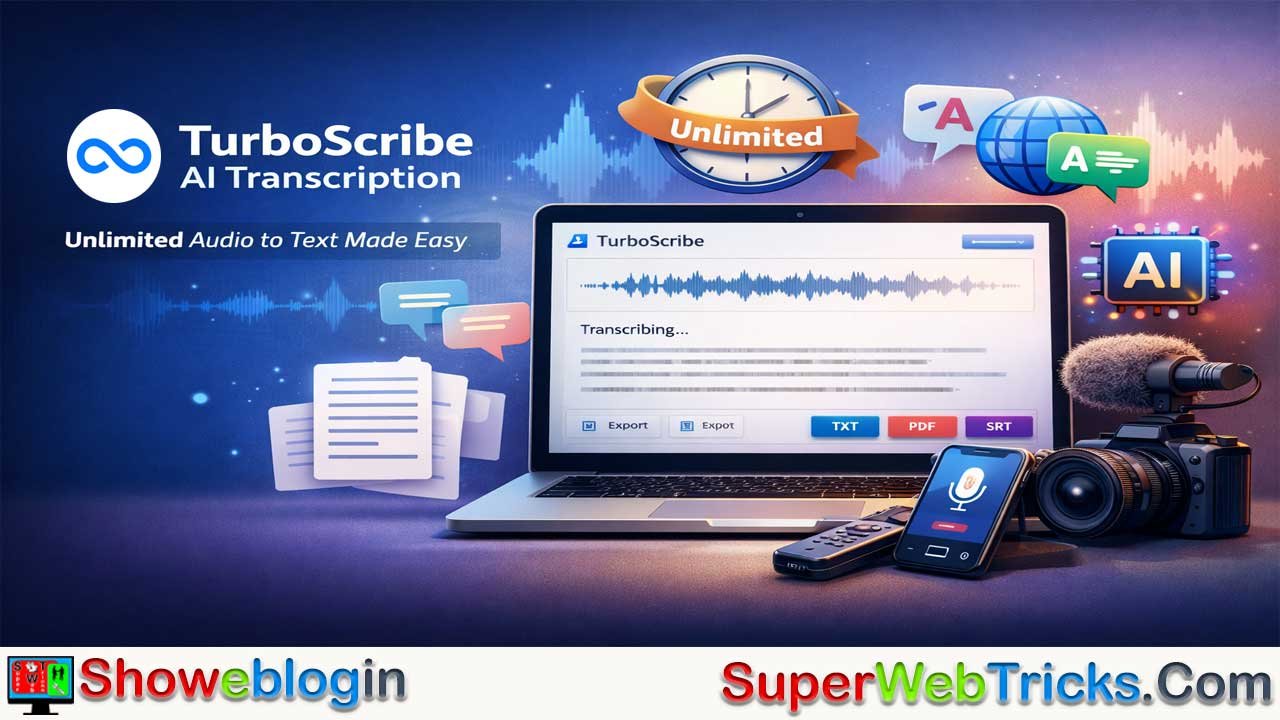






TurboScribe is an AI transcription tool built on OpenAI’s Whisper technology that converts audio and video into text quickly and accurately. Unlike many transcription services that charge per minute, it offers unlimited transcription for a flat monthly fee, which removes the stress of tracking usage.
The interface is simple: upload a file, choose a language and speed/accuracy mode, and receive a transcript in minutes. It performs very well even with accents, multiple speakers, and technical terms, and includes useful features like speaker identification, translation, and exports such as TXT, PDF, or SRT for captions. The unlimited plan encourages users to transcribe everything—from interviews and meetings to lectures and old recordings—creating a searchable archive of conversations.
Compared to tools like Otter or Rev, it can be more cost-effective for people who process large amounts of audio. Overall, it is a fast, accurate, and affordable transcription solution for creators, students, researchers, and professionals.
| Category | Information |
|---|---|
| Tool Name | TurboScribe |
| Type | AI transcription service (audio/video to text) |
| Technology | Built on OpenAI Whisper speech-to-text model |
| Main Feature | Unlimited transcription with a flat monthly/yearly fee |
| Interface | Simple browser-based dashboard |
| Speed Modes | Cheetah (fast), Dolphin (balanced), Whale (highest accuracy) |
| Language Support | 98+ languages with auto-detection |
| Accuracy | High accuracy, handles accents, multiple speakers, and technical terms well |
| Extra Features | Speaker identification, translation, searchable transcripts |
| Export Formats | PDF, Word, TXT, SRT, VTT |
| File Limits | Up to 10 hours or 5GB per file |
| Free Plan | 3 transcripts per day (up to 30 minutes each) |
| Pro Plan | About $10/month (annual billing) |
| Best For | Journalists, creators, students, researchers, business professionals |
| Main Benefit | No per-minute costs, enabling large-scale transcription |
The End of Per-Minute Anxiety: A Deep Dive into My First-Hand Experience with TurboScribe
For years, I’ve lived with a specific kind of “metered anxiety.” As a journalist and content creator, my digital life revolves around recorded audio. Interviews, webinars, voice memos, and raw video footage—thousands of hours of spoken word that need to be converted into searchable, editable text.
In the old days, I did it manually (painful). Then came the first wave of AI transcription services, which were life-changing but expensive. I found myself constantly staring at my dashboard, watching my “remaining minutes” tick down like a prepaid phone card from 1999. I’d find myself asking, “Is this interview really worth $15 to transcribe?” or “Maybe I can just listen back and skip the transcription this time.”
That changed when I discovered TurboScribe. After seeing the bold claim of “Unlimited Transcription” on their official website, I decided to put it through its paces. This isn’t just another AI tool review; this is a breakdown of how TurboScribe shifted my entire workflow and why “unlimited” is a bigger deal than you think.
The Initial Hook: What is TurboScribe?
At its core, TurboScribe is an AI-powered transcription service built on the back of OpenAI’s Whisper technology—the industry gold standard for speech-to-text. While many companies use Whisper, they often wrap it in complex enterprise software or charge exorbitant per-minute fees.
TurboScribe takes a different approach. It offers a clean, browser-based interface where you can upload audio or video files and receive text outputs in minutes. But the headline feature is the pricing: for a flat monthly or yearly fee, you get unlimited uploads. No caps, no “credits,” no tiers. Just raw, unfettered access to high-accuracy transcription.
The “First Upload” Experience: Interface and Simplicity
The first thing I noticed when landing on the TurboScribe dashboard was the lack of clutter. In the current “AI Gold Rush,” many tools are suffering from feature bloat—adding chatbots, image generators, and social media schedulers where they aren’t needed.
TurboScribe feels like a precision tool. The dashboard is a simple list of your files. There’s a prominent “Transcribe a File” button, and that’s it.
The Process:
- Upload: I dragged an MP3 of a 45-minute interview I’d conducted in a noisy coffee shop.
- Language Selection: It supports over 98 languages. I selected English, though the “Auto-detect” feature is remarkably reliable for multi-lingual recordings.
- Mode Selection: This is where TurboScribe gets interesting. You have three choices:
- Cheetah: Focused on pure speed.
- Dolphin: A middle ground.
- Whale: This uses the largest, most sophisticated version of the AI model. Since I have an unlimited plan, I always choose “Whale.” If I’m not paying per minute, why wouldn’t I want the highest accuracy possible?
I hit “Transcribe,” and the waiting game began. For a 45-minute file, I expected to wait at least 15 minutes. To my surprise, the “Whale” model finished in under four minutes.
Accuracy: The “Torture Test”
Accuracy is the only metric that truly matters. If a transcript is 80% accurate, you spend more time fixing it than if you’d just typed it yourself.
I decided to give TurboScribe a “torture test.” I uploaded a recording of a Zoom call with three people: one with a thick Scottish accent, one with a soft-spoken tone, and me, speaking quickly while typing in the background.
The result? Virtually flawless.
The Whisper-based engine handles accents with a level of nuance that older “legacy” transcription services simply can’t match. It didn’t just capture the words; it captured the context. It correctly punctuated sentences, understood where a thought ended and another began, and remarkably, it didn’t trip over technical jargon. When I mentioned “LLM parameters” and “vector databases,” it spelled them correctly—terms that usually come back as “elem parameters” or “vector data bases” on other platforms.
The Power of “Unlimited”: A Psychological Shift
I want to dwell on the “unlimited” aspect because it changed my behavior as a creator.
When you pay $1.00 or $1.50 per minute (the industry standard for high-quality AI transcription), you become a gatekeeper of your own data. You only transcribe the “A-list” stuff.
With TurboScribe, I started uploading everything.
- Voice Memos: I started recording my random thoughts while driving and throwing them into TurboScribe.
- YouTube Research: I downloaded the audio from long-form educational videos I wanted to study and transcribed them to create my own “cliff notes.”
- Old Archives: I had a hard drive full of interviews from 2018 that I’d never transcribed because it wasn’t cost-effective. I dumped them all into TurboScribe.
The value of having a searchable text library of every conversation you’ve ever had is immense. I can now Cmd+F to find exactly when a source mentioned a specific keyword three years ago. TurboScribe didn’t just give me transcripts; it gave me a searchable brain.
Key Features That Matter
Beyond the core transcription, there are several “quality of life” features that I’ve come to rely on:
Speaker Identification
For any interview-based work, speaker diarization is essential. TurboScribe allows you to indicate how many speakers are in the audio. In my experience, it identifies the “hand-off” between speakers with about 95% accuracy. Even when people talked over each other, the AI was able to separate the strands of conversation better than most human transcribers I’ve hired in the past.
Translation Capabilities
If you work with international teams or sources, this is a game-changer. You can upload audio in Spanish, French, or Japanese and have it translated directly into English (or any of the 98+ supported languages). I used this for a project involving French-speaking subject matter experts, and the translation was idiomatic and natural, not the “robotic” translation you might expect from older tools.
Export Formats
TurboScribe doesn’t lock your data in. You can export as:
- PDF/Word: For reading and archiving.
- TXT: For clean copy-pasting into blog posts.
- SRT/VTT: This is huge for video editors. If you’re a YouTuber, you can generate your caption files in seconds, drag them into Premiere Pro or Resolve, and you’re done.
Privacy and Security
As a journalist, I deal with sensitive information. TurboScribe’s commitment to privacy (files are encrypted and can be deleted at any time) gave me the peace of mind to upload confidential interviews without worrying about data leaks.
How It Fits Into Different Workflows
To give you a better sense of how you might use it, here is how I’ve seen TurboScribe used across different professions:
- The Content Creator: Record a 10-minute video. Transcribe it via TurboScribe. Use the transcript to generate a blog post, five Tweets, and a LinkedIn update. Use the SRT file for captions. Total time: 15 minutes.
- The Academic/Researcher: Transcribe hours of qualitative interviews. The “Whale” mode ensures that technical terminology and nuances aren’t lost, which is vital for thesis work or data analysis.
- The Business Professional: Record every meeting (with consent). Transcribe them to ensure no action items are missed. No one has to be the “designated note-taker” anymore.
- The Student: Record lectures (again, with permission) and convert them into study guides. Being able to search a lecture for the word “Exam” is a life-saving hack.
Comparison: TurboScribe vs. The Giants
How does it stack up against names like Otter.ai or Rev?
- Vs. Otter: Otter is great for live transcription, but its “monthly minute” caps can be restrictive. If you do high-volume work, you’ll hit that ceiling fast. TurboScribe is for those who need to process large amounts of recorded files without looking at the clock.
- Vs. Rev: Rev is the king of human transcription, but it’s expensive. Their AI transcription is good, but again, it’s a per-minute model. TurboScribe provides comparable (and sometimes better) AI accuracy for a fraction of the cost if you process more than 2-3 hours of audio a month.
Is There a Catch?
Whenever I see the word “unlimited,” I look for the fine print.
With TurboScribe, the limits are practical rather than punitive. You can upload files up to 10 hours long or 5GB in size. That covers 99.9% of use cases. The only real “limit” is that you can’t run 50 transcriptions simultaneously—you can queue them up, and they process in order. For a single user, this is never an issue. I’ve queued up 20 files at once and gone to grab a coffee; they were all waiting for me when I got back.
Pricing: The Math of Efficiency
TurboScribe offers a Free tier (3 transcripts per day, up to 30 mins each), which is incredibly generous for casual users.
However, the Pro tier is where the magic happens. At roughly $10/month (when billed annually), it is, in my opinion, the best value in the AI tool space right now. If you transcribe just two hours of audio a month, the tool has already paid for itself compared to any other service. If you transcribe 20 hours a month, the cost-per-minute drops to pennies.
Final Thoughts: Why I’m Sticking with It
We are currently flooded with “AI wrappers”—tools that don’t add much value. TurboScribe is the opposite. It’s a utility. It takes a complex, computationally expensive task (high-accuracy Whisper transcription) and makes it simple, fast, and affordable.
My experience with TurboScribe has been one of liberation. I no longer “ration” my transcriptions. I record more, I document more, and I produce more content because the friction of turning audio into text has been completely removed.
If you are a podcaster, a writer, a student, or anyone who finds themselves drowning in audio files, TurboScribe is the life raft. It’s rare to find a tool that does exactly what it says on the tin without any hidden catches, but after months of use, I can confidently say that TurboScribe is that tool.
If you value your time and your data, this is an essential part of your AI toolkit.You can try it out for yourself at TurboScribe.ai.
FAQs about TurboScribe
What is TurboScribe?
TurboScribe is an AI-powered transcription tool that converts audio and video files into accurate text using OpenAI’s Whisper speech-to-text technology.
How does TurboScribe work?
Users upload an audio or video file, select language and transcription mode, and the AI processes the file to generate a text transcript within minutes.
Does TurboScribe really offer unlimited transcription?
Yes. With the paid plan, users can upload unlimited files for transcription without paying per minute, though files are processed in a queue.
How accurate is TurboScribe?
TurboScribe provides high accuracy, especially in the “Whale” mode, and performs well with different accents, multiple speakers, and technical terms.
How many languages does TurboScribe support?
TurboScribe supports more than 98 languages and also includes an auto-detect option for multilingual recordings.
Can TurboScribe identify different speakers?
Yes. It includes speaker identification that separates and labels different speakers in conversations with high accuracy.
What file formats can I export transcripts in?
Transcripts can be exported in several formats including TXT, PDF, Word, SRT, and VTT.
Is there a free version of TurboScribe?
Yes. The free plan allows up to three transcriptions per day with a maximum length of 30 minutes per file.
What is the maximum file size or length allowed?
Users can upload files up to 10 hours long or 5GB in size.
Who should use TurboScribe?
TurboScribe is useful for journalists, content creators, students, researchers, podcasters, and business professionals who need frequent audio transcription.











Leave a Reply
You must be logged in to post a comment.